
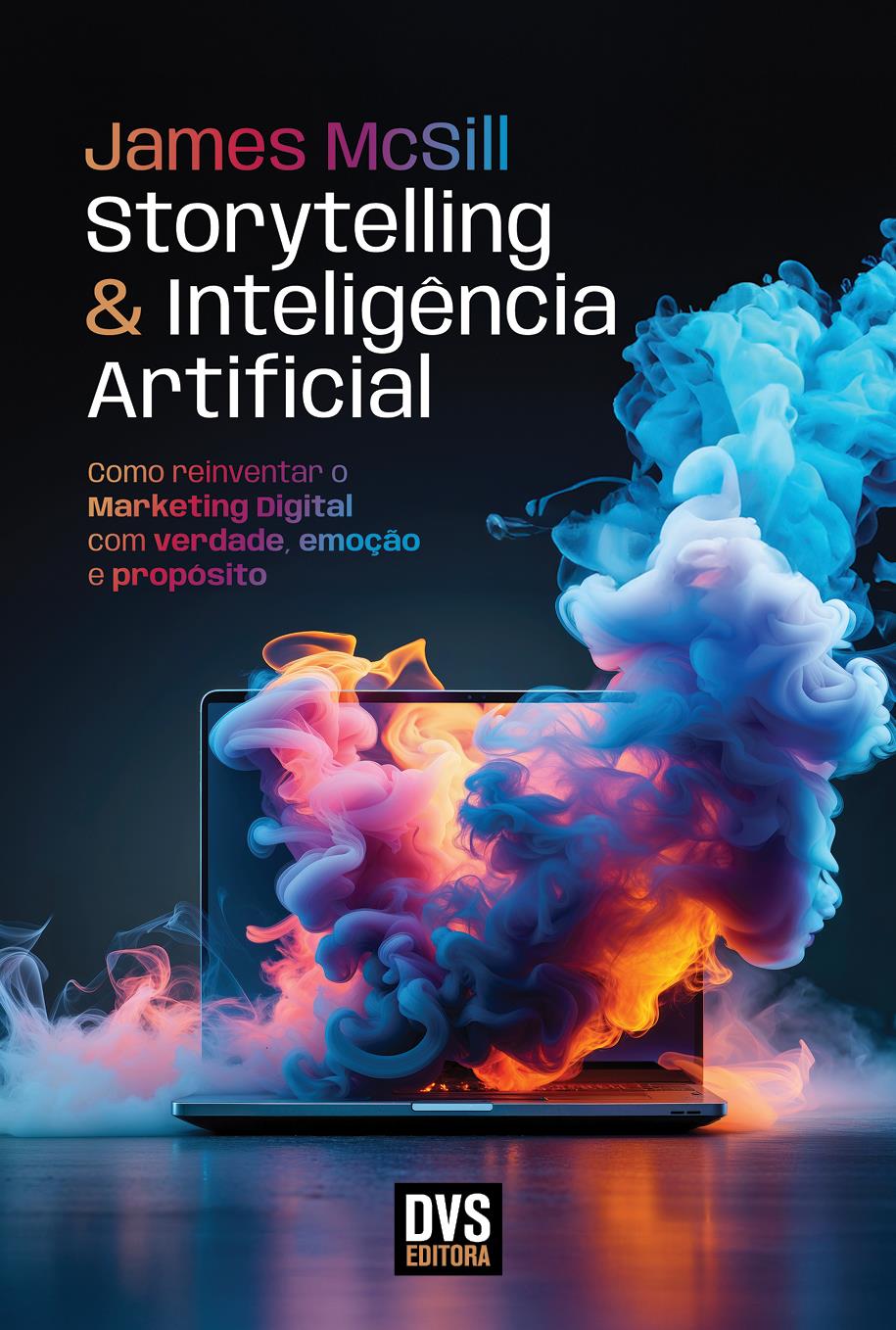
How do you maintain humanity in a market increasingly dominated by algorithms? This is the central question posed by Storytelling & Artificial Intelligence, a new book published by DVS Editora and authored by James McSill, one of the leading experts in narrative applied to marketing and a pioneer in integrating emotion, language, and AI technologies. With over 35 published works and a global presence as a mentor to writers, communicators, and brands, McSill proposes an urgent reflection on the role of authenticity in an era of technically perfect, yet emotionally empty content.
Throughout the book, the author analyzes the disruption of traditional digital marketing models—such as rigid funnels, launch formulas, and copywriting based on repetitive triggers—in the face of a saturated and increasingly skeptical audience. For McSill, the rise of artificial intelligence does not eliminate human value, but redefines priorities: while machines take on repetitive tasks, it is up to people to achieve what AI cannot, such as sensitivity, intention, metaphor, rhythm, and narrative courage. More than communicating well, it becomes essential to have something genuine to say.
Combining strategic reflection, narrative ethics, and new storytelling methodologies, Storytelling & Artificial Intelligence positions itself as essential reading for professionals in communication, marketing, branding, writing, and entrepreneurship. The book offers a roadmap for navigating a landscape where re-humanizing language is not just an aesthetic choice, but a competitive advantage—and, above all, a commitment to the integrity of the stories we tell.
You claim that digital marketing has reached a tipping point. At what point did you realize that traditional formulas stopped working, and what does this “saturation point” reveal about us as a society?
The breaking point didn’t happen suddenly; it was a silence. A void that began to echo behind the scenes of campaigns, in conversations between creatives and managers, in metrics that no longer reflected conversion, but emotional fatigue. I realized, around 2020, that the public reacted less to what was “perfect” and more to what was “real.” Narratives calibrated by algorithms began to lose strength because, as I write in the book, “automation eliminated error, and with error, it eliminated the human.” What this saturation point reveals is that people can no longer bear being reduced to data. Marketing has become a mirror that only reflects performance. Society, exhausted, desires mirrors that reflect meaning. We are facing a crisis of empathy, and artificial intelligence, paradoxically, has come to force us to reclaim the emotion we neglected while chasing clicks.
But this book has something that distinguishes it from others: it wasn’t born solely from theoretical observation or trend analysis; it was born from lived experience in different markets and cultures. I worked directly with teams in the United Kingdom, Portugal, Japan, Brazil, the United States, Mexico, China, and Belgium, and I was able to see firsthand how each society reacts to technology and storytelling. This experience gave me a cross-cutting perspective: I understand what excites a Briton and what mobilizes a Brazilian, what inspires a Japanese person and what touches a Portuguese person. These are cultural nuances that no marketing manual captures, but they make all the difference when we talk about emotion and authenticity.
Therefore, this book is not a compilation of formulas nor an essay on the digital future—it is a lived map, built from errors, tests, and real experiences. In it, I show that innovation lies not in the tools, but in how we use them to restore humanity to communication. And perhaps that is the essential difference: this is not a book about technology, it is a book about how to remain human in a world dominated by machines.
In the book, you argue that AI should take on the “hard work” so that humans can handle what machines can’t. In your practical experience, when did you realize that emotion and intention are still exclusively human territories?
There was a moment, during one of my experiences in Asia, when I clearly perceived the limit between what technology can reproduce and what only humans can feel. I followed the development of a voice system that promised to recognize and express emotions. It was fascinating to see how much it could already imitate: the right pauses, the appropriate tone, even a kind of calculated breathing. But, however perfect the execution, something was missing. The voice existed, but there was no life in it. It lacked presence, that invisible thread that connects the speaker to the listener. It was at that moment that I realized that emotion and intention cannot be programmed. They are born from experiences, from memories, from vulnerabilities. They are made of what is not said, of what is felt. The human voice does not only communicate sounds, it communicates soul. And no matter how much artificial intelligence evolves, there is something that escapes it: the tremor that comes from fear, the laughter that is born from sincere affection, the silence that means more than a thousand words. The machine can calculate, repeat, predict. The human cannot. The human lives. And that’s why I believe technology should free us from mechanical work, so we can take care of what is truly ours: gesture, gaze, touch, emotion. That’s where what still makes us irreplaceable resides.
The idea of replacing personas with living archetypes based on emotional states is disruptive. Do you believe that, deep down, the public has always wanted to be seen for what they feel and not for what they buy?
Without a doubt. The consumer is a recent invention; the sensitive being is ancient. “Personas” have reduced the human being to profiles, but what truly moves people is not demographic data, but rather emotional myths: the desire to be understood, the fear of being invisible, the yearning for belonging. That’s why I proposed dynamic archetypes in the book, emotional structures that evolve, adapting to changes in collective mood. They function as “narrative minds,” fueled by AI, but guided by emotion. I believe that the public has always wanted this: to be read by the soul, not by the algorithm. That’s why a brand with purpose resonates more than one with strategy, because, ultimately, the customer is just a modern form of an old character: the hero searching for meaning.
You talk about embracing imperfection as a communication strategy. In a world that demands constant performance, how can a professional find the courage to show their vulnerabilities without losing authority?
Authority no longer comes from infallibility, but from consistency. The public today doesn’t trust those who never fail, but those who make mistakes consciously. Vulnerability, when authentic, doesn’t destroy credibility; it increases perceived humanity. In the European hubs I frequent—York, Amsterdam, Lisbon, Berlin—I see companies reconfiguring their branding around what we call “strategic error”: the public admission of failure as proof of transparency. Admitting a mistake opens the door to dialogue. And it is in this dialogue that the bond is born. Courage, therefore, is not the absence of fear, but the decision not to hide the human within. Perfection, today, is the new veneer of lies.
Your book proposes transforming content into “living prototypes,” in continuous beta. How does this logic change, in practice, the relationship between brands, narratives, and audiences?
This means that a brand ceases to be a broadcaster and becomes an organism. Living content is not a finished piece, but an ongoing conversation. In my Story Design labs in Lisbon and Shanghai, we created AI systems that transform posts and campaigns into adaptive structures, learning from the audience in real time. Each comment generates a micro-adjustment of tone, each reaction redefines the plot. Storytelling ceases to be linear and becomes symbiotic: the audience is no longer a spectator, but a co-author. In practice, this inaugurates a new narrative economy, where emotion is given and reaction is the script.
With so much automation and algorithm-generated content, what is the biggest ethical risk you see in the use of AI, and what responsibility falls on those who work in communications?
The risk is not substitution, but the emptying of meaning. When we delegate to the machine the choice of what evokes emotion, we abdicate intention, and without intention, all communication becomes manipulation. The contemporary communicator needs to adopt a design ethic: to create technologies that expand consciousness, not anesthetize it. This is what I always advocate: a good voice system, or any truly useful technology, needs to unite various areas of knowledge, from engineering to psychology and language. But there is one element that cannot be replaced by any algorithm: the ethical human. Without this awareness, every technical advance risks becoming manipulation disguised as innovation. The responsibility is twofold: first, to the public, who trust in what we create; and second, to humanity itself, which is shaped by these choices. Artificial intelligence is not neutral: it reflects the intentions, values, and even the shadows of those who conceive it. Therefore, each line of code inevitably carries a worldview.
You move between very different countries, cultures, and markets. How has this multicultural experience shaped your view of what makes a story truly universal?
There was a moment when I understood that emotion and intention remain profoundly human territories. I’m almost 70 years old and have 51 years of professional experience; one develops an instinct. It wasn’t a theoretical epiphany, but a sum of experiences lived in different places and languages, over years of coexistence with cultures that think, feel, and communicate in very unique ways. The privilege of being able to move between the United Kingdom, Portugal, Japan, Brazil, the United States, Mexico, China, and Belgium, and of speaking the languages of these lands, with the exception of Chinese, which I still study with humility and curiosity, gave me a very concrete perception of how technology affects people unequally, because each people has its own way of feeling the world. In the United Kingdom, for example, discourse tends towards restraint, towards logical clarity, but there is an almost literary delicacy in the silences, a care in speaking without hurting. In Portugal, communication is an act of the soul: words are chosen for the emotional weight they carry, not just for their meaning. In Japan, I learned that silence also speaks, and that the pause between two sentences can signify respect, empathy, or deep reflection. In Brazil, affection is in the very essence of language, in laughter, in improvisation; it’s an emotion that doesn’t disguise itself, that offers itself entirely. In the United States, clarity and assertiveness dominate, but there’s also a charm in well-directed emotion, in contagious enthusiasm. In Mexico, words dance: the culture there mixes faith, irony, and human warmth in a single gesture. In Belgium, I find subtlety, an elegant and discreet way of communicating emotion, almost as if feeling were a shared secret. And in China, where I still stumble between tones and ideograms, I perceive the value of gesture, of the gaze, of the unspoken. There’s an intrinsic respect for the harmony of the group, and this shapes the way of speaking and listening. In all these realities, I noticed something in common: emotion is the bridge, and tone, not words, is what defines the truth of a message. The machine, however sophisticated, still cannot cross that bridge. It understands the word, but not the sigh. It reproduces the sound, but not the feeling. Therefore, I argue that artificial intelligence should take care of what requires precision and repetition, so that humans can remain in the realm of intention, listening, improvisation, and tenderness. It is this difference, so subtle and so vital, that still makes us who we are. And perhaps, by living among so many cultures, I have learned that there is no single way to be human, but in all of them there is something that no machine can learn: the courage to feel.
This multicultural experience completely changed my understanding of what makes a story truly universal. Working with such diverse teams and audiences, from Japan to Mexico, from the UK to Brazil, showed me that what unites people is not language, but the emotional structure behind each narrative. In all these contexts, what truly resonates is the emotional truth, the moment when someone recognizes themselves, regardless of language or culture.
In Japan, for example, I learned that a story needs space; silence is part of the message. In Brazil, I realized that engagement comes from closeness and affection: the audience wants to feel immersed in the narrative. In Portugal, there’s an appreciation for subtext, for the pause that invites reflection. In the United States and Mexico, clarity and rhythm are fundamental: it’s necessary to capture attention every second. And in Belgium, authenticity is key; the audience values what sounds genuine, even if imperfect.
Over time, I began to understand that universality doesn’t come from creating a story “for everyone,” but from creating a story from a true feeling. When a narrative is born from a real, human experience, it crosses borders without needing to be translated. Emotion is the common language.
Therefore, today, when I advise authors or companies, I insist that there are no universal formulas, only universal emotions expressed in specific cultural ways. And the secret lies precisely there: respecting differences without losing the essence. A story is universal when it speaks to the human heart, even if each culture hears that voice differently.
For those who fear that AI will “steal their voice” as creators, writers, or communicators, what is the first step to rediscovering authenticity amidst the digital noise?
The first step is silence. Before speaking, it’s necessary to listen again to oneself, to the world, to what hasn’t yet been said. Artificial intelligence can replicate styles, but it doesn’t create intention. And intention is the core of the voice. Whoever rediscovers their own voice rediscovers the power to transform noise into a message. In my view, AI is like an orchestra: it can amplify, harmonize, even improvise, but the original melody must come from the human soul. Writing, creating, communicating will continue to be a spiritual act, an encounter between consciousness and language. And as long as this encounter exists, no machine can steal what is essentially human: the desire to be understood.
And it’s important to say: everything I discuss in this book is undoubtedly new. Artificial intelligence and how it intersects with storytelling are still being discovered, tested, and reinvented. Therefore, perhaps the expression the reader will encounter most often throughout the pages is “in my opinion,” not out of uncertainty, but out of intellectual honesty. We are exploring a territory under construction, where studies emerge every day, and almost magical phenomena are created every week. The boundaries of the possible change as we write about them. Thus, this book does not intend to be definitive; it is an open dialogue, an attempt to think about the future while it is still taking shape before us.
Follow James McSill on Instagram