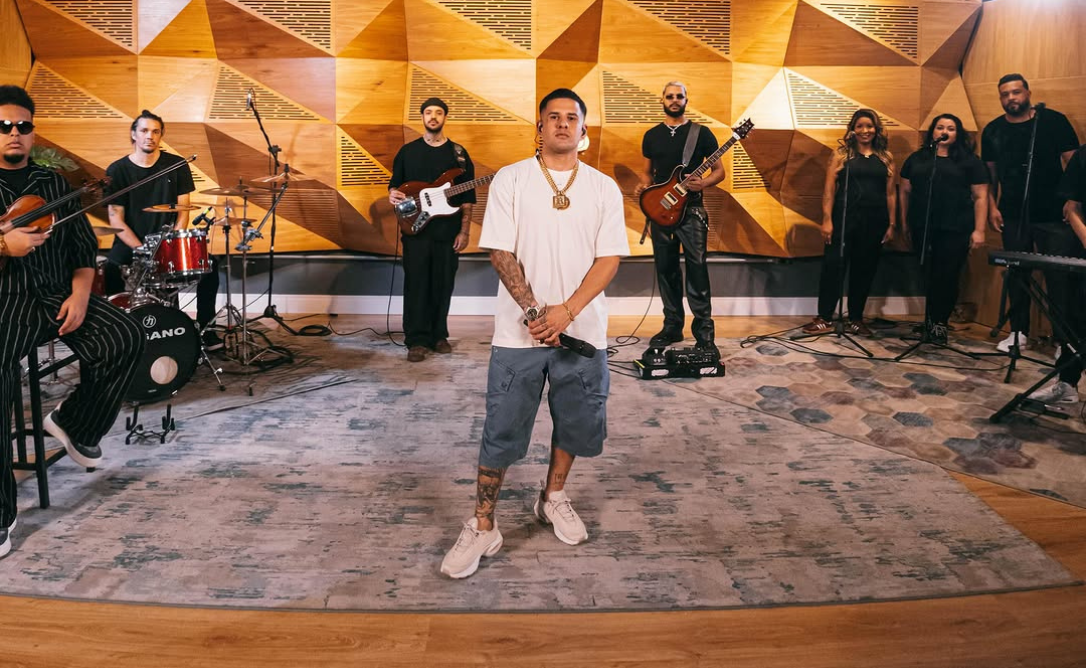
With 16 years in the funk scene, MC Rodolfinho continues to solidify his artistic identity without losing his connection to the streets of Osasco, where he built his references and worldview. Mixing the roots of Rio de Janeiro funk with influences from rap, reggae, and MPB (Brazilian Popular Music), the artist positions himself as a bridge between generations and is preparing a new phase in his career with the release of the audiovisual project “Solidificando a Caminhada” (Solidifying the Journey), arriving in March with a more musical and organic approach. In the interview, he talks about his origins, the role of funk as an instrument of social transformation, the power of the stage, the maturation of his audience, and the global future of the genre, reinforcing that, even with expansion and aesthetic evolution, maintaining the essence is what sustains the true connection with those who have followed him from the beginning.
Rodolfinho, you were born and raised in Osasco — a place with a strong street and music scene. What from that experience most influences your sound and how you connect with your audience?
Osasco gave me a foundation. It gave me resilience. It gave me vision. I grew up seeing the streets up close, seeing dreams and hardship walking side by side. This shaped my way of seeing life and writing. Most of what I sing comes from things I’ve lived or witnessed firsthand. The connection with the audience comes precisely from that. When I talk about overcoming obstacles, ambition, family, mistakes and successes… it’s not a rehearsed speech, it’s reality. Those who come from where I come from can sense when it’s true and identify with it.
Your style blends Rio de Janeiro funk with references to rap and hip-hop. How would you define your sound within this new generation of funk?
I come from the more traditional funk scene, where most MCs rapped over the heavy drum beat, without much harmony. But I’m restless and I like to keep up with the aesthetic evolution of the genre. So, I believe I’m a bridge. I carry the roots of funk with me, but I also engage with the younger generation because I have the humility to always learn and keep up with the aesthetic updates in funk.
Many people still see funk only as entertainment, but it’s also resistance and the voice of the peripheries. What does funk represent to you today, after so many years in the movement?
Funk saved my life, as well as the lives of thousands of young people and families. I see funk as one of the greatest sources of opportunity for the people of the Brazilian periphery, just like samba, rap, and even football. It’s a movement denouncing the injustices we experience, but also raising awareness and bringing about transformation. And of course, it’s also entertainment and fun. Funk is complete.
With the growth of digital platforms, artists have new ways to reach their audience. What changes for you between online success and the excitement of a live show?
Digital platforms and their algorithms are excellent tools for boosting artists’ careers. They democratize access and give everyone the opportunity to promote their work. But they also greatly accelerate consumption. The market becomes faster, releases are constant, and sometimes some songs end up being more fleeting. But that’s part of the market’s own growth.
But a live show is all about feeling. It’s about exchanging energy in the moment. When you see the crowd singing your song from beginning to end, looking you in the eye, no number can replace that. It’s the truest gauge there is—it’s truly organic.
You’ve already released some remarkable songs and been part of various projects in the funk music scene. Is there any artist or collaboration that’s still a dream for you to achieve?
I dream of recording with artists from other genres that are close to funk in essence, such as rap, samba, and reggae. I really enjoy Rael’s work, for example. It would be a dream come true to be able to record with him someday.
You’re always reinventing yourself. What can we expect from your upcoming releases? Is there something different coming in terms of sound or theme?
On March 5th, I’m launching my new project, “Solidifying the Journey.” It’s an audiovisual project with 4 tracks, all featuring a band, organic instruments, and a more musical approach. It’s the work in which I’ve explored musicality the most in my career. It has influences from reggae, MPB (Brazilian Popular Music), funk, and urban music. It’s more aesthetically elaborate, but without losing the essence and the message of our funk lyrics.
With 16 years in the business, I’ve started to enjoy other styles as well, and my audience has matured. I felt it was the right time to release something like this to connect with this phase—and also with the younger generation, who today have a much more open ear.
Even with your success and visibility, you maintain a discourse very close to your origins. How does it feel for you to continue being the voice of those who have supported you from the beginning?
I’ve always admired that in the artists who inspired me, especially the older funk artists, like Neguinho do Kaxeta. They grew, they became successful, but they never stopped representing where they came from. Funk is born in the favela, it’s born from lived experience. If we lose touch with our origins, it becomes difficult to connect with our own audience, because the connection comes from identification.
I want to reach more people, of course. I want to expand, evolve, reach other audiences. But the roots can’t be lost. And today even the rich kids are enjoying music that talks about the favela, that carries truth. When it’s real, it transcends any social class.
Funk music is gaining popularity worldwide, from Paris to Miami. How do you see the future of the genre and the role of Brazilian artists in this global expansion?
I see funk as a movement that has long since crossed borders. Paris, Miami, Europe… the world already dances to our BPM. What’s happening now is the recognition of that. The future of the genre depends a lot on our organization and vision. We have our own identity, we have an aesthetic, we have a rhythm that doesn’t exist anywhere else. If Brazilian artists understand the cultural value they carry, they won’t position themselves as inferior abroad.
The role of Brazilian artists in this expansion is to maintain the essence, but raise the level of production, strategy, and professionalism. It’s not about copying what already exists abroad—it’s about exporting what is ours, with world-class quality. Funk has global reach. And when we combine truth with strategic vision, the movement grows without losing its essence.
Follow MC Rodolfinho on Instagram