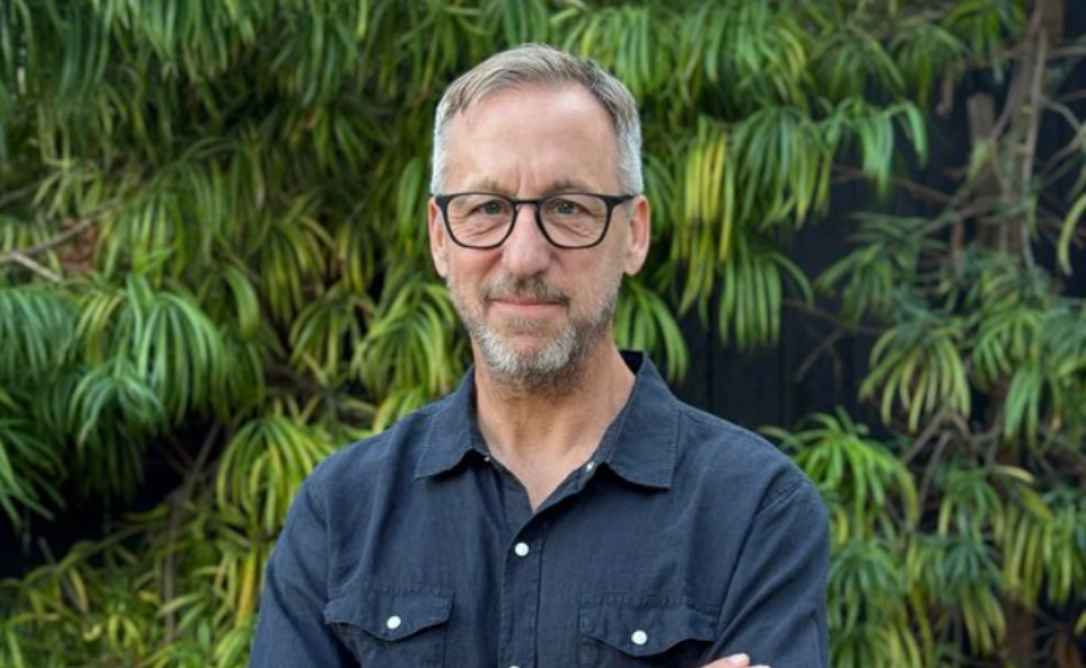
Carrying the Disney name means belonging to a history deeply connected to the foundations of modern entertainment, but Tim Disney has built a creative path of his own as a filmmaker, entrepreneur, and storyteller. The son of Roy E. Disney, grandson of Roy O. Disney, and great-nephew of Walt Disney, he now brings his perspective to The A.R.C., a graphic novel created with J.C. Lacek and Vincent Dubourg that uses humor and absurdity to explore a “pandemic of lying” alongside questions of wealth, power, and inequality.
In the interview, Disney discusses stepping outside film to discover the language of graphic novels, why satire must work as comedy before anything else, and the greater moral responsibility he believes rests with those who hold disproportionate wealth and power. Reflecting on his own family history, he also acknowledges that his position has allowed him to see into very different worlds. Yet beneath the scathing humor of The A.R.C. lies an ultimately hopeful idea: “We don’t have to be stuck with the terrible dynamic we are currently experiencing. It doesn’t have to be like this.”
You have built much of your career in film. What made you realize that The A.R.C. needed to be a graphic novel rather than a movie or television series?
The core idea for our book, The A.R.C. – a ‘pandemic’ of lying – came to me during the COVID era, and I pitched it to a movie producer friend as a movie idea. He suggested developing it as a graphic novel instead, or at least initially – for two reasons: he thought it would be a great way to develop the idea, to work through the story and characters; and because he suggested it would be “faster and easier. It was neither fast nor easy, but in the end I’m very glad it worked out the way it did, as it has been a great experience, and it has resulted in an actual, beautiful, physical book – something I never imagined I would or could do. That same movie producer introduced me to my co-writer J.C. Lacek, and J.C. brought in our great illustrator Vincent Dubourg. Everything that may be good about the book is a result of that collaboration.
The book uses humor and satire to examine wealth, power, and inequality. How did you balance entertaining readers with preserving the seriousness of the issues at its center?
You are right that there is a seriousness of purpose beneath all the silliness and scathing humor. And it was important to us that the book express a kernel of hope and optimism in the end. But I don’t think satire works if it is not funny first and foremost. So that was our focus. It is, I suppose, sometimes harsh, crude, and in bad taste. Ok. The insanity of our current world requires extreme measures. We saw it as our mission to apply some electroshock therapy to our otherwise numbed culture.
During a period of intense political polarization, satire can encourage reflection but also provoke resistance. How do you prevent the book’s message from reaching only readers who already agree with its perspective?
The book posits a “pandemic of lying”, of dishonesty, disinformation, misinformation, propaganda. That did not, and does not, seem like a partisan issue. It was important to dole out the ridicule even handedly. I hope we succeeded. We truly are all in this together.
The A.R.C. has been compared to Don’t Look Up and The Big Short. What do those productions demonstrate about humor’s ability to make complex political and economic systems more understandable?
Those are incredibly flattering comparisons. Wow. Both of those great works, especially “Don’t Look Up” in my view, use absurdity to make a plain and simple point that otherwise has become impossible to see beneath the noise and clutter of cynical and disingenuous messaging. If The A.R.C. succeeds in doing that, even a little, we will be very happy.
What was the creative process like with co-writer Jacey Lacek and illustrator Vincent Dubourg? How did the visual language allow you to communicate ideas that might not have carried the same impact through words alone?

Vincent, J.C., and I enjoyed a really wonderful collaboration, which was very open and free-flowing. As a newbie to the process, it really helped to have JC as a patient teacher, and to rely on Vincent for his great instincts on how to stage scenes and lay out panels effectively. I learned that graphic novels involve a blend of cinematic, literary, and visual elements. But in the end it is primarily about images, and putting across multiple layers of meaning simply. The words are important, but one ought to use as few of them as possible.
You are the son of Roy E. Disney, the grandson of Roy O. Disney, and the great-nephew of Walt Disney, placing you within a family directly connected to the creation of one of the world’s largest entertainment empires. While developing a story that examines wealth, power, and inequality, how did your own family history shape your perspective, and what personal responsibilities or contradictions did you have to confront?
I suppose that connection has afforded me the opportunity to see into multiple worlds, which was helpful for certain parts of the book. There is an ever-increasing class divide in this country, sadly, and folks on various sides of it become increasingly inscrutable to each other. Our book is not trying to explain each side to the other – maybe because we think the side with the surplus of money and power has a vastly greater moral obligation to think about its counterpart. With some important exceptions, we don’t see enough of that happening.
The A.R.C. made its debut at San Diego Comic-Con, an event historically connected to entertainment and popular culture. After the humor, the striking visuals, and the initial reading experience, what reflection do you hope will remain with audiences?
I hope the legacy of The A.R.C. will be laughter first and foremost, and a little germ of an idea that we don’t have to be stuck with the terrible dynamic we are currently experiencing. It doesn’t have to be like this.