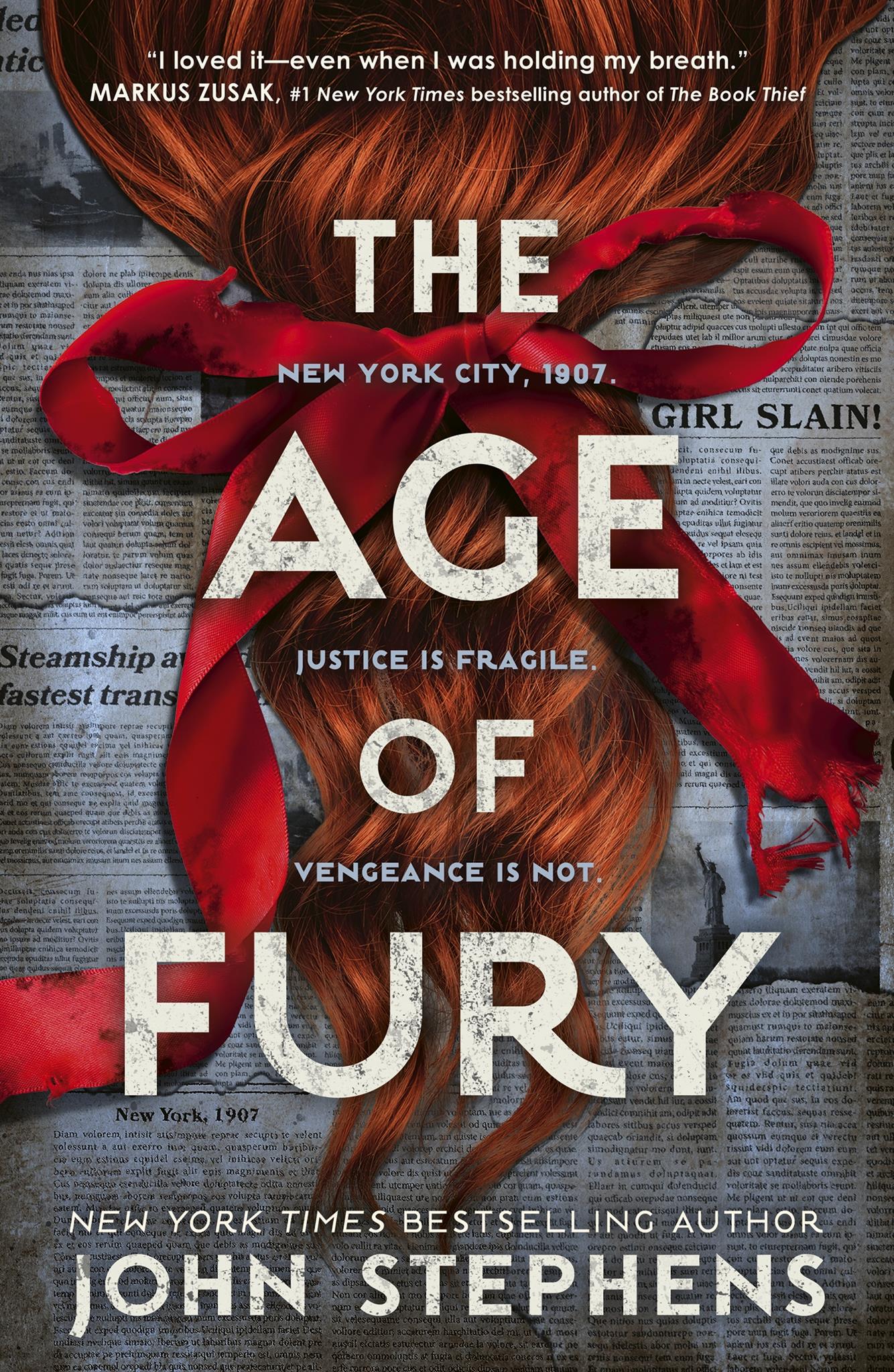
After years of building characters on series including Gilmore Girls, The O.C., Gossip Girl, and Gotham, John Stephens brought a question that has long shaped his storytelling into fiction: not only what a character wants, but what they need without yet realizing it. In The Age of Fury, that approach guides Caitlin Quinn, a young immigrant searching for the truth about her sister, and William Furey, a gangster whose violence exists alongside the possibility of transformation and love.
Set in New York City in 1907, the novel also led Stephens to find echoes between the past and the present. As he researched an era shaped by rapid technological change, debates over immigration, and vast economic inequality, the period began to feel like “a mirror to our own moment.” In the interview, he discusses trading television’s strict runtime for the freedom of a novel, creating a heroine who refuses to acknowledge the power the world tries to hold over her, and exploring a question he admits still has no simple answer: where does justice end and vengeance begin?
You have spent much of your career working in television on shows including Gilmore Girls, The O.C., Gossip Girl, and Gotham. When writing The Age of Fury, which instincts from television did you bring into the novel, and which did you have to leave behind to embrace the freedom of fiction?
The first thing I carried with me was how I approach character. I always ask myself what a character wants, what they’re going after. In Gilmore Girls, it might be Rory getting into Yale. On Gotham, it could be Jim Gordon finding the killer of the Waynes. In The Age of Fury, it was Caitlin tracking down her sister’s murderer. Knowing what a character wants gives shape to the narrative. But paired with that, I always ask, “If this is what a character wants, what do they need that they don’t realize?” In Caitlin’s case, it was accepting that she needed and deserved love.
In terms of what I had to leave behind, the simplest thing was the iron rule of writing to a specific time. In almost everything I’ve written, we were restricted to a certain run-time. In the freedom of a novel, as long as I wasn’t boring the reader, I felt at liberty to explore a moment, a scene, or an aspect of character that would’ve fallen by the wayside in television.
The Age of Fury is set in New York City in 1907, a city shaped by opportunity, immigration, inequality, and corruption. What made that particular historical moment the right setting for Caitlin and William’s story?
It’s a period of time that I’ve always felt particularly appealing, in that it still contains some of the slower rhythms and manners of the Victorian age, even while modernity is breathing down its neck. But in fact, the more I dug into it, the more the era felt like a mirror to our own moment. Society, and the world, in 1907 was being rapidly reshaped by new technologies (the telephone, telegram, steamships, the airplane) in a way that feels identical to what we’re experiencing. New York in 1907 was also grappling with how they were going to manage the waves of immigration, and manage a domestic backlash against immigration, that feels identical to our current situation. And there were vast fortunes being created (Rockefeller, Vanderbilt, Carnegie) so that the gap between the rich and poor was greater than ever. Again, all very familiar.
So to place William and Caitlin’s story in the midst of all that, to have them be ‘somewhat’ aware that the world was changing, that there was unfairness, but to try to carve out meaning, and love, in their own lives, as so many of us are, felt very very familiar.
Caitlin arrives in New York searching for her missing sister and finds herself pulled into a world of violence and power she initially knows very little about. How did you approach giving her agency without treating her vulnerability as a young immigrant as weakness?
The very nature of having Caitlin be a young woman and an immigrant in 1907 New York, a city in which she knew no one, put her automatically in a vulnerable state. But the beauty of Caitlin as a character—speaking as someone who was writing her—was that she never acknowledged that vulnerability. Having lost her father when she was young meant she was used not simply to shouldering responsibility, but to fighting for her rights and what she believed she was due. So much of the world’s power over us, I believe, comes from our acknowledging the world’s power over us, and Caitlin, I decided, would never ever do that.
William Furey is introduced as a notorious gangster haunted by a rage he cannot fully explain. What interested you about building a romantic lead who also carries violence, danger, and the possibility of redemption?
This perhaps speaks to the romantic in me. In my own life, I’ve found that certain relationships have changed who I am as a person. This is true of friendships, certainly. Certain friendships have made me be a better person, more curious, more sympathetic. But even more so, the ‘right’ romantic relationship is one that, I think, brings out the best version of ourselves. And perhaps even makes us want to change, to be worthy of that relationship and that person. In that, the right relationship can be transformative. It was for me, and it for William. Not that I was ever a gangster 🙂
The novel uses alternating points of view between characters who enter the same mystery with very different experiences, loyalties, and motivations. What did that structure allow you to reveal about Caitlin and William that a single perspective could not?

I initially started the book only from Caitlin’s POV, and I knew—seventy or eighty pages in—that it just wasn’t working. Partially, it was that I was telling a love story, and I wanted to get inside William’s mind and heart to tell the story properly. To allow it to be balanced. But also, Caitlin had landed in a very complex world—New York of 1907—with many different forces swirling around her. Giving William his own chapters meant I could let him give the reader a clearer picture of the landscape than Caitlin could.
Justice and vengeance sit at the heart of the novel. In a world where institutions and powerful people can themselves be corrupt, how did you explore the line between a legitimate search for truth and the desire to take justice into one’s own hands?
It was certainly something I thought about a lot, and I still don’t have a clear point of view on it. The world that Caitlin and William inhabit is one that is governed by various layers of corrupt institutions, all of which bow to the power of money. I knew, from the POV of the reader’s satisfaction and my own, that the villains of the novel had to pay for what they did. But William and Caitlin simply enacting justice in a cold-blooded way (or even a hot-blooded way) didn’t feel right. I tried to thread the needle.
After years of creating television characters who need to earn an audience’s investment episode after episode, what still tells you that a story — whether on screen or on the page — has created a genuine emotional connection with its audience?
There’s no precise formula or yardstick I can use to determine that. I have to feel it when I’m writing. I have to feel the hook where I’m engaged in the situation the character finds themself in. After the fact, I frequently can go back and look at it and think, ‘Oh yes, that’s why I was engaged, because they felt X emotion which I relate to.’ But in the moment, in the writing, I just have to feel myself leaning in.
Follow John Stephens on Instagram