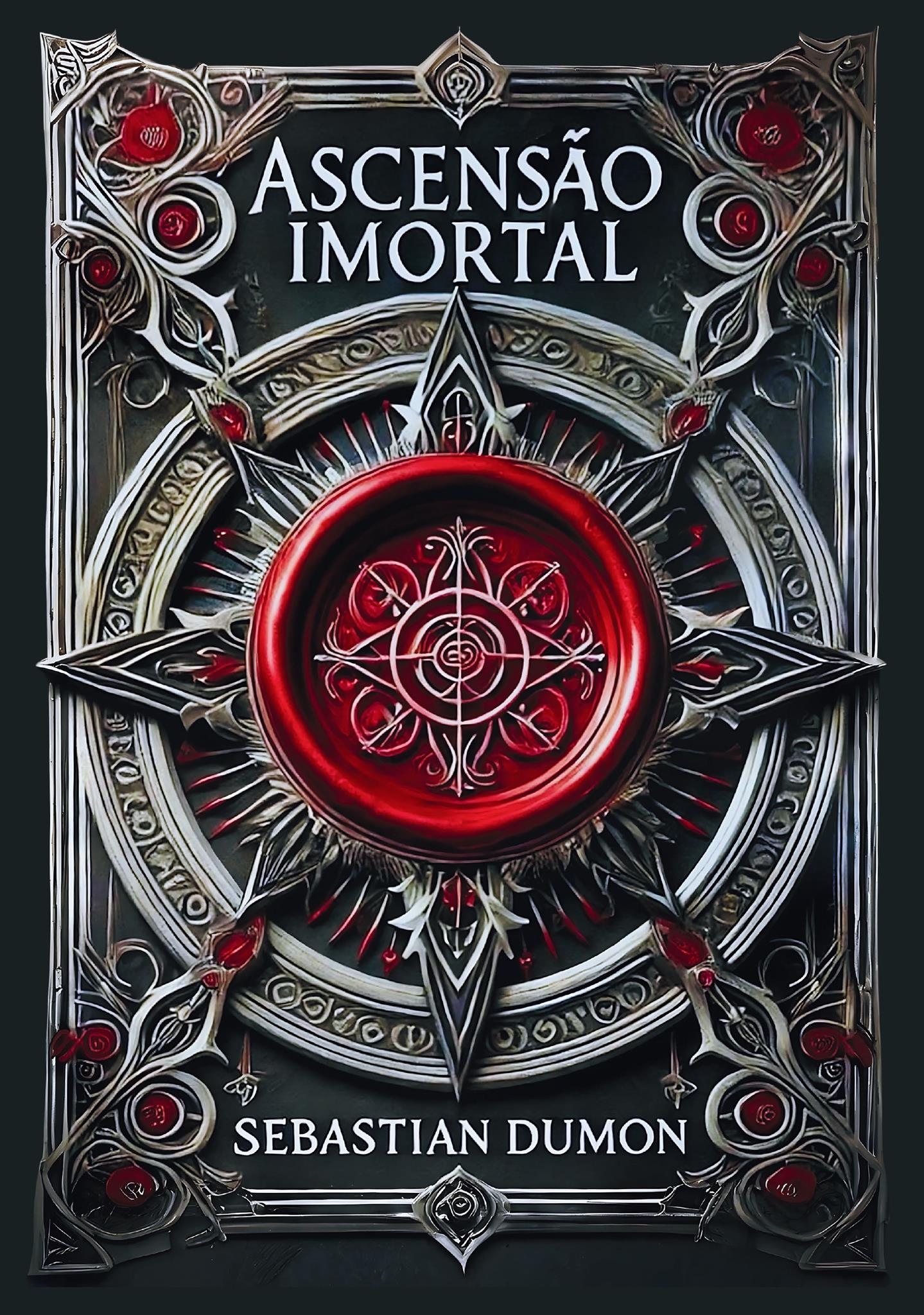
In Immortal Ascension, the second volume of the Seven Immortals trilogy, Sebastian Dumon delves deeper into a dystopia where the promise of eternal life ceases to be a myth and becomes a political weapon, a bargaining chip, and a tool of domination. After centuries of the secret existence of seven immortals created by an ancient virus, the emergence of an eighth survivor under the light of modern science triggers a biotechnological revolution that changes the course of humanity. Transformed against his will, Lucas Moretti finds himself at the center of Project Rebirth—an initiative that promised to save lives but ended up fueling abusive laws, contested clinics, and even Blood Farms, where people work while being exploited as a vital resource for the new global elite. Alongside doctors, hackers, and survivors of the social catastrophe, Lucas joins a resistance fighting against authoritarian governments and powerful Augmented individuals, while society tries to grapple with the moral limits of a science capable of defeating death, but not inequality.
The idea of immortality has traveled many paths in literature, but you chose to approach it from a “scientifically feasible” perspective. What sparked your desire to take immortals out of fantasy and place them so close to reality?
I’ve always been fascinated by the fine line between what we call fantasy and what is, in fact, just one step ahead of science. Immortality, in my universe, is not magic, it’s a consequence. From the moment we understand the code of life, as we do today with genetics and biotechnology, the idea of living forever ceases to be a myth and becomes a possibility. The desire to “make immortals real” was born from this provocation: what if we are closer to it than we imagine? It was a way of taking the concept out of the supernatural and putting it on the table for debate in our time.
In the second book, we see the creation of the Renascer project, which begins with an ethical intention but is quickly distorted. This shift is very reminiscent of real movements in science and technology. What current world events have most influenced this social critique?
The world is surrounded by good ideas that become corrupted along the way. The Rebirth Project is inspired precisely by this paradox. Recent history shows how good intentions can be hijacked by power agendas. We saw this happen during the Covid-19 pandemic, when issues such as treatment alternatives, risks and effectiveness of vaccines, which should be discussions exclusive to medical and scientific circles, were quickly displaced to the center stage of the ideological arena.
Genetic engineering, artificial intelligence, and projects like Google DeepMind’s AlphaFold, which predicts protein structures and points to cures for various diseases, reveal both the transformative potential of science and the risk of its instrumentalization. The question driving this critique is simple: to what extent does a discovery remain human before it becomes political?
Lucas Moretti is transformed against his will and becomes a key player in global disputes. To you, does he represent more human vulnerability or the power that arises from the unexpected?
Lucas represents the collision between these two things. He is a symbol of human vulnerability in the face of what one does not understand, and, at the same time, of the strength that arises precisely from this helplessness. Everything he experiences is imposed upon him, but it is in the process of reacting, of understanding who he is, that he transforms into something greater. Lucas is a mirror of our time: ordinary beings trying to reinvent themselves amidst forces far greater than ourselves.
The “Blood Farms” are one of the most powerful images in the book. Did they originate from some metaphor about the labor market, social inequalities, or the way the world transforms people into resources?
Absolutely. Blood farms are a direct metaphor for how the contemporary system extracts vitality, time, energy, and health from people in exchange for survival. They are factories of life and exhaustion at the same time. In the universe of immortals, blood is the fuel; in ours, it is time. The critique is clear: we live in a model that transforms human beings into disposable resources. But beyond that, it’s a finger in an open wound, where the needs of some are transformed into the obligations of others. When, under the guise of virtue, the silence of the complicit and the applause of the beneficiaries, freedoms are suppressed, rights are violated, and barbarity is installed.
Ana, João, and Mariana represent a very diverse resistance—science, technology, and traumatic experience. How did you conceive of this trio? Do they represent different ways of reacting to the violence of the system?
Yes. The idea has always been to show that resistance is not born from force, but from diversity. Ana is reason and faith in science; João is action, the expression of revolt; and Mariana is memory, the remembrance of all that was lost. Together, they are a reflection of how humanity still tries to rebuild itself: balancing logic, courage, and empathy. They are not perfect heroes, they are survivors trying to make sense of ruin.
Despite being a dystopia, much of the plot sounds frighteningly plausible. Did you ever wonder, while writing, if you were predicting the future—or simply interpreting the present through a more extreme lens?
I think I write about the present with a sincerity that the future will confirm. Science fiction has this power: to amplify what is already happening. When I describe extreme surveillance, increased inequality, or genetic manipulation on a global scale, I am merely pushing existing trends to their limit. Dystopia is simply an unfiltered mirror reflecting what we have already accepted too much.

His background is in architecture. How does this training influence the creation of worlds, societies, and political structures as detailed as those in the Seven Immortals trilogy?
Architecture has taught me that every space carries an ideology. There is no neutral construction, be it a city, an underground dome, or a medieval castle. When I design the settings for the trilogy, from the Shadow Dome to the devastated zones, I think of them as living organisms, with layers of power, fear, and history. Architecture gives me the technical perspective on space and the symbolic perspective on what it represents: who dominates, who resists, who observes from above, and who lives in the shadows.
The third book, The Immortal, is scheduled for release in 2026. Without spoilers, what is the big question or theme you still want to explore to conclude this saga?
The question that drives the last book is simple, yet devastating: “What remains of humanity when everything that defined it is overcome?”
After exploring the origin and cost of immortality, the ending looks to the soul, to the emotional, philosophical, and existential price of crossing boundaries that perhaps shouldn’t be crossed. It’s a story about transcendence, but also about loss. “The Immortal” will be less about the end of the story, and more about what is still worth preserving when humanity itself becomes optional.
Follow Sebstian Dumon on Instagram