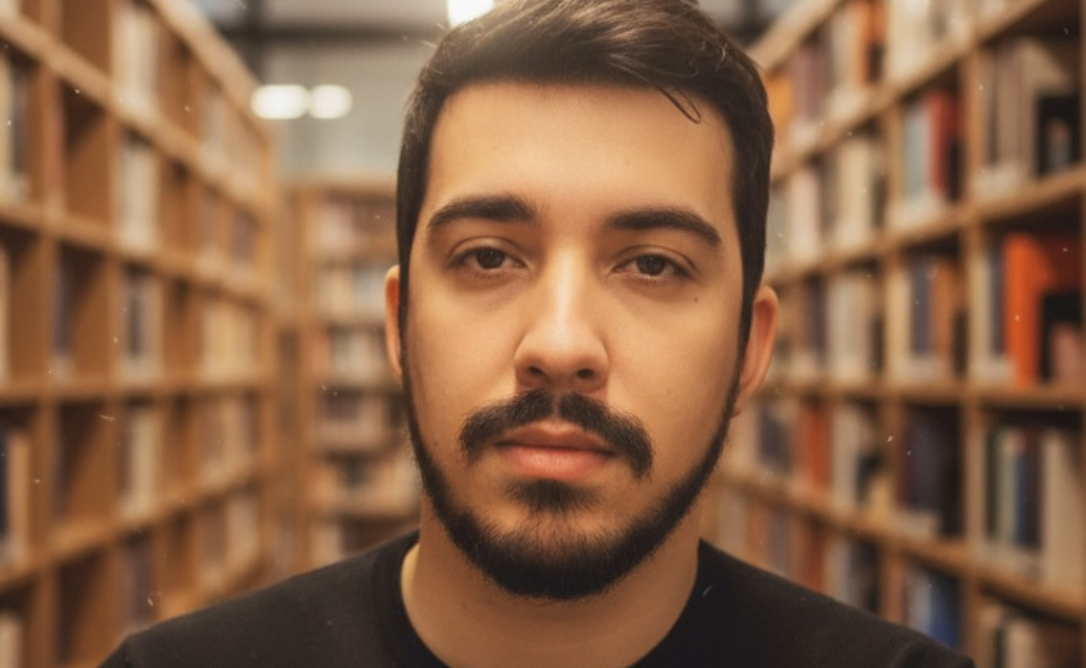
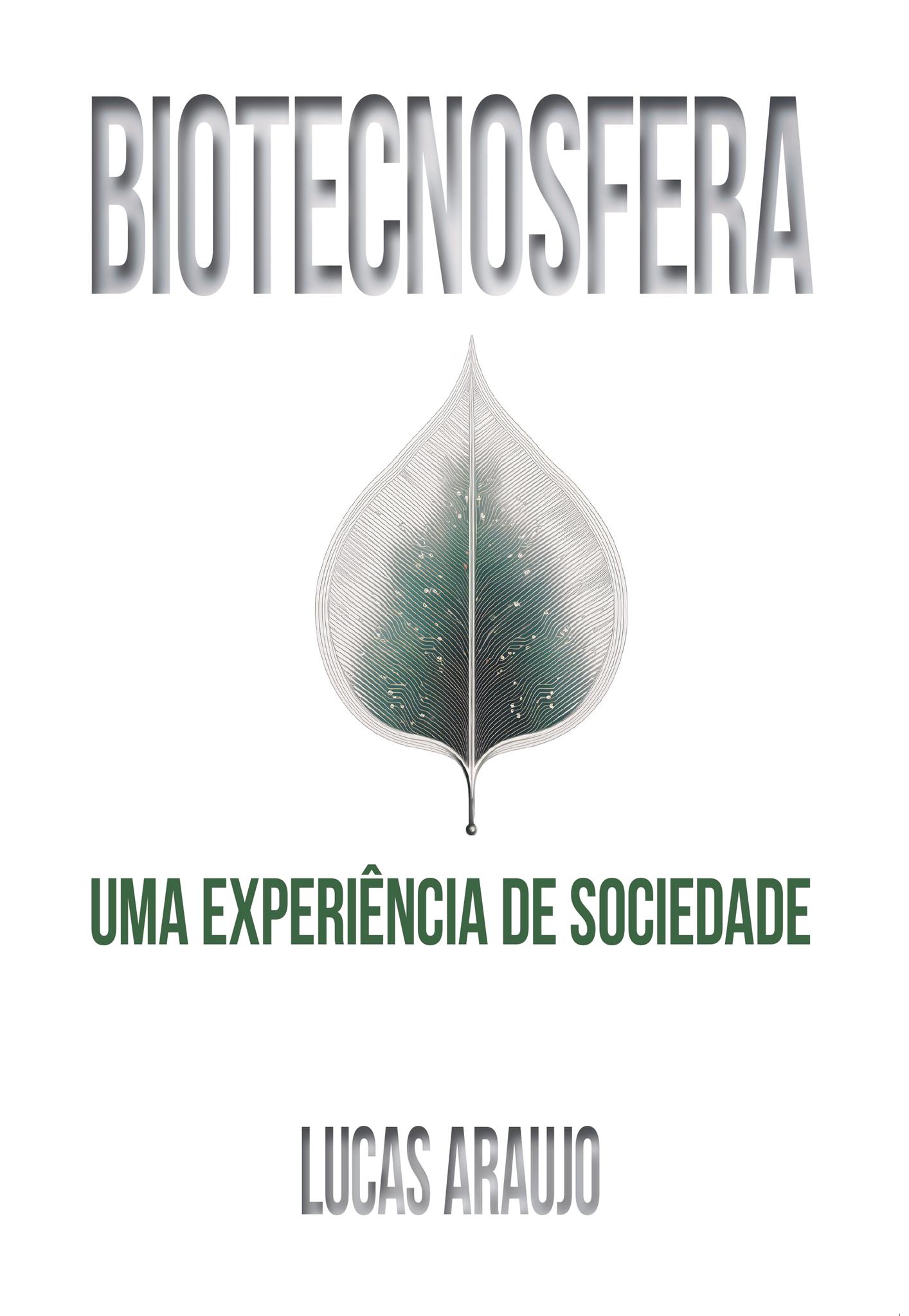
Following the collapse of the structures that sustained the world as we know it, seven advisors are summoned to rethink the very idea of society. It is from this scenario that the accounting entrepreneur and writer Lucas Araújo constructs Biotecnosfera: uma experiência de sociedade (Biotechnosphere: an experiment in society), an original work of fiction that proposes a profound reflection on human reconstruction, technological ethics, and collective regeneration. Born from daily interactions with artificial intelligence, the book presents a future in which humans, technology, and nature must learn to coexist not as opposites, but as parts of the same living organism.
Noah is someone who needs to confront his own ruins before helping to rebuild the world. In his personal view, why is it so difficult to propose a new future without first going through this painful dive into his own past?
We are human beings, not blank slates. I believe that to propose a new future, we need to engage in dialogue with the past, making peace with our neuroses and wounds, since the past and the future are their greatest producers.
I understand pain not as the problem, but as a warning that something is amiss. We need to revisit these pains, negotiate with them, until the burden becomes bearable on our shoulders, freeing up space for something new.
The book presents discussions on Governance, Economics, Climate, Health, Security, and Education. Among these pillars, which one challenged you the most as an author—and which one transformed you the most as an individual?
What challenged me the most was Security, because I started from a blind spot due to my lack of technical knowledge. Everyone fears violence and wants security, but for me, security, beyond the data, also has an individual aspect where it’s a feeling that isn’t always anchored in reality; I had to think from a broader perspective. What transformed me the most was Climate, without a doubt. It made me question the waste and pollution I generate daily and what I can do to recycle, preserve, and regenerate, as well as the urgency of doing so.
You create the idea of a Common Algorithmic Charter, an ethical governance of artificial intelligence. In your view, what is the healthy boundary between humans and algorithms—and at what point does technology cease to be a tool and become a mirror?
The healthy limit is immediately before anthropomorphism. When we start treating machines as people, we prioritize the inorganic over human contact, which is essential, and technology ends up becoming a mirror when we demand that it replace us. In this relentless pursuit of productivity, without first asking what or whom this productivity will serve, we are condemning ourselves to having replicas that never tire, producing things for us, but which most of us will not be able to enjoy.
The story stems from his daily interaction with AI and also from his experience in the accounting world. How did these two seemingly disparate universes converge to create a fictional narrative that blends philosophy, social structure, and human sensibility?
I often say that in Brazil, the complex bureaucracy demands that accountants be polymaths, specialists in various fields. We have daily contact with diverse professions, and we feel firsthand the violence of seeing our profession being extinguished by automation. The advent of generative AI has made me see the acceleration of this process. Furthermore, the study of taxation shows me the origins of our inequality. Hence my philosophical questioning and the proposition of a world reconstruction in “Biotechnosphere”.
In the book, the council assembly becomes almost a ritual, a space for collective transformation. In your opinion, what is missing from real conversations in contemporary society that would allow them to become bridges instead of trenches?
We need to listen to the planet that is screaming. We need to see those in need instead of those who already have too much, and we urgently need to remember that humans are social animals. If we continue to sink into this comfortable isolation that big tech encourages us to remain in, we will die alone and without oxygen, watching some streaming service of our choice, having ordered food from some delivery app, with a bunch of useless things bought online and delivered to our door.
The biotechnosphere presents a vision of coexistence between humans, technology, and nature. In practice—in the world we live in today—what would be the first concrete step to bring these three elements closer together in a truly regenerative way?

I believe in approving regenerative public policies for cities, with progressive tax penalties for non-compliance. For example, mandates for planting trees in urban areas, such as one tree for every 100 m², using technology to monitor impacts via environmental mapping apps. Including regenerative education as a mandatory subject in schools and universities. Humans lead collective actions, technology optimizes efficiency, and nature recovers ecosystems.
The plot holds a revealing twist that changes how the reader understands the book itself. Without spoilers, of course: what was the emotional intention behind this narrative device? To provoke, console, awaken, or deconstruct?
The intention was to live and provide an organic experience. Just as I merged with the ethos of the character Noah, the book Biotechnosphere intends for the reader to enter that reality, which may be ours, and understand that perhaps it already is. The intellectual provocation in Biotechnosphere is about climate change and technology, but it is primarily philosophically metaphysical.
You live amidst numbers, legislation, and tax structures—and, at the same time, write a fiction that speaks of soul, collapse, and rebirth. What does Biotecnosfera reveal about the human Lucas that exists behind the Lucas the accountant?
Perhaps it’s curious that Accounting, contrary to common sense, is not an exact science. Therefore, Lucas the accountant is someone who, beyond numbers, exists to help and care for humans. Biotechnosphere reveals the human Lucas who is also the accountant, the writer, the musician, and so many other things that speak not only of utility and functions, but also of this tangled web of things that we are or are becoming, and which cannot be replaced by algorithms and tools.
Follow Lucas Araújo on Instagram