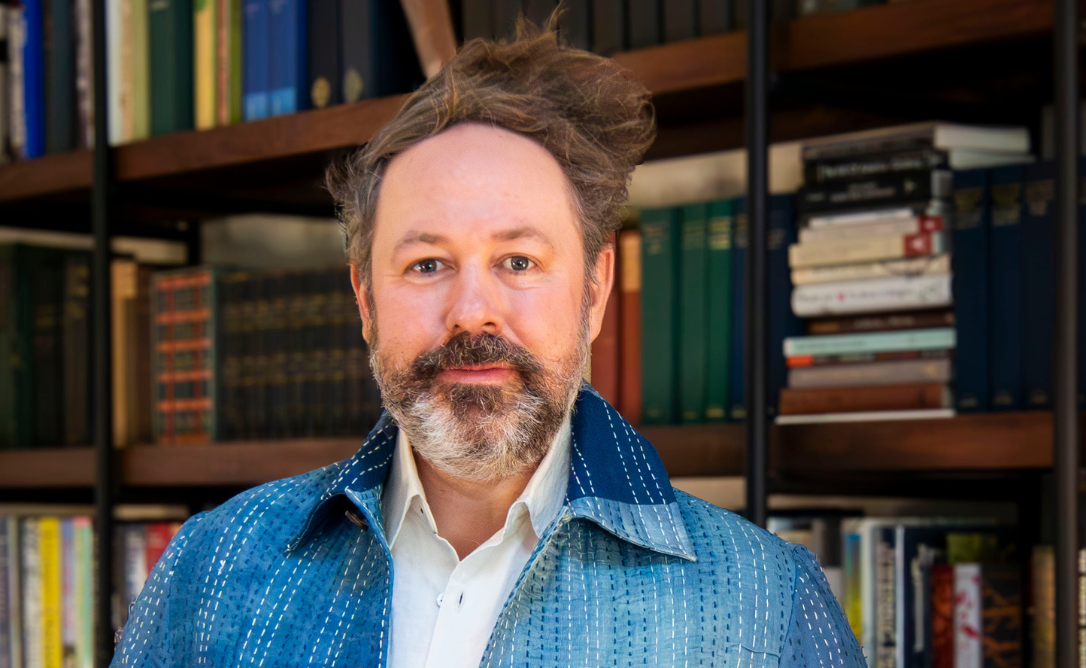
For Jeremy David Engels, today’s democratic crisis is not merely political — it is emotional and spiritual. A Liberal Arts Endowed Professor of Communication Arts & Sciences at Penn State University, co-founder of Yoga Lab, and author of six books, Engels argues that democracy cannot survive without mindfulness, attention, and compassionate listening in everyday life. In his forthcoming book, On Mindful Democracy: A Declaration of Interdependence to Mend a Fractured World, he calls for a radical shift from individual independence toward human interdependence as the foundation for rebuilding trust, community, and civic life.
You’ve said democracy is broken—and that democracy cannot exist without mindfulness. When did this move from an idea into a core conviction for you?
Scholars have been warning about the deterioration of democracy for most of my life. What convinced me that it’s broken was observing how the mainstream political news covers events in the United States—it’s always “will the shutdown benefit Democrats in the next election,” or “Republicans seek to capitalize on [insert your tragedy] to win votes.” Democracy has become a war between parties for power, influence, and money—such shocking amounts of money that could be put to much better use than paying for elections. At the university where I work, I regularly teach classes on war rhetoric, on propaganda, and on contemporary controversies in public culture. My goal is to teach my students the skills they need to be capable democratic citizens and civic leaders. I’ve discovered that they are more successful at navigating this complex world when they are also practicing mindfulness. They are better communicators, and better listeners. I’ve seen the power of mindfulness as a teacher, and I know it myself as a practitioner.
We’re seeing extreme polarization, attention fatigue, and emotional burnout. How do you connect these symptoms to what you call a “mindfulness failure,” not just a political failure?
Mindfulness is a practice of coming home to the present moment. We come home by calling our wandering minds back to the here and now, where it belongs. In The Miracle of Mindfulness, Zen master Thich Nhat Hanh writes:
Mindfulness is the miracle by which we master and restore ourselves. Consider, for example: a magician who cuts his body into many parts and places each part in a different region—hands in the south, arms in the east, legs in the north, and then by some miraculous power lets forth a cry which reassembles whole every part of his body. Mindfulness is like that – it is the miracle which can call back in a flash our dispersed mind and restore it to wholeness so that we can live each minute of life.
In so many ways we are like this magician. We split our attention between the past and the future, between memory and anticipation, and we let our senses be carried away by the social media feed that scrolls across the screen like a flood. No wonder we are so often lonely and off-balance! No wonder we are burned out! No wonder we feel polarized and disconnected! How could we ever feel at home in the world when our minds are elsewhere?
Mindfulness trains us to focus on what matters, and to see the whole picture. Mindfulness helps us to see past the narrow vision of separate, isolated selves locked in a political war, revealing all that we share. Every time we stand up, we stand on common ground. Mindfulness teaches us to manage difficult emotions, so that they do not overwhelm us. It is for these reasons, as I say in my book, that democracy does not work without mindfulness.
You describe “practicing democracy” as a moment-to-moment discipline. What does that look like in everyday life for people who aren’t involved in politics?
Democracy is a practice. The way we move, the way we speak, the way we show up for one another—these are not rehearsals for democracy; they are democracy. Anytime we show up for someone else to care for them and for the life we share, with an open heart while remembering that we stand on common ground, we are practicing democracy. It’s not always flashy or noteworthy. And it’s happening all the time. The key is to recognize that the power of democracy to change lives and worlds increases the more we do it together. That’s why community is at the center of democracy.
In your view, what role do communication—language, listening, and presence—play in reducing reactivity and rebuilding trust in divided communities?
The words “communication” and “community” share the same etymology. Healthy, welcoming, vibrant communities practice good communication. Here I would point out that these words are derived from the Latin terms for togetherness (cum) and a gift (munus), so both community and communication are practices of mutual gift giving. And what do we give when we communicate? We give ourselves. We give our presence, our time, and our attention, to another person. If that person receives that gift by listening, and offers us the same gift in turn, we are both enriched. The gift of self is central to community. If we create spaces where people feel safe sharing presence, time, and attention, it will go a long ways towards rebuilding trust and softening reactivity when people disagree.
You frame rage, fear, and division as signs of a dysregulated nervous system—personally and culturally. What are a few simple practices that can help people interrupt that cycle when conversations get heated?
Tara Brach’s “R.A.I.N” practice (recognize, allow, investigate, nurture) and Rhonda Magee’s “S.T.O.P.” practice (stop, take a deep breath, observe, proceed) are simple and profound techniques that easily can be integrated into your daily life when things get heated. The key is to pause, and to take at least a few moments to notice how you are feeling, and to allow things to settle, before continuing. I notice that when my students get agitated, their breath quickens. So we share this simple practice, pairing words with breath: we take three breaths together, saying “in” on the in-breath and “out” on the out-breath; then three breaths saying “breathing in” on the in-breath and “breathing out” on the out-breath; then three breaths saying “breathing in, I know I’m breathing in” on the in-breath and “breathing out, I know I’m breathing out” on the out-breath. By lengthening the breath like this, we’re able to settle back down and refocus on the topic at hand.

Your forthcoming book proposes a “Declaration of Interdependence.” What does interdependence mean in practical terms, and how might it reshape our understanding of freedom and civic responsibility?
I am convinced that our problems today are not problems of democracy; they are problems of perspective. We have been conditioned to see ourselves as separate selves, when in fact our lives are interconnected, and to value independence at the expense of interdependence. In practical terms, interdependence means two things:
First, it means recognizing and celebrating the many ways our lives are bound. Think of all the people who make your life possible. Every day we speak languages we did not invent, walk on paths we did not pave, mostly eat food we did not grow, write on devices we did not build, and connect over an internet most of us did not create. We are who we are because of our own efforts as well as the efforts of our ancestors, our families, our mentors, our teachers, our communities, and our friends. There is no me and no you without the earth that is our home and our common ground. There is no me and no you without the plants we eat, the cooling rains that become the rivers and lakes we drink, the trees that purify the air we breathe, the bacteria that colonize our bellies and digest our food for us, or the antibodies that fight off disease and cancer. There is no me and no you without us.
Second, it means recognizing that we need to work together if we want to be happy. Mindfulness shows us we are not enemies. If you suffer less, I will suffer less, for you will be less likely to inflict your suffering on me. And if we suffer less, all of us suffer less, for we will be less likely to inflict our suffering on the world. All of us benefit when there is less suffering, and more joy, in the world.
For those experiencing civic despair or burnout from the news, what’s one small but real first step they can take to reclaim a sense of belonging and agency?
Do something that reconnects you to joy and helps you to remember the wonder, and the luminescence, of simply being alive. So often when we are stressed the first things we give up are the things we love the most, because society deems them “optional” and “unproductive.” But these activities are not really optional—they are what make life meaningful. If you’re burned out and in despair, reclaim your ability to just be, to just smile. Put down your phone, connect with someone you care about, and have a real conversation with them. Remember what it feels like to connect with someone. Give the gift of your attention, your time, and your presence, and know that in this moment that gift is enough. Talk with your friend about what gives you hope. Remember that it’s not all bad news all the time. Sure, there is pain in life, and injustice; but there is love, and justice, too. Talk, listen, and recognize that you are not alone.
Follow Jeremy David Engels on Instagram