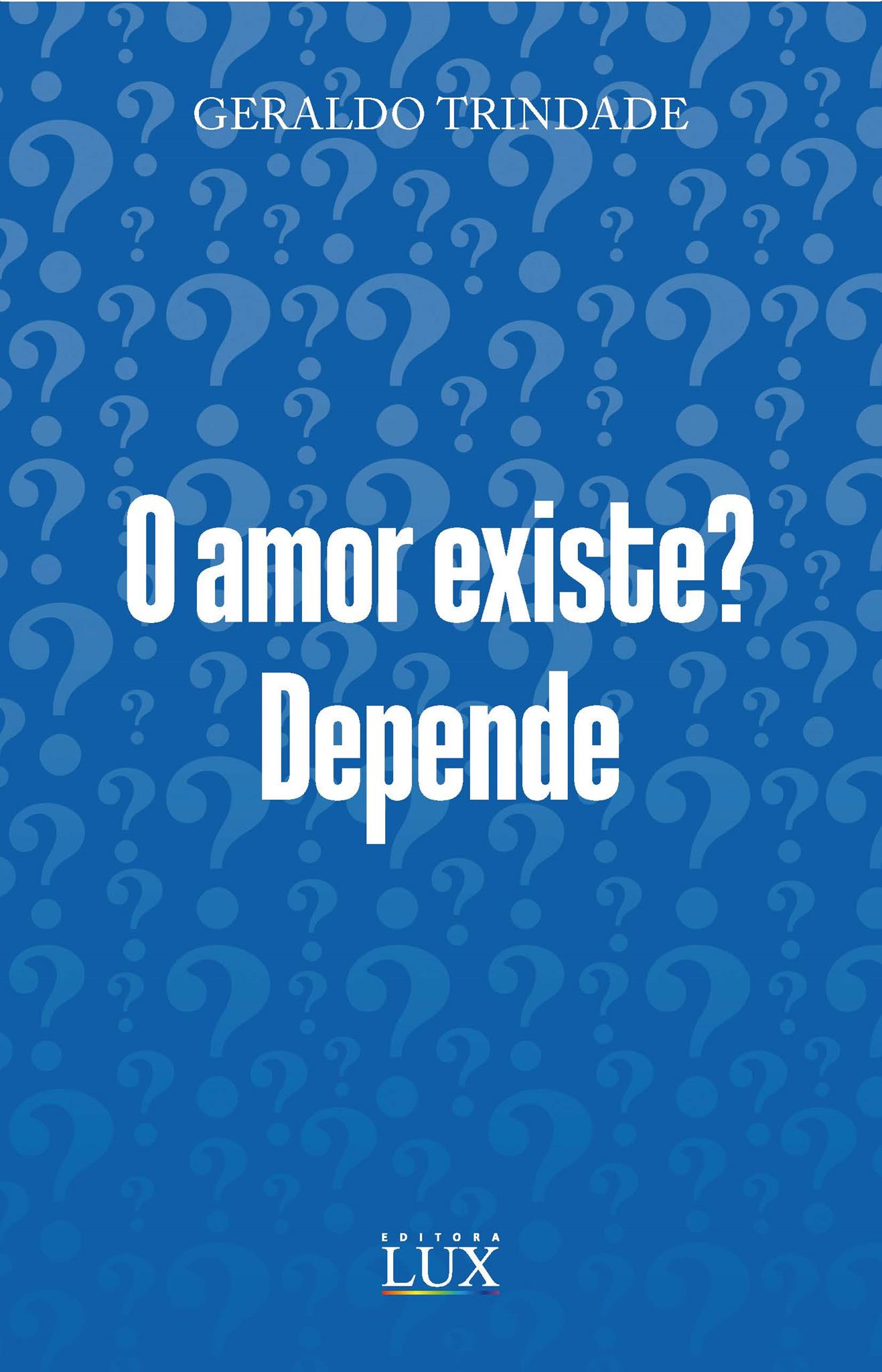
In *Does Love Exist? It Depends*, debut author Geraldo Trindade transforms intimate memories and observations into literature to investigate how love can coexist with tensions, aggression, and normalized behaviors within the home. With a sensitive and non-sensationalist autobiographical narrative, the author exposes the ambiguity of family bonds and proposes a contemporary reflection on domestic violence, emotional responsibility, and reconstruction, intentionally leaving gaps for the reader to recognize and rethink patterns that often remain silenced in everyday life.
The title “Does love exist? It depends” already carries a strong provocation. At what point in your personal journey did you feel that this question needed to be asked – and written?
There wasn’t one specific moment. Throughout my life I’ve noticed the extreme contrast that exists in romantic relationships. For example, I’ve lived in a harmonious and happy relationship for 48 years, and I always refer to my wife as the reason for my existence; very different from relationships where pairs of rings give way to pairs of handcuffs.
In transforming intimate experiences into literature, what was the process like of revisiting family memories that involve affection, but also pain and ambiguity? Were there moments of internal resistance during the writing process?
No, no resistance, because the aggressions I suffered left no trauma; they were devoid of hatred. Fatherhood made me see this side of things.
You choose not to resort to explicit or sensationalist accounts of domestic violence. What does this narrative choice reveal about how you believe this topic should be addressed in literature?
The book has the advantage of entering homes where the State cannot be present. And I preferred to emphasize my beautiful love story instead of recounting a common violence of the time. As for the result, in the small district where I have lived since I was born, the book exceeded all my expectations among readers; I received hundreds of messages from them, and I was even honored at the City Hall of Mariana – MG. The comment that most caught my attention among those sent to me was the following: “If I were a woman abuser, after reading this book, I would be ashamed to look at myself in the mirror.”
The book shows how violence can arise precisely in spaces where protection is expected. Why do you believe these tensions are still so normalized within family relationships?
It’s an interdependence that, in itself, doesn’t generate violence, but it’s very uncomfortable, especially for women. It seems that passing generations are serving as a laboratory for women, who are increasingly freeing themselves from material dependence on men, while many men cannot free themselves from psychological dependence on women. And in many cases, a morbid jealousy emerges that annihilates love and exposes the worst in human beings; and superior physical strength, which should be used to provide and protect, is then used to assault. And in this case, the victim lacks options.
By leaving gaps for the reader to interpret and recognize aspects of their own reality, what kind of dialogue do you hope to provoke with those who read the work?
I wrote a very concise book so that anyone, anywhere, could read it. And the hundreds of people who read it had different reactions, in different groups. Mothers, especially those my age, were moved to tears. Teachers took it to discuss in classrooms and sent me messages or letters. Households reported that their relationships improved significantly. It’s worth noting that I’ve lived in the same district since I was born, and everyone knows me and is an eyewitness to what they read. But since human nature is universal, I believe that people’s reactions will be the same everywhere.
Amidst stories of rupture, the book also points to paths of reconstruction and hope. For you, what makes it possible to break cycles of silence and aggression within the domestic environment?
Regarding the silence of victims, technology and information have proven very efficient. As for violence against women, it can be for various reasons, but none are justifiable. I, fortunately, have no personal experience in this regard. Many cases of violence occur due to betrayal or the end of a relationship; fidelity is not proof of love, it is proof of respect, and there should be respect! Because nature, in its purpose of perpetuating the species, created passion, but did not make it faithful. I, who always refer to my wife as the great love of my life, feel completely reciprocated, but in case of a breakup, I would not want it to be due to betrayal, nor in a sudden manner. Without wanting to make a joke out of such a serious matter, to begin with, there was a courtship period, so why not a “breakup” period to end it? As an illustration, let’s use an example from the real estate market. You rent a house for an indefinite period, what do you prefer: that the owner notifies you in advance that they will need the property, or that you are evicted immediately? Or worse still, what if they put another tenant in the house while you’re away? There are more dignified, honest, and civilized ways to end relationships that no longer make sense.
The idea that love is not absolute, but a construct based on attitudes and choices, runs throughout the narrative. How has this realization changed the way you relate—to yourself and to others?
I’ve always been very good-humored, and the fact that I went from a home without affection, without hugs, without dialogue, to a home based on love and respect, and seeing relationships taking different paths, if you ask me if love exists, my answer is: it depends.
After sharing these reflections with the world, what kind of transformation do you hope “Does Love Exist? It Depends” can bring about, both in readers who have experienced similar situations and in society as a whole?
Let’s analyze the title: Does love exist? It depends. Depends on what? It depends on you meeting the other person’s expectations. Passion is a natural process, but love seems more like a decision than a feeling. This decision depends on those expectations. There’s a saying by a thinker that “the fool learns from his own mistakes and the wise man learns from the mistakes of others,” so I believe that each chapter of my book serves as guidance, both to be imitated and avoided, because it is a faithful work in which I talk about a love that is impossible to overcome, but which also has behaviors that can be interpreted as crime, sexism, or repression. I hope the reader will begin to consider this “it depends” in their relationships. And if love is built over time and still depends on the other person, the transformation I hope for is that they focus on respect, because this you can demand, it’s concrete and immediate.
Follow Geraldo Trindade on Instagram