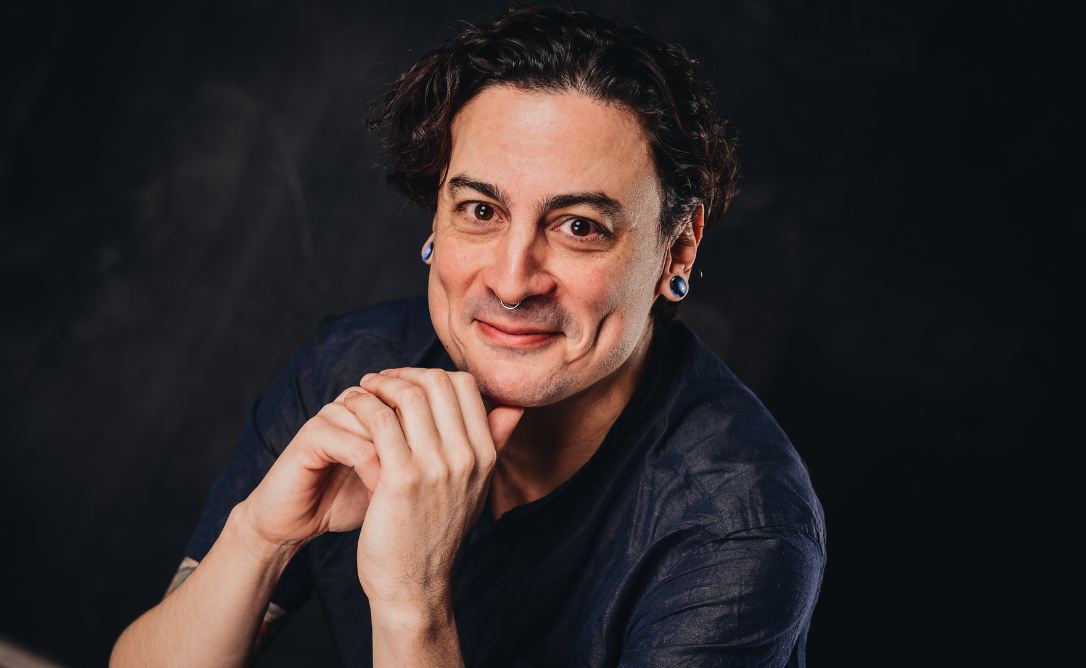
In Between Mountains and Predictions, the Minas Gerais-born physician and writer Felipe de Caux constructs a sensitive and impactful narrative about destiny, memory, and social injustice, following the journey of Madalena, a woman marked by premonitions and successive losses throughout her life. Set in the interior of Minas Gerais and permeated by elements of magical realism, the novel exposes the wounds left by the military dictatorship, the weight of class inequalities, and the historical silencing of the most vulnerable populations, transforming fiction into a powerful human portrait of pain, resistance, and hope.
Madalena is a character marked by successive losses and historical injustices. At what point did you realize that her story needed to become a novel—and not just an idea stored in your memory?
Madalena’s story emerged as an unexpected detour. I was writing a different plot, exploring the protagonist’s childhood in the interior of Minas Gerais, but her presence in that introduction gained strength. Madalena took the reins of the narrative, proving that telling her family’s story was more urgent and important than the original idea. I decided to leave the characters free, allowing them to mature and dictate their future. The moment arrived when their saga became impossible to ignore.
The book blends omens, prophecies, and almost magical elements with a very harsh social reality. How did you balance the realism of pain with the symbolism of destiny without falling into fatalism?
This is, in large part, the theme of the book: the doubt about who decides our future—destiny, our decisions, or the social environment in which we live. I maintained this uncertainty in the narration itself, as Madalena oscillates between faith and denial, conformism and struggle. The use of magical realism, however, serves deeper functions. First, it translates characteristics of Latin American culture that, in my view, words alone cannot explain. Furthermore, by treating the fantastic as something commonplace, I seek to denounce how society normalizes brutal and absurd events simply because of their frequency. Finally, the extraordinary lends a poetic and metaphorical tone to the scenes, strengthening the narrative and making pain, in a way, more palatable through art.
Many of the tragedies in the plot—alcoholism, machismo, homophobia, poverty, state violence—seem less like “prophecies” and more like consequences of social structures. Do you see Madalena’s fate as supernatural or social?
Without a doubt, I see it as social. By transforming events into prophecies, I criticize the way many of these tragedies are portrayed as unsolvable problems or geographical fatalism. These are justifications, like many others that exist, that often serve to blame the victims for their own destinies, removing the weight of decades of neglect and structural inequality. In the book, prophecy functions as a mask that conceals the responsibility of the State and society.
The relationship between elderly Madalena and the doctor in the nursing home functions as a space for listening and reconstructing memory. What is the importance of “telling one’s own story” as a form of healing or resistance?
In my view, the act of narrating initially served to allow Madalena to share the weight of her burden and ward off loneliness. Healing through storytelling is an individual process: we tell our stories because, sometimes, they are too heavy for us to carry alone. However, the function of resistance is much broader and more collective. By learning about these trajectories, we have the chance to learn from them, avoiding the repetition of historical errors and finding ways to fix problems that we insist on ignoring. Telling one’s own story is, therefore, an act of resistance against forgetting and a tool for social transformation.

The disappearance of her son during the dictatorship is a central wound in the book. What motivated you to revisit this painful period of Brazilian history through fiction?
As I began writing, the plot grew and followed its own path until the fiction ended up colliding with the real history of Brazil. I tried to use the events of the time as a backdrop, but at a certain point, they became forces that shaped the characters’ destinies. When I reached the period of the dictatorship, I decided to narrate the lives of those who lived on the margins, who in part ignored what was happening around them, but were not immune to it. As the work developed, I explored different perspectives within the system—a fraction of the vast number of possible viewpoints, but which I felt were underexplored: Madalena represents those who ignored the violence until their lives were devastated by it; Francisco symbolizes those who lived with constant fear in the academic environment and who also suffered from state repression; and João embodies the alienation of those who, manipulated, even doubt their own peers. There is no way to tell stories about Brazilians who lived during that time without delving into the pain of that violence.
You are a pediatrician and nephrologist currently living in Germany. How has your experience in medicine—dealing with fragility, loss, and families—influenced your writing and the emotional construction of the novel?
It’s impossible to separate Felipe the doctor from Felipe the writer. I believe my writing carries a “clinical” aspect; my way of telling a story is almost like elaborating a diagnosis of the soul and society. Throughout my career, I’ve lived with very different realities that allowed me to see pains I never experienced, but which became present within me. I worked in the countryside as a family doctor and specialized at the Santa Casa de Belo Horizonte, but I also worked in emergency care units and private hospitals. Now, in Germany, this vision has expanded even further with the culture shock. Medicine has made me more “hardened” and realistic in the face of finitude, but, paradoxically, it has also made me much more sensitive and empathetic to the subtleties of human fragility.
Despite so much pain, the narrative also speaks of resilience and hope. Where do you think Madalena finds the strength to keep living when everything seems to be falling apart?
Madalena did what most of us do when faced with the hardships of the journey: she clung to small joys. Reunions, births, and celebrations are fragments that exist even in the most arid paths. Furthermore, she relied on mechanisms that keep us standing even when we want to give up: resilience, routine, a sense of obligation, and, as with so many, faith. Madalena finds strength in life’s own insistence on continuing to unfold, proving that hope is not an extraordinary event, but a daily survival tactic.
If the reader could take away only one feeling or reflection after finishing Between Mountains and Predictions, which would you prefer it to be: indignation, empathy, memory… or something else?
Although the reception is always up to the reader, I would love for the book to make them look at their own lives and those around them. To make them see that much of what we experience today is more complex than what is imposed upon us. These are historical and generational problems, often ignored, but which we inherit and which end up deciding—almost like a prediction—the ease or difficulty with which our path is built. I hope they reflect that current ills will only be alleviated when they cease to be invisible, and also understand that there is no such thing as immediate results: it will take time to notice improvements, because these social “shackles” are structural and have been built and deepened over centuries.
Follow Felipe de Caux on Instagram