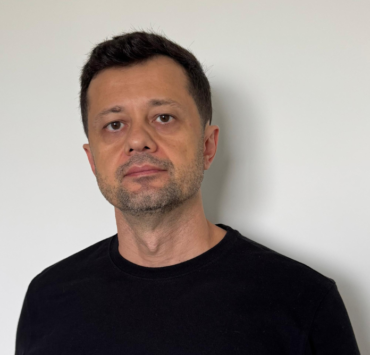
In the anthology *Corpo Estranho* (Strange Body), Marcos Vinicius de Paula brings together twelve short stories that traverse different times and territories of Brazil to investigate what is revealed when individuals are confronted by moral, affective, and social limits. Between social critique and fantastical elements, the author constructs narratives that explore religious obsessions, family tensions, social mobility, structural violence, and intimate resentments, composing a disturbing mosaic of the Brazilian experience. A professor of Sociology and keen observer of contemporary reality, Marcos transforms discomfort and contradiction into literary material, inviting the reader to confront the dark zones that insist on returning—even when we try to ignore them.
Your stories delve into morally ambiguous characters and uncomfortable situations. What attracts you more when writing: the internal conflict or the social chaos surrounding them?
Both things. In fact, I believe they are intimately connected. The social dimension of life reflects the psychological dimension. The psychological dimension reflects the social dimension. Of course, internal and external conflicts each function in their own way. That’s why the specific interest. But I think it’s important to emphasize that the two conflicts are linked, they form a totality. So, my attraction when writing turns to both dimensions: the social and the psychological. My interest is in the synthesis of the two phenomena.
As a Sociology professor, you observe Brazilian reality up close every day. At what points does the classroom end up becoming raw material for your fiction?
In two moments, I believe. The moment I encounter that world, with the multitude of characters, stories, and conflicts it carries, and the moment I find myself in it, absorbed, also becoming a character. It’s the setting and my feelings about it. As a teacher, I participate in that environment; I am one of its types. That environment consumes me, shakes me, delights me, teaches me. That is also material. And quite rich material, in fact. So that’s it: in a vibrant environment like a school, we learn from the setting and we learn from our reaction to the setting.
Many stories in the book blend social commentary with almost fantastical or symbolic elements. Do you think fantasy helps explain reality better than pure realism?
Pure realism and fantasy are narrative devices that often aim to reach the same place. I like both as aesthetic forms. There are stories where I use pure realism, and there are stories where I use fantasy. These are challenges not only discursive but also formal. It’s important to remember that literature is of a different order than a philosophical treatise or a scientific dissertation. Literature teaches and transforms through fiction, through fantasy embedded in an invented story. It has no commitment to an exact exposition of reality. In this sense, it’s possible to explore many possibilities through it. To speak of the world through metaphors, symbols, exaggerations, absurdities. Because this is an important dimension of understanding: analogy. Fantastic texts give us the possibility of seeing reality through analogy. And this analogy must be found in arrangements that are outside this world. I think it’s a wonderful resource. It touches me to see fantasy well-crafted in writing, just as it touches me to see pure realism.
In stories like “Extreme Unction” and “Canary of the Earth,” we see characters dominated by obsessions, guilt, and paranoia. Do you believe these “excesses” are individual or reflections of cultural pressures in contemporary Brazil?
As I said before, all inner life echoes outer life. There are no paranoids outside of repressed and repressive societies. There are no chauvinists outside of misogynistic societies. There are no racists outside of societies with a history of slavery. My aim is to present characters whose psychological characteristics correspond to the environment in which they are embedded. Of course, I try not to do this mechanically. The beauty of literature lies in constructing unique and unconventional stories. My characters, therefore, correspond to their environment, they are a product of it, but each one has their own inner life, their quirks, their desires, their paranoias, etc. The challenge and the grace of writing come from there.

The title “Foreign Body” suggests something that doesn’t fit in, that is unsettling. In what sense do you feel that your characters—or even you yourself as the author—occupy this place of “estrangement” within society?
A foreign body is any object foreign to a body that becomes embedded within it. This title permeates the work because all the stories are, in some way, marked by some element that doesn’t fit into a certain logic. It’s the struggle between logic and the given. For example, in the story whose name originates the book’s title, the character struggles his whole life to belong to high society, but his own body doesn’t allow this to happen when he meets the requirements. In a country like ours, racist, almost divided into castes, the physical body, the phenotype, also tends to count as an element of inclusion and wealth. According to liberal thought, according to capitalist discourse, everyone who achieves wealth should be able to enjoy its benefits. That’s the logic. But reality clashes with this logic, and the body becomes foreign because it is alien. As for me, I often feel like a foreign body too. But that’s beside the point. What matters is the maladjustment, the lack of fit, the absurdity that generates all those stories.
Your texts don’t seem to seek to comfort the reader, but rather to provoke discomfort. Do you see literature as a space for confrontation rather than for acceptance?
Certainly. Literature is much more than entertainment. It’s a dimension of human life, insofar as one of the sources of understanding and transformation, since mythologies, has been stories, narratives, fictions. The advent of philosophy and science creates a direct discourse in which we lose sight of this. The fable, let’s say, loses its importance as a source of knowledge and transformation. Capital intensifies this process when it turns literature and other arts into sources of distraction and entertainment. The role of those who love to tell stories and make art is to demonstrate that the fable, the narration, the fiction is a symbolic source of nourishment, of life, of truth, and of humanity. It is our role to fight for this. And this fight will produce beautiful things and indigestible things. I like the indigestible things because they teach us through strangeness, through shock, through uncertainty. It is sometimes necessary to hurt the reader’s mind with horrifying images so that understanding is truly edifying.
When writing about structural violence, inequality, and institutional abandonment, was there any story that affected you more emotionally than others? Was there one that was difficult to finish?
“The Flesh of the Tide” deeply affects me. It’s a story based on a true event. When I went to the Maré favela complex a few years ago, talking to a friend who lives there, I learned about that event, the event that concludes the story. So I decided to add to that story, to create characters and a setting for it. I think it was a way of creating memory, of ensuring that people never forget the true dimensions of inequality and misery.
After piecing together this mosaic of Brazilian characters and landscapes, which image of the country resonated most strongly with you: the grotesque, the poetic, or the image of human resilience that survives despite everything?
For me, the country is a synthesis of all of this. The Brazil I live in, the Brazil I experience, that I witness and that I am, is a grotesque poem, a poetic grotesque, a corrupted hero, a heroicized corrupt man, a flower and a nausea. The Brazil I see is colorful and gray, made of great contrasts, strange contrasts. I love and hate this country. I hate and I love it. It is necessary to tell it in this way, Apollo and Dionysus, Hercules and Quasimodo, to understand what it really is: a closed wound with the blade inside.
Follow Marcos Vinicius de Paula on Instagram