
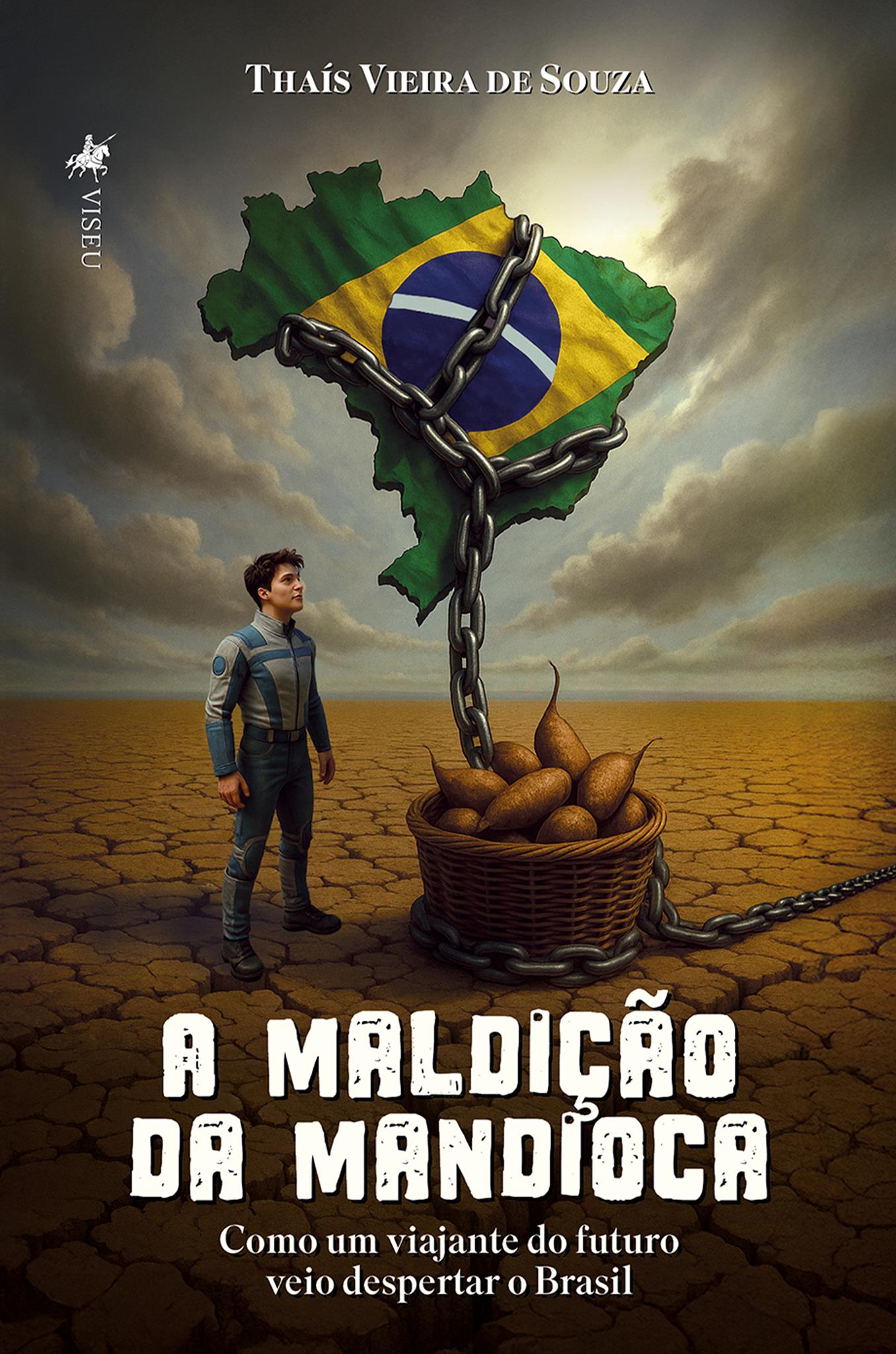
In *The Curse of the Cassava*, São Paulo-born writer Thaís Vieira de Souza presents a narrative that combines science fiction, history, and economic reflection to investigate Brazil’s path throughout the centuries. The plot follows Max, a young man living in the year 3050 who, amidst existential crises, accepts the mission of traveling back in time to understand the origins of the political and economic decisions that shaped the country. By revisiting decisive moments in Brazilian history, the author proposes a critical reading of cultural immediacy and invites the reader to reflect on the choices that can redefine the nation’s future.
In The Curse of the Cassava, you create a seemingly perfect future in 3050, yet you still present a protagonist who feels a profound existential void. What interested you in exploring this contradiction between material progress and the search for meaning?
When we talk about human beings, the search for meaning is inevitable; it’s what drives great achievements, like those we’re about to uncover in “The Curse of the Cassava.” Even if the setting is perfect, presenting a protagonist who could be any one of us creates a connection and makes the story interesting. Max shows us that, without a real purpose, material progress doesn’t fill existential voids.
Max’s journey takes him through several pivotal moments in Brazilian history. How did the idea of using time travel as a narrative tool to discuss the country’s economic and social issues come about?
It was necessary for the protagonist to see the story from a privileged point of view, coming from the future. Max unveils Brazil from an economic perspective and ends up being surprised by what he finds. The idea was to present unknown data about the country, revealing that our current problems are recurring patterns. The time travel shows that the past still dictates the present.
The book is defined as “economic fiction,” something uncommon in Brazilian literature. What was the challenge of transforming historical and economic concepts into an engaging narrative for the reader?
In fact, this wasn’t a challenge; it was the best part! Using fiction as a tool grants the reader access to technical data in a lighthearted way. This brings the audience closer, allowing them to see, through new lenses, the magnitude of Brazil’s potential. And in the end, nobody can resist a good story, and as a bonus, we’ll also reveal the mechanisms that are still hindering our prosperity.
Throughout history, Max identifies a culture of immediacy that spans centuries of Brazilian history. What led you to reflect on this pattern and how does it influence the country’s choices to this day?
The abundance of natural and climatic resources, coupled with the influx of immigrants, generated disorganized growth that fell short of its potential. For 500 years, Brazil has possessed advantages that have fostered a culture of immediacy. Hence the “curse”: the ease of harvesting what the land provides, such as cassava, has addicted us to immediate gain, without the need to plan for the long term and structure the future.
The work blends adventure, romance, historical reflection, and economic analysis. How did you find the balance between telling a good story and, at the same time, provoking reflections on the future of Brazil?
Every good story needs to resonate with reality. In the book, the character is real: he suffers, falls in love, experiences family crises, and finds meaning in achieving something much greater than himself. This entire plot is what humanizes the heart of the book: a growth plan for Brazil. By immersing themselves in this journey, the reader realizes that the country’s economic future is a result of our choices.
Max begins the story lost in his own doubts and ends it trying to propose a new path for the country. In what ways does his journey also reflect processes of self-discovery that many people experience today?

In every way! Every human being needs to find meaning in their life. The story of our protagonist shows that, despite crises and fears, with a little courage, each of us can find the true purpose of our existence. Max exchanges inertia for protagonism, proving that any transformation begins with the willingness to assume one’s role in the story.
Your book suggests that understanding historical roots can give us the tools to transform the future. In your view, what lessons from Brazilian history do we still need to learn better?
The best way to solve old problems is to see history from a new perspective. From there, we will be ready to plan for the future. Max did this brilliantly. Brazil, for example, has not yet gone through the educational development cycle; this would make us grow 5% per year for the next 25 years! We could grow in many other aspects if we cultivated this perspective.
After finishing reading The Curse of the Cassava, what kind of reflection or question would you like readers to take away about their individual and collective role in building the future?
I would like everyone to change their perspective on Brazil and their own history. Throughout our journey, it’s true that we could have grown much more, but we still have many cards to play! The future is not simply what happens, but what we intentionally decide to build. We need to believe and, with courage and determination, rewrite a truly happy ending.
Follow Thaís Vieira de Souza on Instagram