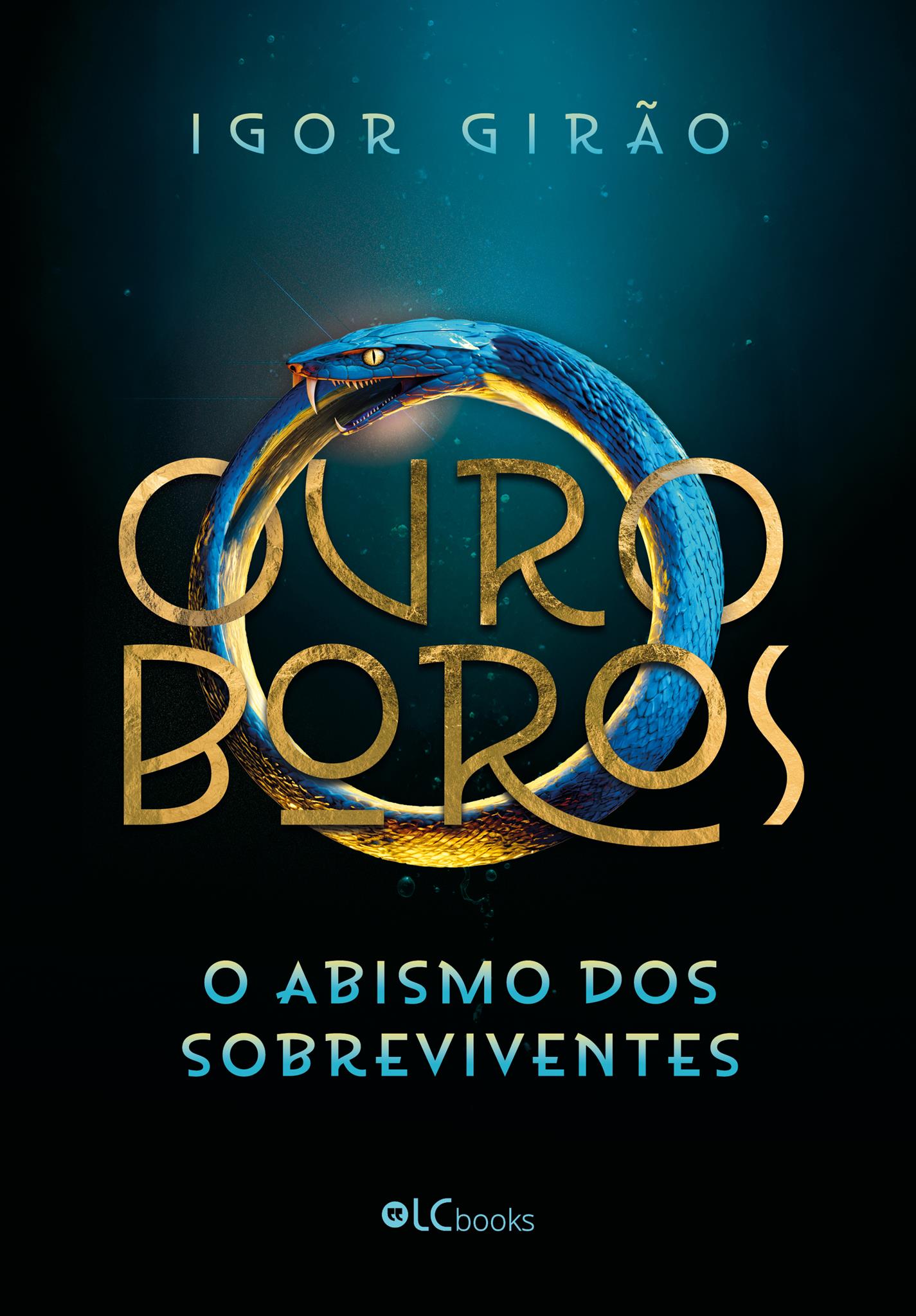
In a scenario where survival means giving up one’s own freedom, writer Igor Girão constructs, in the novel Ouroboros, a dystopia marked by control, surveillance, and exclusion. Set in a technocratic society that emerged after the destruction of the Earth’s surface, the work follows characters who challenge a system that measures human value by utility and perfection. In an interview, the author reflects on themes such as ableism, social pressure, and dehumanization, proposing a narrative that transforms contemporary tensions into an intense and provocative fiction.
Ouroboros starts from a very unsettling idea: a system that promises survival but demands freedom as its price. What anxieties of the present gave rise to this dystopia?
Ouroboros is born from a world that decided to move on — but somehow didn’t take humans along in the process.
The idea of systems that enable people to survive major catastrophes is not new. Whether in social, religious, or even nuclear scenarios, this notion of extreme resilience has always existed. But in Ouroboros, what troubled me was something else: the feeling that all of this happens within a society that, while evolving, has also closed itself off in a technocracy and a core of absolute certainties.
The attitudes that underpin this system—and which also serve as the ignition point of the narrative—arise precisely from the chasm that exists between people. When we stop focusing on what makes us human, this chasm grows.
In the book, the pressure of the ocean functions as a constant metaphor: it’s the abyss, the weight and force that compresses us from all sides. It creates an almost inescapable structure of confinement. Today, I see that many people are trapped in their own absolute certainties. And, in this process, they end up distancing themselves from doubts—which are precisely what allow for growth, connection, and transformation.
Ultimately, this dystopia arises from this unease: from the loss of the ability to recognize the other as someone complex, changeable, and always under construction.
Sony is a character of immense strength, but also marked by the violence of ableism. What led you to create a protagonist who so directly challenges the logic of utility imposed by this society?
Sony is amazing. I could answer that question with just that—but then I’d be a complete jerk (laughs). The big issue is that she’s a fantastic human being. In an ideal world, in a truly mature society, I wouldn’t even need to emphasize that she’s blind, highly skilled, possibly autistic, antisocial, and a hacker. All of that, within what is plausible, makes up someone capable of reading situations, dealing with people, and understanding what is appropriate, what is not, and what is necessary in each context.
Speaking like this, it might seem like she’s a superhero—and that I’m falling into the trap of ableism, placing her as someone “beyond” or “above” her. But that’s not it. Sony is full of contradictions. She’s extremely insecure, has moments of daydreaming, can be arrogant… and has a very loose tongue (laughs). When I say she’s incredible, it’s not because she’s perfect—it’s because she’s deeply human, three-dimensional, with facets that we all have, but don’t always show.
And that’s where the conflict with the system comes in. Ouroboros doesn’t know how to deal with either perfection or diversity—even when that diversity carries its own form of perfection. As the saying goes: “the orderly system is immutable, only chaos generates growth.”
Sony even had to prove that it was useful within that logic. But its nature is subversive. Consciously or not, it becomes a thorn in the side of the system. It’s almost as if it were saying: “If I’m going to be measured by my usefulness, then you’ll also have to swallow my right to be useless.”
Bento carries the weight of having been designed to represent perfection. What interested you most in exploring this character: the privilege he symbolizes or the lack of autonomy that lies behind it?
There’s a phrase from Bento that, for me, is central. At one point, he says to Sony: “They stole my chance to learn from my own mistakes.” And that’s devastating. Because, when you stop to think about it, he’s someone who had everything: a privileged home, an anatomically perfect body, an above-average intellect. In theory, he would have no reason to be unhappy. But that’s precisely where things fall apart.
Bento wasn’t treated like a person—he was treated like a trophy, like a hero, and at the same time like a scapegoat. He was the first successful experiment in a scientific program led by his own father. And, because it worked, almost inhuman expectations were projected onto him. Heroic acts, impossible solutions, “bread and circuses” style distractions were expected of him. He became a receptacle for the pains of an entire society—someone who should solve problems that shouldn’t even exist. And the cruelest part: the moment he failed—or even when he didn’t—the criticism, the envy, the attempts to justify or belittle who he was would come.
What interested me most about Bento was precisely this: showing that even the so-called “privileged man” can be trapped in a structure that dehumanizes him. And this is not about comparing suffering or validating one over another—but about remembering that there are people who do not deserve to suffer and yet do, just as there are people who deserve to face consequences and do not. If we cling too much to absolute certainties about who is guilty or who should be held responsible, we risk losing sight of the complexity of reality.
Bento’s arc leads him to a point where he becomes more self-aware—and, above all, aware that perhaps he is more part of the problem than the solution. And that hurts too. Because, deep down, his very existence carries an uncomfortable question: how many people had to be sacrificed so that someone like him could exist? It’s the same logic behind an old provocation: how many miserable people need to exist for billionaires to exist?
Alex Petrov emerges as someone who begins to disrupt the established order. In his view, what typically triggers this kind of disruption: a major shock or the silent accumulation of discomfort?
Alex is one of the most disruptive characters in the narrative. He begins as someone integrated into the system—an anonymous, almost lethargic citizen—until the moment his daughter, Yandra, is born. That is the breaking point.
From then on, I imagine a whirlwind of thoughts went through his head. He was a writer, married to a brilliant scientist, meaning he was within a technocracy both intimately and structurally. And there’s an interesting tension there: as a writer, he inhabits the realm of the sensitive, the symbolic, fiction—almost in opposition to the exact sciences, to technical logic. It’s that old conflict between the human and calculation, between the aesthetic and the functional (laughs).
But beyond that, what really matters is that Alex begins to look at the world differently. He stops writing as escapism and starts facing reality. The question changes. It stops being “what can I imagine?” and becomes: “what kind of world is my daughter being born into? And even more cruel: how will she prove her usefulness when I’m no longer here?” This kind of thinking is corrosive.
At some point, he breaks free. He joins the Exiles and begins to fight against the system. But this decision doesn’t come without a cost—the risk to his life increases, and his worry for his daughter grows along with it, brutally.
Ouroboros is an extremely vigilant system that operates with a logic of persecution and even practices of social cleansing. At the same time, it is fictional—but not entirely. Because we’ve seen this before. Intellectuals being persecuted in South America—in Chile, Argentina, Bolivia, and Brazil. We’ve also seen this in other contexts, such as in Congo, Ireland, and Germany. These patterns are not a coincidence.
So, ultimately, Alex’s breakdown doesn’t stem from a single isolated shock. It’s the result of an accumulation—of discomfort, of perception, of responsibility. But there is, indeed, a very strong emotional trigger: the birth of his daughter.
If Ouroboros exists as a system, I couldn’t ignore these historical parallels. Naming these mistakes might be a way to distance ourselves from them—or at least to avoid repeating them so easily. I believe that. And, in a way, Alex believed it too. Hopefully, the similarities between him and me end here (laughs).
Although the novel is set in an extreme scenario, it seems to engage with very familiar feelings, such as surveillance, pressure, and inadequacy. To what extent has science fiction allowed you to express, in a more radical way, things that already happen in everyday life?
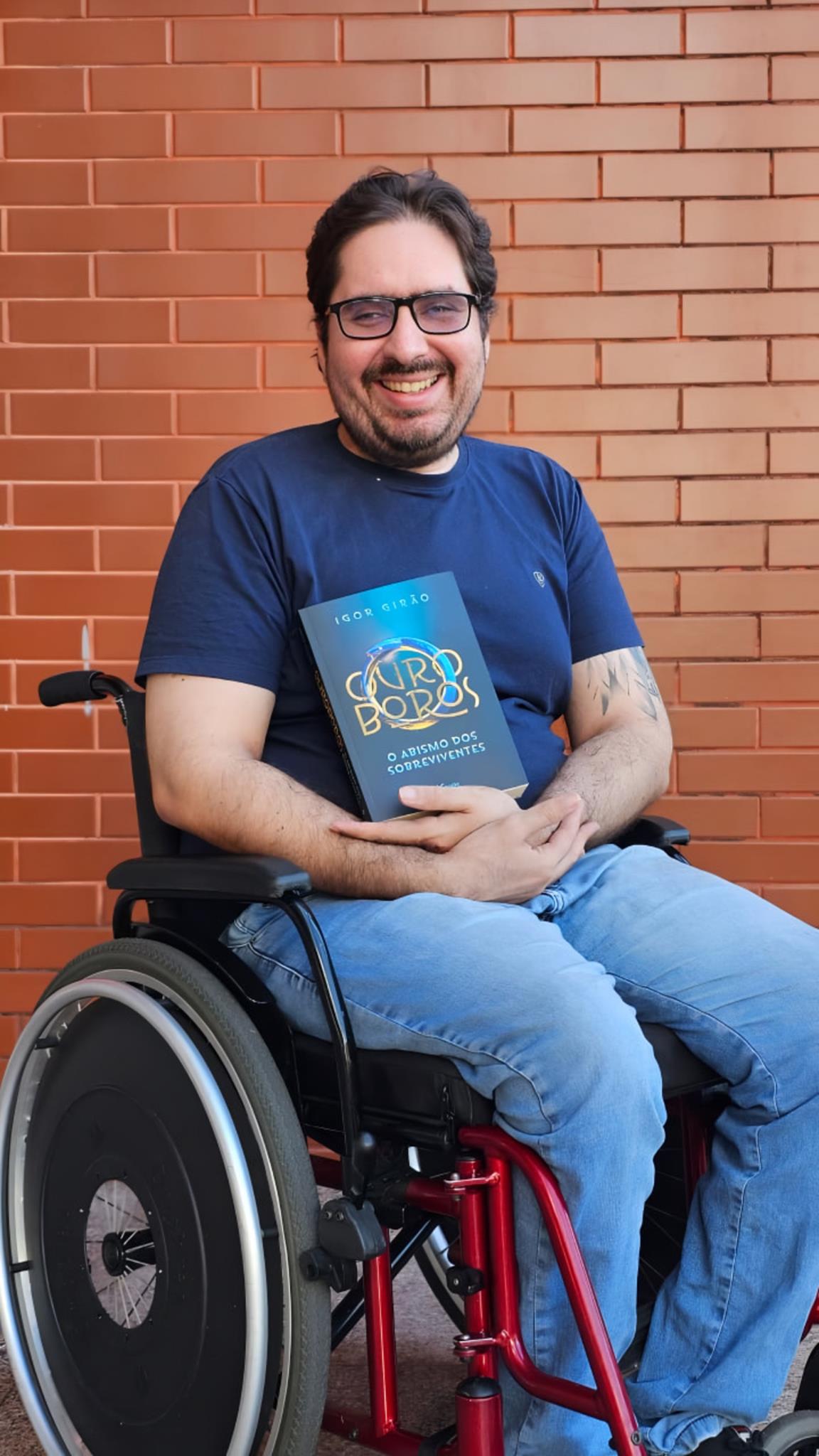
I am a person with multiple disabilities: I am visually impaired, I have a motor disability, and I use a wheelchair. So the question that always comes to mind is simple—and at the same time brutal: am I living in the same world as you or not?
Because the world I experience is unequal, asymmetrical. It’s a world that constantly measures us—by our potential, but mainly by our limitations. By what we cannot be, by what we cannot say, by what we cannot buy, by the places we cannot go, where we cannot be.
And when all of this materializes in society, what emerges is a great paradox. It’s a dark society, but with a sun struggling to appear. A cruel society, but where people smile. A profoundly individualistic society, but where cities, neighborhoods, groups, and attempts at coexistence still exist.
This contrast becomes fuel. It feeds this constant unease between what we need to be and what others expect us to be. And, in the space between being and being able to, another layer emerges: what is truly important to us—and what we hold onto just to avoid losing people around us.
And then other questions arise, each one more profound than the last. If this world is so paradoxical, why do we insist on keeping cruel people around us? And furthermore: if we are all embedded in this logic, to what extent do we also reproduce it? These are questions within questions, gears within gears.
Science fiction, for me, doesn’t create this scenario—it only radicalizes it, amplifies it, makes it impossible to ignore what’s already happening. It takes everyday life and pushes it to the limit.
And even so, I don’t think we’re living in absolute hell. Because there’s still awareness. There’s discomfort. There’s the capacity to reflect—24 hours a day—and try to do things differently. Maybe that’s not enough. But still… it’s something.
I think I asked so many questions that I ended up interviewing myself here (laughs). But, in the end, that’s it. And, to be honest, I’m really enjoying all of this.
The book criticizes a logic that confuses performance with human value. Do you feel that this is perhaps one of the most urgent discussions of our time?
Yes, I believe this is one of the most urgent discussions of our time—and it directly addresses something that is often misunderstood: ableism. Ableism is not something “natural,” it is not inevitable, nor did it arise from nothing. It is a social construct—and more than that, it is a choice that has been made and reinforced over time. And it’s important to say: we, people with disabilities, did not make this choice.

But it’s not simply a matter of “us versus them.” This is a much more complex issue. Because this logic of value based on utility permeates everyone. It shapes how society sees, judges, and organizes people—including those who, at some point, will also be discarded for not performing well enough.
The problem is that the idea of ”being useful” has become a dangerous yardstick. It defines who fits in, who belongs, who deserves space—and who constantly needs to justify their own existence. But being human cannot be reduced to that.
Fitting in isn’t always the answer. Often, it’s quite the opposite. Because when we accept without question a system that measures value in this way, we also accept that anything that deviates from the norm can—and perhaps should—be left aside. And that’s where the danger lies.
Ouroboros explores precisely this question: to what extent are we willing to adapt in order to be accepted? And, more importantly, what do we lose of our humanity in this process?
Ultimately, the discussion isn’t just about disability. It’s about dignity, diversity—and the courage to exist beyond what others expect of us.
The ouroboros symbol carries the idea of a system that feeds on itself to continue existing. At what point did you realize that this image was the ideal metaphor for the novel?
The choice of the ouroboros symbol didn’t come immediately—it revealed itself as the world of Ouroboros itself took shape. At some point, it became clear that the system I was building wasn’t just oppressive—it was self-sustaining. A system that feeds on its own flaws, its own victims, and its own contradictions to continue existing.
And that’s the ouroboros. A cycle that doesn’t break easily, because everything within it is reused: pain becomes control, control becomes order, order becomes justification—and the process begins again.
When I realized that the society in the book functioned this way, the metaphor practically imposed itself. Because it’s not just a regime that oppresses from the outside in. It’s also fueled from within—by the people who maintain it, by the beliefs that sustain it, by the absolute certainties that prevent any real rupture. And this connects directly to everything we’ve already talked about: ableism, the logic of utility, technocracy, the loss of humanity in the name of efficiency.
The system doesn’t need to be perfect—it just needs to keep working. And to do that, it learns to recycle itself. The ouroboros, then, is not just an aesthetic or philosophical symbol. It’s structural. It explains why it’s so difficult to break free. Because, in the end, it’s not just about confronting something external. It’s about interrupting a cycle that, in some way, also runs through us.
By intertwining the trajectories of Sony, Bento, and Alex, you construct different ways of confronting the same system. What did you want to show about human resilience through these three very distinct experiences?
I think I’ve already talked quite a bit about these three points of view—but what interested me was precisely putting them in tension.
Bento represents the “perfect man” who begins to perceive himself as a thinking being—and, more than that, as the product of a process that, at its core, is also a problem. He is human, but he was molded not to be.
Sony, on the other hand, faces a completely different challenge: proving its functionality in a world not designed for it. It must contend with judgment, pressure, expectations—while simultaneously dealing with its own strengths and limitations.
Alex Petrov, on the other hand, is the disruptive one. Someone who trades sensitivity for action, for revolution. In a system that is mathematical, symmetrical, and oppressive, the simple act of breaking the deterministic logic—of thinking differently—is, in itself, resistance.
And that’s where the contrast arises. Bento is a product of the system. Sony is an anomaly of the system. And Alex is a screwdriver thrown into the gears.
There are three ways of existing, three ways of resisting, three ways of fighting. Because a revolution is not born from a single line of thought. It needs multiple perspectives, different levels of consciousness, different degrees of commitment—until it reaches that point of no return.
And that’s precisely what feeds the system itself. The snake that devours its own tail. Because sometimes, when we believe we’re freeing ourselves… we’re already being digested.