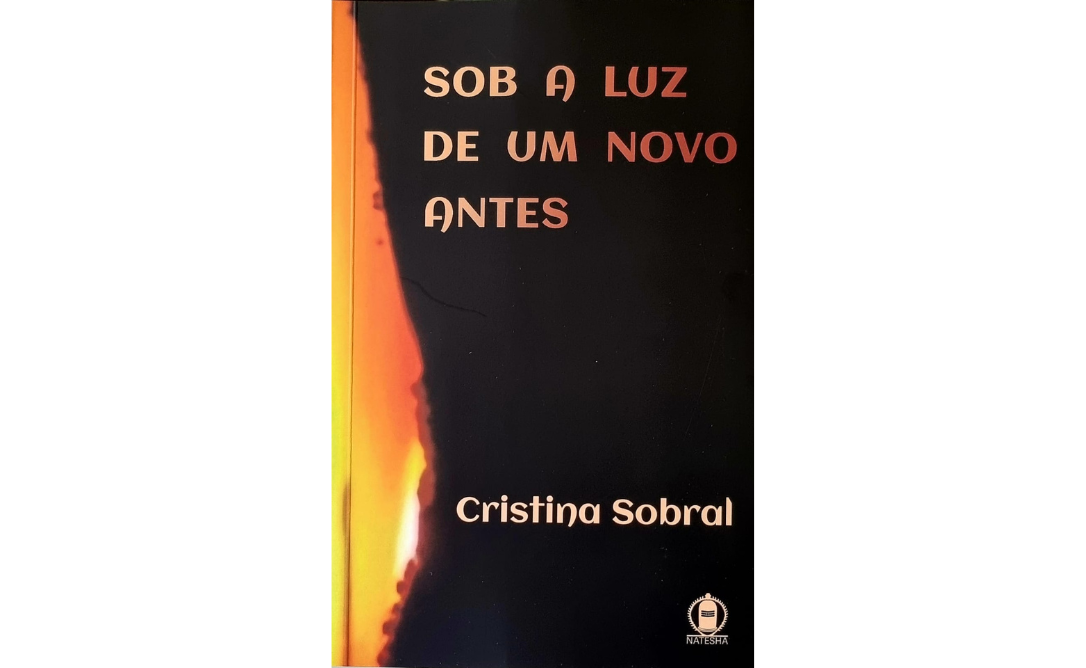
Amidst the accelerated pace of contemporary life, poet Cristina Sobral proposes a gesture of deceleration in “Under the Light of a New Before,” a work that delves into the most sensitive zones of human experience. With verses marked by economy of words and imagistic density, the book investigates themes such as memory, silence, loss, and reinvention, while the female lyrical self traverses the anxieties of the current world. In the interview, the author reflects on the creative process that arises from silence and profound observation, revealing poetry as a space for listening, reflection, and encounter with that which often remains unspeakable.
In “Under the Light of a New Before,” you present poetry as a space for pause in a world marked by haste. At what personal moment did you realize that writing was also a way to slow down and listen to yourself?
I began writing poems at thirteen, but I always felt poetic writing as something that led me to the deepest part of myself, and also to the outside and beyond of myself, something that made my gaze pierce the obvious in search of the essence of things. I wasn’t looking for a rational explanation for the poetic phenomenon, I was simply experiencing it. But poetic art was never the only path in my process of self-discovery. To it were added meditation, intuitive knowledge, pictorial art—bringing wonder and joy in wordless expression—listening and attentive observation of others, readings, studies, reflections, in short, everything that brought more light to my consciousness also served and still serves as humus for poetic activity. All under the light of a new before.
Light appears as a recurring metaphor throughout the work. Was there a specific moment in your life when you felt this “light” reveal something that previously seemed invisible?
Yes, there were times when light was not a metaphor.
The author mentions that the book was born from a process of “unlearning and stripping away.” What was the most difficult thing to unlearn so that these poems could exist?
First, we must become aware that what is established and continues to shape our steps does not correspond to our worldview; then we must overcome the struggle between conflicting visions, or bring them closer to an acceptable point. This is a slow, often painful process that leads us to our singularity. It is from the waters of this source that the poem must quench its thirst for expression.
Her verses seem more interested in provoking questions than offering answers. What kind of questions still remain unanswered within her after finishing this book?
My verses are a provocation of life within me and do not arise from any ulterior motive. In “Volatile” this point is touched upon: “…My verse is made of encounters and passages/ that the poem weaves together with impunity — the challenges/ the ecstasy, the dreams, the earthquakes…/ are the threads that weave together the intuited and the lived…” As life challenges us daily, there will always be questions. What changes, not with the conclusion of the book, but with continuing to live, is our capacity to not succumb to the absence of answers.
The work engages with themes such as silence, loss, war, and reinvention. How can we transform such dense and often painful experiences into something that also contains beauty and lightness?
Perhaps with the understanding that all of life’s experiences are part of its continuous flow of renewal. I bring this reflection in a short poem called “Basements” (Prumo/2018): “There is always a false bottom in the basements/below which some light flickers/and the soul rises.”
The female lyrical voice in the book observes the world with sensitivity, but also with unease. How does her experience as a woman influence the way she sees and translates the world into poetry?
In all six of my books, the question of the feminine has been the subject of poems, and although it is still a brutal reality in the contemporary world and Brazil boasts an unacceptable rate of rape and femicide, my desire is that these forces—the feminine and the masculine—be harmonized in every human being, and that this feminine asserts itself as a desire for power and not as a desire for domination, for might, a feminine that does not seek to subjugate, nor adopt the ways of its aggressor as a mirror.
The woman describes the poem as “a tear in the mystery.” In writing, does she feel she is trying to understand life or to accept that certain things will never be fully understood?
The two things are not mutually exclusive. The search for understanding life and the acceptance that human consciousness has limits in the face of the immensity we do not know generates debates that refine and deepen our view of ourselves and the world. This view, which is not content with the superficial, is attentive to what erupts from this opening to give body to its voice. “…Then I continue arguing with the inaccessible/ dialoguing with uncertainty and chance/ thus filling my alchemical vessel/ with the little of myself that I know and the much that I cannot encompass.” (Beyond and Before, PRUMO/2018).
When the reader finishes “Under the Light of a New Before,” what kind of feeling or inner transformation do you hope will remain with them?
The feeling that it was all worthwhile, that the reader of Under the Light of a New Before celebrated with this poet the great feast of encounter to which they were invited.
Follow Cristina Sobral on Instagram