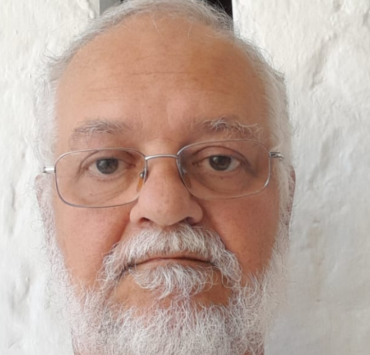
Transforming the dreaded “blank screen” into a creative starting point is the goal of Professor Wigvan Pereira dos Santos in *I’ve got a blank space, baby: write your research project now and conquer the blank screen*. In the book, the author proposes a didactic and accessible approach to guide students in developing academic projects, combining scientific rigor with references to pop culture. In an interview, he explains how light language and examples from series and music can help bring science closer to students’ reality and make the process less intimidating.
Your book starts precisely from a very common fear among students: the block when faced with a blank screen. At what point did you realize that this fear was not an exception, but almost a collective experience within academic life?
I realized this in myself, first and foremost. I believe that all thought about others and about the world begins with thought about oneself. We think comparatively, and having oneself as a point of reference can make us more compassionate towards others, but it also demands confronting one’s own limitations, which can be painful. I think that every teacher, when they remember themselves as a student, tends to understand the students’ difficulties with more kindness. For this to happen, however, the teacher needs to acknowledge that there was a time – a long time – in their training when they didn’t have all this knowledge built up and that perhaps they even dealt worse with the internal and external issues involved in conducting research, taking a test, submitting an article, or presenting a seminar than the students are dealing with. I am a researcher and, of course, producing articles, projects, and research since 2004; the blank screen is much less frightening today because I have developed my own maneuvers to escape that fear. But it is still challenging. I need to think a lot before I start writing anything. For example, I spent a month studying to write a project. Yesterday I sat down and wrote fifteen pages. But during that month of study, I thought a thousand times that I was incompetent to handle that subject, that I had nothing to add, that my contribution was irrelevant. I think it’s very healthy to doubt yourself, as long as that doubt isn’t paralyzing, as long as you continue to advance a little bit each day. So, I put myself in the place of the student who has never written an article and is already required to submit a research project. If I, with my experience, still need time to face my doubts, I think someone who has never done this before might be terrified. So, it’s not that I’ve realized that the fear of the blank page is a collective experience, but rather that I perceive it every day in myself, my own difficulties, and I try to treat people with the same sensitivity that I would have liked to have been treated with back then, at the beginning of my journey. I had great teachers, but I also had teachers who certainly would have done much less harm to the world if they had chosen another career. (Or maybe not, right? What if they had chosen to study biochemistry instead of Nietzsche?! Maybe the world would have already exploded. Haha)
You combine scientific method and pop culture references in a very particular way. How did the idea of bringing Taylor Swift, Gossip Girl, and Stranger Things closer to a universe that is often still seen as rigid and distant come about?
I always try to align my writing style with what my students consume. Usually, in the first orientation meeting or something like that, I ask students to talk about their tastes. All background knowledge is important when writing, as long as it’s well-articulated, and your references—that Subway salad we create in our minds with unlikely vegetables and sauces—is what makes a text yours, a text impossible for someone else to write. That’s what gives it your accent, so to speak. When I started my academic journey as a Philosophy student, I noticed that conferences were very humorless. And Philosophy is incredibly fun; there’s no reason for it to be so serious. So, I started throwing in pop culture references to surprise the audience and even use bombastic titles to get the public interested in my work and avoid presenting in an empty room. I was looking for my own way of doing it, with irony and humor. In Didactics, there’s a term that’s often used: sensitization. Something that’s done at the beginning of class or when introducing a new topic to grab the student’s attention, not simply moving from one subject to another as if we were in a relay race. So, I use pop culture references and humor selectively as a way to grab attention, to illustrate, to exemplify, to lighten the mood, to connect, to break the ice. This applies in class, in a paper presentation, in a lecture, in a book like this one. (In theoretical books I’m more serious these days, haha. Age takes its toll and I’m more grumpy and less daring than I was in my youth, unfortunately.) But using pop culture references isn’t an isolated idea; it’s something embedded in my way of thinking about teaching, about communicating with students, in my desire to find something people are familiar with in order to build other knowledge from there. For example, I’ve used Twilight to talk about Plato, and I’ve even used horror movies to introduce more metaphysical issues, which high school students have more difficulty accessing. But after the initial sensitization, there’s the content part, which isn’t always going to be fun and enjoyable – life isn’t just the fun parts, right? The boring parts are important too, haha.
The title “I’ve got a blank space, baby” already breaks expectations and invites the reader into a different kind of conversation. What did you want to communicate right away by choosing that name for the work?
I like titles. I think a lot about my titles. The title is like an invitation to enter the house, which is the book. So, from the title you already know a lot about the style of the book. You’re not going to read a title like that and think that what follows is a treatise by Umberto Eco. Haha. But besides the unusual aspect, which is using a Taylor Swift verse to talk about something technical, I also wanted to start from what I said in the previous answer: break the ice, show the person that the knowledge they have of the world is a starting point for building other knowledge, that they won’t be starting from scratch. I think it’s good, in books like this, to already show a tone of familiarity. Now, there’s another nuance in this title: I’m not saying that the student has a “blank space,” I’m admitting that I have one myself. And, in a research career, we will always have a blank canvas, it will be part of our daily lives, so it’s better to overcome the fear of it. And there’s the “baby,” the affection, the tenderness. Because a pedagogical relationship can also be mediated by affection, it doesn’t have to be an authoritarian one. It’s as if I were saying: “Friend, I also have a blank canvas here, I know it’s scary, but we can do it.”
After 15 years of teaching Methodology, what are the most common obstacles, insecurities, or misconceptions you see in students when it comes time to structure a research project?
There are many obstacles. But the worst one, and the one from which all others arise, is not knowing what needs to be done. Lack of clear instructions. Lack of clear direction. Many professors don’t say how it should be done, they only say it’s bad and needs improvement. That’s where all the other insecurities, obstacles, and misunderstandings come from. The student doesn’t have to know how to structure a research project. It’s not knowledge that falls from the sky or is automatically installed in their brain after three years of undergraduate studies. Someone needs to teach the student. And it should be the professor. But many professors think that’s not their job – or perhaps they say that because they don’t know how to teach how to structure a research project, they only intuitively know what’s wrong.

There’s something almost emotional about the book’s message, as if it were saying to the reader, “You can do it.” To what extent was writing this book also a way of addressing anxieties you’ve witnessed in the classroom for years?
I hadn’t read that question and ended up talking about that affective dimension when discussing the title. I’m very happy you noticed. I usually tell my students not to see me as a coach, but as a cheerleader. I’m always rooting for them, trying to encourage them, trying to show them that things can be lighter and that difficulties aren’t so terrible. Things are very difficult sometimes, but we are capable of overcoming the worst things. I don’t say that I can accommodate anxieties, neither in the book nor in the classroom, because, first, I’m not qualified for that – psychologists study for years to develop more effective ways of dealing with the anxieties of others. Second: there isn’t enough time to accommodate the anxieties of all students even if I were capable of doing so. Third: not all anxieties should be accommodated, some anxieties have to be dealt with, haha. Fourth, because, going back to the first point, I’m not qualified to know which ones should be accommodated and which ones should be dealt with. Anxieties are very deep and individual things, and therefore exceed my capacity. I don’t have enough tools to deal even with my own, and I need support and qualified listening. What I can do – and do – is try to welcome the person, whether anxious or not, and give them the confidence that, regarding this specific task, which is writing a research project, I will do everything I can to make the path easier. Seeing the student as a person who can make mistakes, who can have a bad day, who can dislike you, already makes a big difference in the process. The book has a little of that, within the limitation of the fact that I am not in direct contact with the reader and speak in a general way, so that more people can identify with it.
In many circles, academia still seems to speak a language that pushes people away rather than bringing them closer. Do you believe that making science more accessible is also a way to democratize access for those who feel they are entitled to occupy that space?
The idea of making science more accessible has been used very irresponsibly by people who lack a solid background to avoid pointing out any errors. Many people who call themselves science communicators on social media are simply more interested in establishing themselves as public figures than in developing their own knowledge. And if you point out that some information is wrong, they respond, “It’s because I simplified it to make it easier.” What good is being easier if it’s wrong or incomplete? I also don’t think science should become a kind of entertainment, as if everything needs to be fun to be valid. It’s not science that needs to be packaged in dopamine to attract people, but people who need to understand that some things take time, patience, and a lot of study to develop. Knowledge, scientific or otherwise, cannot be treated irresponsibly. The language of academia is more difficult for several reasons. The first is that some terms are truly difficult; concepts take years to formulate, and they can’t be simplified. An article, dissertation, or thesis is geared towards a specific audience—people who study those concepts. Academia is designed to promote qualified debate among scholars in a particular field; it’s not necessarily designed to teach or train those without knowledge in the area. There are issues that are only relevant to scholars in a specific field. Once, for example, I went with a doctor friend to a dermatology congress. I saw a two-hour roundtable discussion about the presence of substance X in dermocosmetics. Someone who isn’t in the field of dermatology wouldn’t be able to follow that discussion. I followed about ten percent because I’ve always liked biology and chemistry, so I could at least understand the connection between molecules and reactions in cells. But a didactic text about substance X would be more accessible to someone who wants to buy an ointment and wants to know the risks involved. Not an article, dissertation, or thesis. They are different languages and audiences.
People should believe they can occupy this and any position because they are capable of developing the necessary skills. Our concern perhaps shouldn’t be about making science more accessible, but rather about empowering people to become rigorous scientists or scholars with solid training. This book of mine isn’t a scientific book; it’s a manual, a didactic and technical book, so its purpose is really to make things easier, and I can afford to use more accessible language. But in my theoretical books, I can’t be so accessible because I need to deal with dense concepts and subjects. For example, I wrote about a novel by an Angolan author, Rosária da Silva, a novel that deals with politics, colonialism, violence against women, and social problems. I couldn’t discuss these subjects without being very dense. But on my website, I wrote a more didactic text, as it’s aimed at a general audience. But I couldn’t be as irreverent as I am in this book.
By using pop culture references to explain scientific concepts, you show that personal experience can also be a gateway to knowledge. What precautions were taken to do this without compromising the rigor that research demands?
In this book, I don’t explain scientific concepts. It’s a didactic and technical book in which I teach, in an informal, conversational tone, how to develop the stages of a research project. In the research itself, the student will work with scientific concepts, if that’s the case for their project, or philosophical or artistic concepts, and so on. So, I use examples from pop culture to convey the technique of writing a project in a more relaxed way. But scientific writing demands a lot of rigor, and it’s not always possible to include more informal elements. Some areas allow for greater stylistic flexibility, but in general, the writing of a monograph, article, dissertation, or thesis has to be more neutral. This is because language changes all the time, and references become obsolete very quickly in these times we live in. Scientific writing is more “rigid,” so to speak, even to preserve its meaning for longer. Even in the case of this book, for example, which is not scientific research but a didactic book, the references can become obsolete. Twenty years from now, perhaps the things I mentioned will no longer be known. Even in fiction, this is a risk. I wrote a novel in 2010 called White Shoes. One character is a young man who loves the pop world and makes references to it excessively, using catchphrases from TV shows, etc. When I went to print the edition ten years later, I had to update everything because many things the character said I didn’t even remember myself. Scientific writing wages this battle against obsolescence in the language itself, so to speak. That’s why, when reading an article, we feel that the writing is very dry, that it seems like a medicine leaflet. But this is due to the desire to preserve that knowledge for longer. There are no guarantees, however, because the world changes all the time – and so does language.
But since this book is an educational book, my rigor was to convey the content as accurately as possible, even if in a lighter way. Humor, irony, and pop culture references are used as stylistic devices to make the writing more like a spoken conversation because I wanted the reader to feel like they were having a conversation with me, not reading a technical manual. It’s possible to make technical and instructional content lighter without losing rigor. Making scientific or theoretical content lighter without losing rigor is a more arduous task. Pop culture references can also be considered a teaching tool at times, as I mentioned earlier, a sensitization tool, as didactic theorists say.
When a student finishes their book, what do you expect to have changed within them: just their ability to write a research paper, or also how they see themselves as a researcher?
I believe that how we see ourselves impacts our writing, whether it’s a project or anything else. Writing has a very deep connection to our existence. We write with our memories, our desires, our bodies; we mobilize feelings, fears, revolts… Writing is something much more existential than it seems at first glance. It is the fruit of thought, and thought is constructed in a continuous relationship with oneself, with the world, and with others. Writing is not merely a technical skill, and seeing it that way is perhaps the reason why many have immense difficulties when asked to produce a text. The technical aspects of writing are grammar, cohesion, punctuation, and spelling. In the case of a research project, there are steps you need to execute, just as in writing a dissertation, narrative, or letter. The rest is thought. And that’s something no one can do for you. It’s a non-transferable task. So, I hope that the student, upon finishing my book, will be more confident regarding the form, technique, and writing style required by a research project. And so, free up space in your mind to think about your own research and to become a researcher, a little each day. The book will offer a step-by-step guide. But the most fun and exciting part is the thinking. So, may the student quickly learn the technique, which is meticulous but not difficult, and be able to spend more of their life on what matters most.