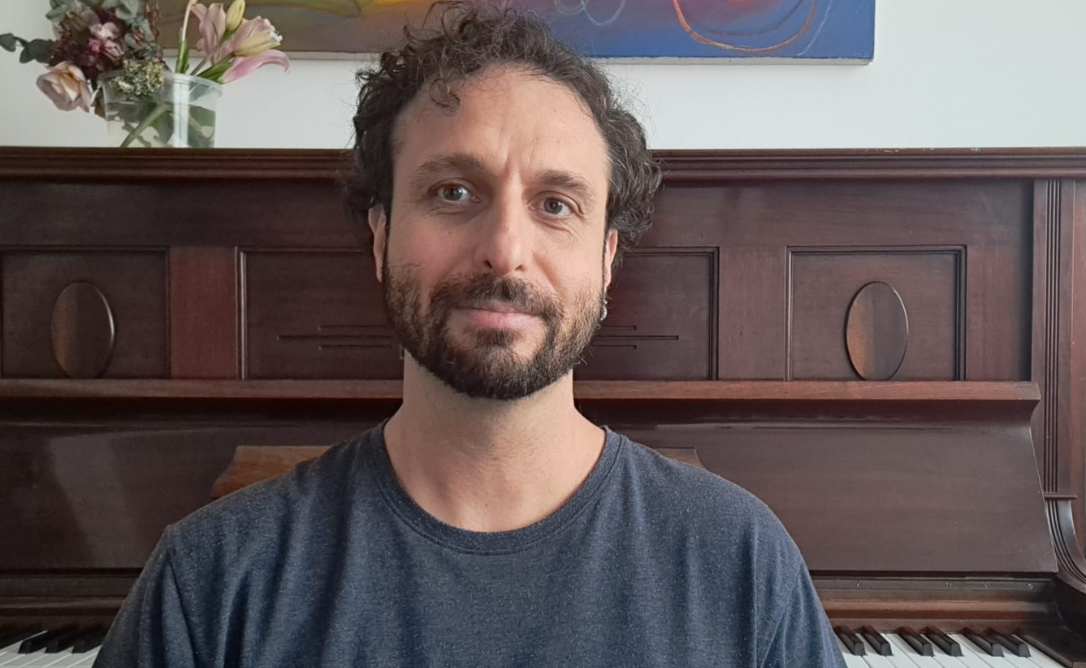
Inspired by the psychoanalytic concept of free association, writer Ivan Hegen presents in *Free Association* a collection of short stories that blends memory, fiction, and self-analysis to explore the contradictions of human experience. Between existential crises, affective relationships, social conflicts, and reflections on identity, the work constructs intimate narratives that move between humor, anguish, and political questioning. In an interview, Hegen discusses the process of transforming experiences into literature, the influence of psychoanalysis on his writing, and his desire to provoke reflection and freedom of thought through art.
“Free association” draws on a concept from psychoanalysis to structure the narrative experience of the book itself. At what point did you realize that this idea of speaking without censorship, almost as if on a couch, could also be a way of constructing fiction?
I remember reading it with great interest. there issome time,Philip Roth’s “Portnoy’s Complaint” is narrated as if it were a session with a psychoanalyst. It’s a book filled with sexual compulsions, guilt, and neuroses. It was a learning experience, but also a reunion with my family context, being the son of psychoanalysts and the ex-husband of a colleague of my parents. Right in the first story of “Free Association,” the words flow together without much hierarchy or censorship, with the narrator on a couch, where marital intimacies clash with Oedipal ruminations.
Throughout the work, memory and invention seem to constantly intertwine. What interests you most about this place where real life ceases to be merely a memory and becomes literary material?
Art is interesting to the extent that it establishes a good conversation with life. I avoid completely confusing life and art, so as not to falsify my reality and so that fiction maintains a minimum distance from which dialogue allows me reflection. I like this exchange, this contact, this friction. But it may be that, for my reader, it is often not possible to perceive the boundary between fact and invention. For some people, that may be the charm. A friend who read the book refused to know.whichSome parts would be based on real events, while others would be more invented. This is someone I trust.;Iwould enterIn a confessional tone, but he preferred uncertainty, and I respected his desire to enjoy the book in an undefined zone.
You write that it’s impossible to emerge unscathed from the attempt to transform life into art. What does this process of writing about fragilities, desires, and contradictions also demand of you as an author and as an individual?
As I write, I try to think as little as possible about how future readers will react, especially the real people who inspire the characters. I find out later.NIn this “Free Association” piece, I talked quite a bit about family members, and I think I caused some discomfort, but overall, I was forgiven. They didn’t condemn writing that seeks to be much more self-analysis than aggression towards anyone involved. I think my writing process isn’t so different from a therapeutic process, though.That is,It involves moments of anguish in the face of certain ghosts and traumas, but it also leads me to some development and, at times, some relief. There is suffering, but also a lot of pleasure in this work with words.
The stories navigate between personal crises, sociopolitical issues, eroticism, and seemingly banal scenes from everyday life. How do you find unity in a book so permeated by such diverse experiences and tensions?
If there is unity in the stories in the book, it is a relative unity, because I explore various facets of myself, although, ultimately, I don’t cease to be who I am. I’m not seeking a style.;I haven’t created a formula that I repeat or that makes my writing immediately identifiable. Perhaps a constant of mine is trying to orchestrate the psychological dimension with the social dimension, without neglecting language, the rhythm of each sentence. On the other hand, when writing, I want to surprise myself. For example, in the short story “Marital Vacation,” I wanted to explore eroticism from the perspective of a female narrator who takes revenge on her unfaithful husband. In this fiction, I distance myself from my own voice, but not from my personal issues, my questions.
In stories like Divã online and Mal parido, there is a clear focus on the present, on political unease, and on social inequalities. To what extent do you think literature also needs to confront the time in which it is written?
In 2018, Wilson Alves Bezerra published “Vapor Barato,” a dialogue between therapist and patient where psychological problems intertwine with anxieties in the face of the anti-democratic threats of that same year. In my “Online Couch,” I did something similar, with the difference that a poor internet connection would cause interruptions in a communication that crossed the unconscious with politics. Just as in Wilson’s excellent book, I worked on psychological and sociological issues together, in addition to romantic ones. In my short story “Mal parido,” an architect finds herself fascinated by a homeless man and assesses how much she could overcome the social distance to allow herself to be touched by a greater affection. The challenges intertwine.
The book also looks very directly at youth, shyness, the desire to belong, and the pressures to fit in. What do these older ghosts still tell your work today?
During childhood and adolescence, I suffered from almost pathological shyness. I had a few friends, but I was very introverted, reserved in my gestures and words. What helped me gradually come out of my shell was contact with culture. From a very young age, I loved to draw, and my funny little scribbles helped break the ice.generatingSome comments. As I approached adolescence, I discovered a taste for rock music, and while before I was somewhat indifferent to any kind of music, I discovered that the fast-paced rhythm pushed me forward.theTo move around more. And, Without a doubt, the practice of writing, even though it is a solitary activity, has given me a more developed self-image, allowing me to constitute myself more strongly as an individual. None of this is confined within me; it continues to develop, reappearing in what I write and in what I live.

As the son of psychoanalysts, you grew up surrounded by a language focused on listening, the unconscious, and human contradictions. How did this emotional and intellectual upbringing shape your way of observing characters and conflicts?
It was kind of strange, but also interesting to hear my father explain the Oedipus complex when I was around ten years old. I don’t know if I was mature enough to learn about parricide and incest, especially considering he would be directly involved in the problem. Both hehow much of mineMy mother taught me, very early on, to consider the unconscious and the complexity of the human being, immediately discarding any Manicheanism and any other view.totalizingI didn’t have much chance of growing up “normally,” but, since I don’t believe in normality either, I’m partly grateful for the weirdness that helped me stray from the more obvious paths.
You say that through art you seek to incite questioning, anti-authoritarianism, and greater freedom between thought and action. What do you hope to awaken in the reader at the end of “Free Association”: unease, identification, displacement, or perhaps a new way of listening to oneself?
In my PhD in Literature, which I began this year, I am researching the work of the great Elvira Vigna, an author who has some recognition, but who should be read and studied more. I see in Elvira a very consistent anti-authoritarian stance, which is evident in the content and form, in order to delegate to the reader the responsibility for what they read.
Like her, I avoid narrators who simply spout truths; I seek to give space to uncertainties and nuances. Even believing that I have something to say, and even taking a stand when I deem it necessary, I understand that I respect readers more by leaving them the task of deciding what to make of the words thrown at them.
Follow Ivan Hegen on Instagram