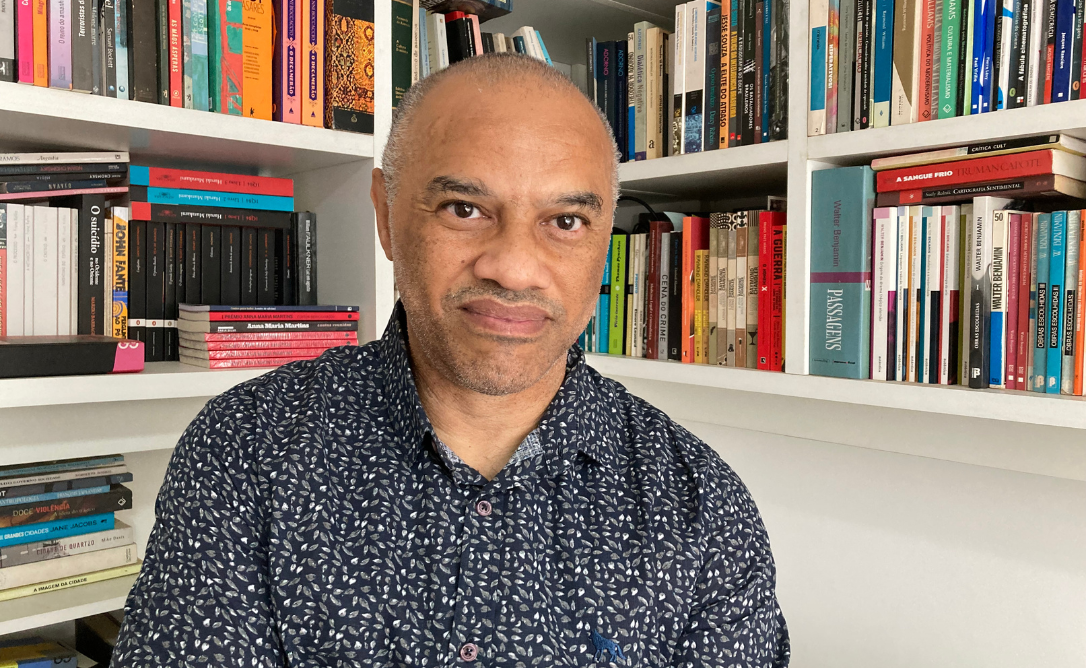
In “There Is No Chance in Hell,” author Vinícius Ferreira takes the reader on a disturbing investigation set in the interior of Minas Gerais, where the apparent tranquility of a town is shattered by a brutal crime involving three children. Following detectives Bartolomeu Franco and Cenoura, the narrative delves into a world of religious fanaticism, social silence, and inequality, revealing a Brazil marked by secrets and omissions. In an interview, the writer discusses the construction of a thriller that combines police suspense and social critique, challenging the ethical boundaries of its characters and the reader themselves.
There is no such thing as chance in hell, part of a brutal crime in a city marked by an appearance of tranquility. What most interested you in exploring this contrast between the calm of the countryside and the violence that hides behind it?
The idea was precisely to construct a story in which violence itself would be used to shatter the illusion that peaceful cities exist.
The image of the three children found in the shed is very powerful and disturbing, even more so because of the symbolic elements surrounding the scene. How was it to construct this crime in a way that would have an impact without losing the human depth of the story?
When investigator Bartolomeu Franco arrives at the crime scene, he notices that the expert is handling it with great nonchalance. That’s when he begins to get truly shaken. How can someone maintain such nonchalance in the face of something so brutal, produced with such sophistication? The question leaves him perplexed, but aware that however violent it may seem, it will still be a human act and that the reasons for the crime must be sought among human motives.
Bartolomeu Franco is not just an investigator facing a difficult case, but also a man plagued by guilt, burnout, and family conflicts. What led you to create a protagonist so morally and emotionally wounded?
I’ve always been fascinated in literature by those characters whose every tiny gesture seems like a battle against the abyss. Those whose soul is best translated as a swampy field that threatens them with the possibility of drowning. Deep down, Bartholomew wants to discover what tortures him to the point of making him incapable of stability. He wants to know the reasons why hell chose him. On the other hand, I think that every homicide investigator inevitably creates demons. Innocence and belief in the natural goodness of humanity die along with the victims of the crimes they investigate.
Bartholomew’s relationship with his father, marked by disapproval, distance, and dementia, adds a very sensitive layer to the novel. How does this intimate dimension interact with the brutality of the investigation?
I think his father’s illness leaves Bartolomeu with a feeling that there’s no going back and fixing the life that could have been but wasn’t. When he doesn’t fix the picture on the wall, which his father didn’t have time to fix before being hospitalized, he seems to be signaling this feeling. He seems to be asking himself, “What have we done with this life?” and this opens up a huge void in his chest, like someone who has lost something precious and, at the moment of being ready for a second chance, begins to lack the memory and time to nurture affections. I think this motivates him to want to solve the crime, repairing an order that seems very unjust to him.

The book points to a society where heinous crimes can happen in plain sight, while many people choose not to see them. To what extent is this story also a critique of social silence and indifference to the suffering of others?
This is a very important issue. In our time, marked by visibility and connection, paradoxically, there is immense selectivity surrounding which causes are or are not worth mobilizing for. I think the book also follows this path, addressing the issue of silence as a more comfortable option for maintaining the established order.
By bringing corruption, social inequality, abuse of power, and religious fanaticism into the plot, you construct a very Brazilian noir. What does noir offer you as a language to talk about this dark country that we often prefer to deny?

Brazil is only a sunny country in appearance and in a mythology created for export. What we actually have is a long tradition of avoiding looking in the mirror and believing that turning on lights might bother both the living and the dead. We construct images of the country and our culture that do not correspond to our real experiences, to our history of violence, exclusion, and exploitation. Noir fiction makes it possible to visit the reverse side of these mirages of the country.
The book’s origin, stemming from a childhood story about a hidden, nameless corpse, is very striking. How did that memory remain vivid in you until it transformed into a novel?
I often say that I have some obsessions and that I deal very poorly with them. Perhaps fiction has always been a way of circumventing their effects on me. I heard this story, told by an uncle of mine, when I was still a boy, and it remained unsettling for many years. I couldn’t understand or accept the fact that no one ever claimed the body, investigated, or even discussed the story. It’s as if that person never existed. The house was demolished, the kitchen renovated, the bones thrown in a garbage bag. My uncle told me to forget about it. It wasn’t worth losing sleep over a story without a solution, without an ending, without a name, a face, nothing. The book shows that I couldn’t.
Your book seems to raise a profound question: how many acts of violence go unnamed, unjustly treated, and unremembered? What do you hope to provoke in the reader by presenting them with such an unsettling and ethically challenging narrative?
If the book is fortunate enough to find a reader, I sincerely hope that, upon finishing it, they will not be able to remain indifferent to it.
Follow Vinícius Ferreira on Instagram