In “Quilombo: Tales and Recipes,” writer Du Prazeres transforms childhood memories and ancestral knowledge into a work that connects literature, gastronomy, and identity. Inspired by the stories and flavors experienced alongside his grandmother in a quilombo (a settlement of escaped slaves) in Rio de Janeiro, the author presents narratives that reclaim traditions, celebrate trajectories, and reflect on the experience of Black people in Brazil. In an interview, Du discusses the process of transforming affection, history, and resistance into a book that transcends the page and extends to the table.
“Quilombo: Tales and Recipes” stems from very intimate memories, linked to her grandmother Nair, to cooking, and to family stories. At what point did you realize that these flavors and memories were also literary material?
I’ve always cooked and I find fascinating works that somehow deal with the theme of food, such as the detective novels by the Italian Andrea Camilleri and the Spaniard Manuel Vázquez Montalbán, the books of our Jorge Amado and the Azorean writer Joel Neto. I understood, therefore, that my family’s recipes could be transposed into literature. In a way, cooking was how my mother and grandmother narrated their stories; what I did was adapt the stories to this “literary” production of theirs, publishing them in text format.
The book unites two very powerful dimensions: words and food. What does gastronomy allow you to say about ancestry that perhaps narrative alone could not achieve?
Gastronomy and literature are two powerful forces very present in my life. Perhaps food achieves a more direct connection with the body than written narrative. In the book, one of the stories talks about the broth of old mulatto (a type of salted catfish) which, in our tradition, gives strength and aids in the recovery of the sick. It’s a proven ancestral truth because the fish has anti-inflammatory properties, is rich in omega-3, selenium, zinc, and is a source of vitamin B12. Literature also heals and strengthens through other, less direct paths. But it eventually reaches us, if we are open to it.
There’s something beautiful about the idea that cooking is also a way to transmit memory, affection, and identity. What did your grandmother teach you, even without necessarily turning it into an explanation?
My grandmother taught me about ethics, respect, and presence. Even in silence, there was a lesson in the way she chose the grains, in the time she spent cooking over low heat, as if listening to the needs of the food to fulfill our own needs. From her I learned patience that doesn’t rush, attention to cycles, and above all, generosity that is offered without fanfare. Cooking, for her, was more than preparation: it was a pact of care, a gesture of giving to the other. My grandmother embodied in that stove the same concepts of respect for the Other that the Franco-Lithuanian philosopher Emmanuel Levinas presents in his books on the Ethics of Alterity. Her wisdom didn’t come in words or theories; it came in her body, in her attentive gaze, in the dish made and full of affection given to whoever was hungry, whether known to her or not.
You start from a quilombo that no longer physically exists, but continues to live on in memory, culture, and writing. How was it to transform this absence into a presence within the book?
The Quilombo of Santo Antônio de Jacutinga has suffered an urban erasure, so to speak, but not a historical one. Its traditions and teachings endure, assuming a different kind of territoriality. The book makes it clear that the heart of the quilombo still beats, transfigured into memory, identity, and hope. The recipes and stories are rooted in ancestral voices, which, fortunately, for now, cannot/do not want to be absent from our daily lives, as they remain alive and unwavering. Belonging to a quilombo is as natural as the cycle of food and is infinite because it is a state of mind.
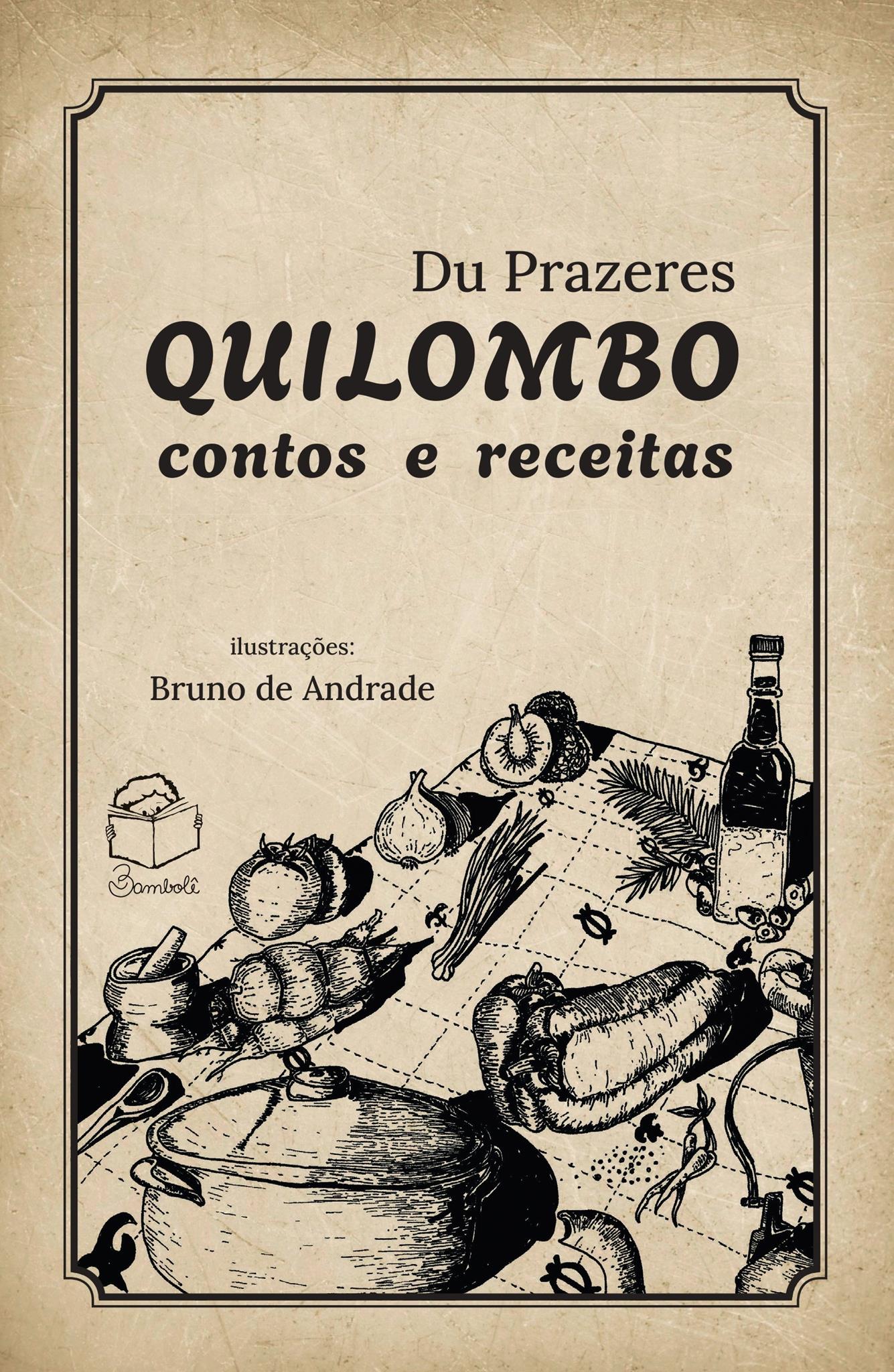
By presenting stories accompanied by traditional recipes, you seem to invite the reader not only to read, but also to feel, imagine, and even taste this heritage. How did this idea of uniting literature and cuisine in such an organic way come about?
Within this project, words and food are inseparable. Similarly, Bruno de Andrade’s images and the presentation by quilombola chef Leoídia Carvalho also form part of this menu. I want the reader to read the book as if they were sitting at the table with me, savoring stories, food, affection, and thinking together. Sometimes one of us cooking and talking about the book or what it evokes, sometimes the other doing the same, in communion. This encounter between words and seasoning, between readers, gourmands, and cooks seems natural to me and a way of pointing towards other horizons of struggle, seeking more solidarity and empathy, so that society may achieve social equality.
Your work also broadens the perspective on quilombola traditions and the trajectory of Black people, addressing leadership, hunger, resistance, and collectivity. What most motivated you to write from this historical and political dimension?

One of my motivations was to show that Black resistance doesn’t exist only in pain and melancholy. There is resistance in creation, in the development of anti-racist thought, in encounters, in celebrations, in affection, in fraternity, and in love. Each story and each dish was conceived as a tool for valuing Black culture and broadening the debate about the socioeconomic conditions to which Black people have been historically relegated. As previously stated, it is a book aimed at integrating people into an anti-racist and more just community.
The griots appear as central figures in this transmission of knowledge. Do you feel that “Quilombo: Tales and Recipes” is also, in a way, a gesture of continuity of this ancestral current for new generations?
I am not a griot; no post-doctoral course can compete with ancestral knowledge and the wisdom of the elders. But I believe my book aligns with the ideals they defended because I have always listened to and respected them. The teachings of the elders were invariably passed down orally. By immersing myself in listening to them, I managed to transpose some of that wisdom, those stories, into written text. Times have changed, and the dissemination of information is multimodal; therefore, the book does seek to present or reinforce ancient knowledge for new generations.
Knowing that the book was selected for the 2026 Literary Kit and will reach students in the municipal school system gives it an even more symbolic dimension. What do you hope to awaken in these young readers by putting them in contact with this affectionate and powerful Afro-Brazilian memory?
I wanted these readers and citizens in training to recognize themselves in the stories. I wanted them to turn to their elders at home and read them with openness and respect. The stories of grandparents, parents, godparents—memories that cannot be silenced because they are alive. I wanted them to understand that literature is for everyone, to perceive ways to break with any attempt to make them subordinate, to marginalize them. I wanted them to write their own narratives and lives and exchange this knowledge with each other. I wanted many things, but if it’s not to try to make all this real, there’s no reason for my book to be published.
Follow Du Prazeres on Instagram