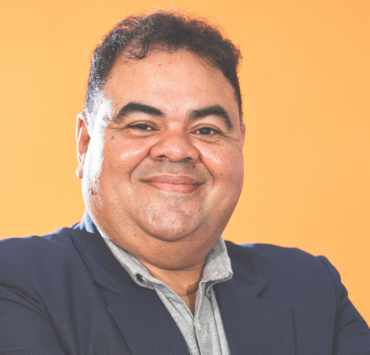
In “What goes on in a doctor’s head?”, the radiologist Rodrigo Silva Müller offers a humorous reflection on the behind-the-scenes aspects of contemporary medicine, breaking with the image of the infallible specialist. Through chronicles that move between daily hospital life, the influence of social media, and the challenges of the digital age, the author reveals the contradictions, pressures, and dilemmas faced by healthcare professionals. In an interview, Müller discusses the need to reclaim the human dimension of care in a scenario increasingly marked by algorithms, bureaucracy, and misinformation.
“What goes on in a doctor’s head?” stems from a clear desire to dismantle the image of the unwavering and distant doctor. At what point did you feel it was time to trade the pedestal for a more honest and human conversation?
In truth, there wasn’t a single moment when I decided to trade the pedestal for a more honest conversation; it was more of a succession of small annoyances over time. I began to realize that the way medicine appears in the media, on social networks, and even in informal conversations doesn’t quite correspond to what we experience in our daily lives. There’s this idea of a doctor as someone always confident, always right, almost immune to doubt, and that’s simply not true. Gradually, I started writing texts about very concrete situations from our routine and realized that, even though they were different stories, they all revolved around the same tensions: our relationship with the human body, with the patient, with the disease, and with our own limitations. The book’s title stems from this, not from a ready-made answer, but from an attempt to show this thought in motion, less on a pedestal and more behind the scenes.
Your book seems to show that real medicine is made less of absolute certainties and more of complex choices, limits, and listening. What else interested you in revealing about this less idealized side of the profession?
Medicine deals with one of the most complex systems in existence, the human body, and in complex systems you never have total control. There are variables we master, others we are still learning about, and many we don’t even know, and this completely changes the logic of the profession. Medical knowledge is not built on absolute certainties, but on probabilities, mainly from clinical studies. We work with chances, not guarantees. Of course, with the advancement of science, these probabilities improve greatly and medicine has evolved impressively, but it still remains a science of controlled uncertainty. And there’s a point I was very interested in highlighting: the patient is not just biology; they are psychological, social, historical, bringing context, beliefs, and the time in which they live. So, ultimately, the book tries to show that good medicine is not just technique, it’s the ability to integrate science, context, and listening.
As a radiologist, you occupy a very particular vantage point within the hospital environment, almost like someone who sees what goes on behind the scenes from the inside. How did this position influence the perspective you developed in the book?
Radiology has placed me in a curious position, because often our direct interlocutor is not the patient, but another doctor, and this means that, in addition to looking at exams, we observe the decisions, doubts, and thought processes of our colleagues. This already creates a privileged behind-the-scenes position, and in my case, this expanded when I worked as a hospital’s technical director, participating in meetings, clinical discussions, and difficult decisions, which gave me very direct contact with the real workings of medicine. Over more than two decades working in radiology, this has accumulated like a diary, a collection of scenes, patterns, and behaviors, and the book is born largely from this place, not from the center stage, but from someone who has spent a considerable amount of time observing what’s happening behind the scenes.
You use humor to talk about serious topics, such as professional vanity, bureaucracy, burnout, and misinformation. Why did laughter seem like a powerful way to address such sensitive issues?
Humor, for me, is not just a tool, it’s almost a language, because it allows you to say difficult things without alienating the reader and creates an openness that makes the text more accessible. I understand that it’s a sophisticated way of dealing with stressful and contradictory circumstances. But there was a very clear effort to never use humor on top of the patient’s suffering or the illness itself; humor appears behind the scenes, in our contradictions, in vanity, in bureaucracy, and in the small absurdities of routine. Ultimately, it reduces the distance, takes the doctor out of that inaccessible place and brings them closer. This, paradoxically, increases trust, because the reader perceives that there is a real person there, not an idealized figure.

There are some very striking images in the work, such as the “Federative Republic of the Surgical Block” and the “WhatsApp Uncle.” What do these figures ultimately say about the contemporary challenges of practicing medicine?
The Federal Republic of the Surgical Block stems from a fond memory of a time when I still considered becoming a surgeon, when the environment was more hierarchical and often marked by arrogance and harsh relationships—something that has changed considerably today with a more regulated and professional practice. This image helps to illustrate how medical culture evolves, not always in a linear fashion. The “Uncle on WhatsApp” is another figure, almost a universal character who mixes affection with misinformation, good intentions with completely misguided certainties, and this creates a new challenge for medicine, which is no longer just about treating disease, but about dealing with competing narratives, often more seductive than science itself.
When you talk about “Dr. Algorithm,” it becomes clear that technology can be very helpful, but it doesn’t replace context or care. Where do you see the boundary between technical efficiency and human presence today?
Technology will profoundly transform medicine, and in many ways for the better, taking over repetitive tasks and freeing up time. The question then becomes what the doctor does with that time. What differentiates the doctor from the machine is not the ability to process data, because the machine already does that very well, but rather the context, the listening skills, and the capacity to understand the patient as a story and not as a set of variables. The more efficient technology becomes, the more important becomes what it cannot reproduce: the human presence.
The book also touches on a sensitive point: the mental health of professionals trained under this “pedagogy of exhaustion.” How much further does medicine have to go before it pays closer attention to those who care for others?
This change is already happening, silently, driven by the new generations. Younger doctors have less tolerance for training models based on exhaustion and an almost heroic idea of suffering. They leave on time, speak openly about burnout, and reject the romanticization of sacrifice that the previous generation normalized. In a way, they are educating the educators, and this is beginning to put pressure on a system that has long fed on self-sacrifice as if it were a virtue. The road is still long, but the pressure for change is no longer coming only from outside medicine. It’s coming from within.
You argue that true wisdom also lies in knowing how to say “I don’t know.” In a profession so closely associated with authority, why might admitting doubt actually be one of the most humane and ethical gestures a doctor can make?
Medical authority has a legitimate role. It organizes care and provides reassurance at a time when the patient is vulnerable. But it has a limit, which is the very limit of medicine, and when a doctor maintains a certainty that does not exist, they are not being stronger, they are being less honest. Acknowledging doubt, when it is real, does not weaken the relationship with the patient. On the contrary, it makes it more genuine. Trust does not come only from the projected security, but from the coherence between what is known and what is said. I believe that the most ethical gesture of a doctor is precisely to clearly recognize the limits of their knowledge and, above all, the limits of their knowledge.
Follow Rodrigo Silva Müller on Instagram