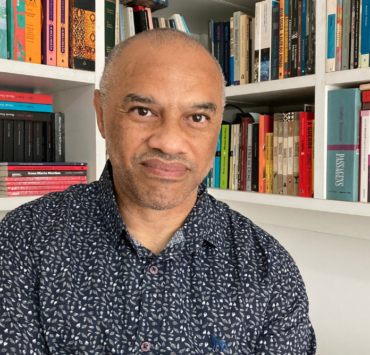
In “Death on the Border,” author Humberto Pimentel constructs a crime novel that challenges certainties by exploring the boundaries between right and wrong. Following the journey of a retired forensic expert who becomes a lawyer and takes on the defense of a police chief accused of a crime, the narrative delves into a universe of ambiguities, where ethics, truth, and justice prove unstable. In an interview, Pimentel discusses the construction of a plot that combines investigation, existentialism, and a critique of the system, inviting the reader to question their own convictions.
Death on the Border starts from a very unsettling idea: that, on the border between right and wrong, almost every truth can be challenged. What motivated you to write a story anchored precisely in these gray areas?
We live immersed in narratives. The idea that human beings possess antagonistic impulses within themselves was the seed of this vision. Internal conflicts and the circumstances of each person’s life can lead to decisions that are only justified from a certain point of view. In extreme situations, there may be an area of moral grayness, where not everyone would act in the same way. Each person has their own truth, but must be responsible for their actions, even if they believe they are acting correctly. Some truths are provisional.
Armando is a character marked by loss, experience, and a darker view of existence, while Noemi seems to represent hope and faith in people. How was it to build such a contrasting yet complementary duo?
This is one of the pillars of the plot, hidden in the subtext: contrasting and complementary visions of existence that, throughout the story, evolve and tend towards convergence. Armando and Noemi interact with each other and with the events of life. With this, each takes a step towards the center, towards a reasonable middle ground, but perhaps this is not entirely possible. This idea has always been present, since the construction of the first traits of each character, but the narrative imposed an unexpected and challenging evolution. Armando is in a wheelchair, and his physical limitation makes him more dependent on Noemi’s energy and hope.
The fact that Armando is a former forensic expert who now works as a criminal defense lawyer already puts him in contact with different sides of the truth. What were you most interested in exploring in this change of role within the justice system?
Armando is not just a former forensic expert; he was one of the best when he was active. He was a professor and specialist in invalidating flawed expert reports. He uses his technical knowledge to bring a scientific perspective to topics such as ballistics and evidence. As a criminal defense lawyer, he brings this background, which is uncommon among legal professionals. All of this greatly broadens the range of possibilities and allows for more exploration of moral ambiguity. His profound knowledge of forensic science makes Armando a lawyer with a multidimensional view of the crime scene and the suspects.
Detective Tonho enters the story as someone seeking help, but he also harbors obsessions, vanity, and vulnerabilities. In a novel like yours, what makes a character truly suspicious: what they do, what they hide, or how they are perceived by others?
A little bit of each of these clues. In Death on the Border, because we have an omniscient narrator, it’s possible to explore various points of view. The reader can analyze all these aspects and draw their own conclusions. Tonho is a complex character, an excellent suspect, as one might suppose. But, as always, the truth is never so obvious. Perhaps the most important thing is what is hidden at first, or what is hinted at, but which may or may not materialize. How far would a police chief go to hide his weaknesses?

Your book breaks with the more traditional logic of clearly defined heroes and villains. Do you believe that this moral ambiguity is precisely what brings fiction closer to real life?
I believe so. The tradition of the detective novel began with protagonists who displayed an expected ethical conduct. What mattered to the reader was the triad of crime (mystery), investigation (logic), and elucidation (surprise). The protagonist’s deductive ability was the main point of the plot, which generally didn’t concern itself much with the psychological depth of the characters. However, in real life things aren’t like that, and the reader knows it. Therefore, the work falls within the neo-noir subgenre, where a perfect hero isn’t expected, but rather the real man, who in a way survives on the fringes of the system.
The work also offers existential reflections on destiny, fatalism, and free will. At what point did you realize that this criminal investigation also needed to be, in a way, an investigation into the human condition?

This idea was present from the beginning, but as the characters deepened, it became inevitable to delve into the human condition. The protagonist’s personal circumstances provide ample room for this. Armando is a man who has lived a long life, despite not yet being elderly. He has suffered setbacks and had some success, so all of this has shaped his personality. Noemi, his assistant, is a young adult, still devoid of emotional scars. The contrast between the two perspectives is what makes the book stand out, but it doesn’t overshadow the search for those responsible.
His legal knowledge certainly permeates the construction of the narrative and investigative realism. How to balance the technical precision of law with the literary and emotional tension of the crime novel?
The book is primarily aimed at an audience without a technical background in law. Therefore, legal aspects are presented in a way that allows a layperson to see some real-life behind-the-scenes scenarios of a criminal defense lawyer. Finding the right balance was a challenge, as there was a strong temptation to produce a text that would only be appreciated by those initiated in criminal law practice. The plot is driven by evident and hidden mysteries, suspense, philosophical and religious reflections. The reader will be able to imagine, beyond the book, the real behind-the-scenes workings of how a crime can be orchestrated and uncovered by someone with expertise in forensics.
By inviting the reader into a world where certainties crumble at every turn, what do you hope to provoke at the end of the reading: doubt, discomfort, reflection, or a new way of looking at the idea of justice?
The book’s premise leads the reader to reflection and, to a certain extent, discomfort. It delves into the protagonist’s soul, a soul led by life to a dark view of existence. Perhaps the investigation into the workings of Armando’s mind is as revealing as the search for those responsible for the crime. Among the many metaphors, let’s say there’s a parallel between the perception of justice that can be done in society and the idea of justice that a complex character might carry within themselves. I want the reader to close the book and question the validity of revenge if there is no justice.
Follow Humberto Pimentel on Instagram