
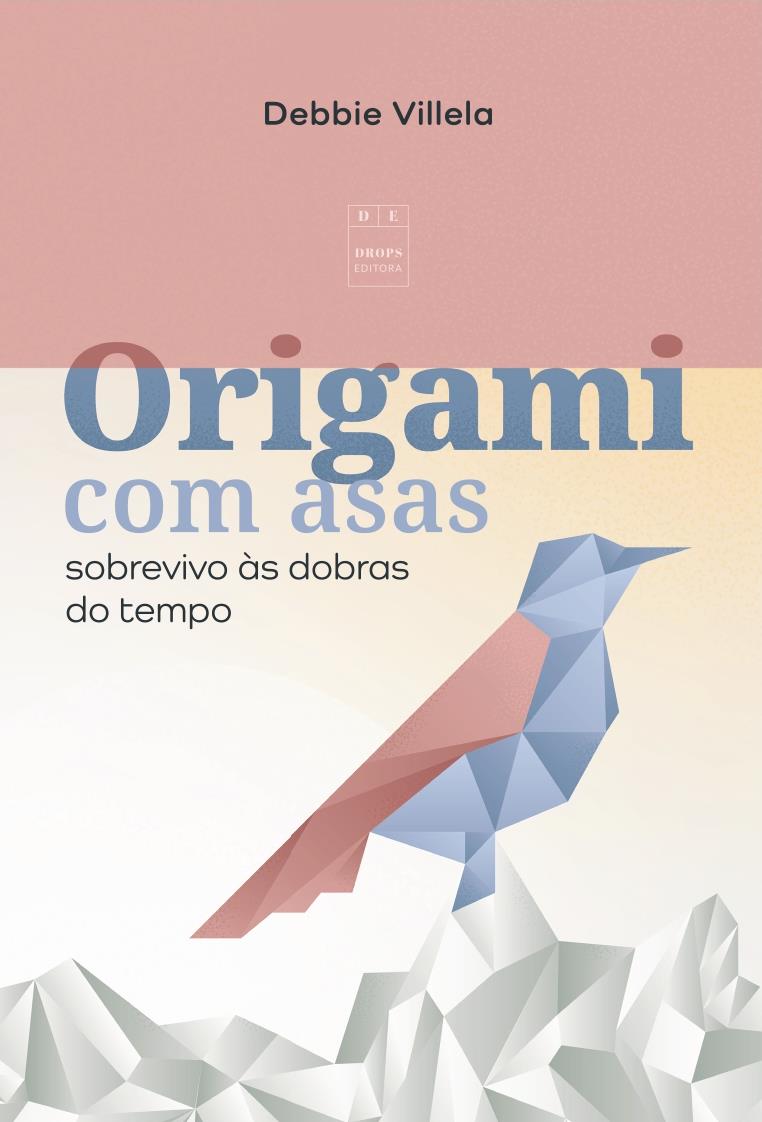
In *Origami with Wings – Surviving the Folds of Time*, Debbie Villela constructs a work marked by the delicacy of observation and the strength of human transformations. Using the metaphor of origami, the author intertwines memories, affections, losses, and new beginnings in texts that move between the intimate and the universal, revealing how each fold of life leaves marks, but also opens new possibilities. In an interview, Debbie reflects on the process of transforming experiences and feelings into writing, proposing a sensitive look at resilience, identity, and the beauty contained in the small scenes of everyday life.
In Origami with Wings, you use folding as a metaphor to talk about time, loss, and transformation. At what point did this image begin to so effectively capture the essence of the book for you?
The image of the fold didn’t emerge as a ready-made concept; it happened gradually. At some point, I realized that everything I was writing was going through this process of being marked, pressed, transformed. The fold doesn’t erase what came before; it transforms. When I understood that time does this to us—it doesn’t destroy, it rearranges—the metaphor ceased to be a device and became the structure of the book.
Your writing seems to find depth in very simple everyday scenes, like a childhood memory or the silence of an empty house. What interests you in this encounter between the small gesture and the great emotion?
The small gesture interests me because it simply happens. And, in happening, it reveals what we didn’t plan, what we didn’t rehearse, what we probably don’t even understand. And it is precisely there that emotion appears with the most truth. An empty house, for example, doesn’t need explaining anything: it already speaks for itself. I think that everyday life holds what we try to avoid naming. Writing about it is a way of facing it without needing to dramatize it.
The book speaks of resilience without sounding like a prepared speech, but as something lived, felt, and experienced. How was it to transform such intimate experiences into a work capable of also engaging with the universal?
Transforming the intimate into something shareable required a kind of careful distancing. It wasn’t about exposing, but about elaborating. When the experience ceases to be solely mine and takes on form, rhythm, language, it opens space for the other to enter. Resilience, in this sense, doesn’t appear as heroic overcoming, but as permanence. To continue, even when hampered, is already a form of strength.
You have a background in fairly objective fields, such as Law and Advertising, but here you reveal a very sensitive and lyrical perspective. How do these different versions of yourself coexist within your writing?
These more objective formations haven’t disappeared; they organize thought. Perhaps they are responsible for the structure, the containment, for preventing the writing from getting lost. Sensitivity, on the other hand, comes from somewhere else, more difficult to control. The two coexist as a tension: one delimits, the other expands. And writing happens precisely in this unstable equilibrium.
The character Valentina emerges as someone trying to understand her own heart amidst romantic illusions and a desire for freedom. What does she reveal about fragility and maturity that a more confessional text might not convey in the same way?
Valentina allows for a shift in perspective. By speaking for her, I can observe from the outside what, if it were directly confessional, might remain excessively closed or indulgent. She carries contradictions without needing to resolve them quickly. Fragility, there, is a state to be understood, not a problem to be corrected. And maturity appears more as awareness than as a response.
There is a delicacy in the book that doesn’t deny the pain, but transforms it into language. For you, does writing function more as a refuge, a way to process things, or a new beginning?

Writing, for me, functions as a process of elaboration. Not in the sense of resolving things, but of giving form to what was previously diffuse. When I write, things cease to be mere sensations and become thought. This doesn’t eliminate the pain, but it prevents it from becoming amorphous. And, in a way, it’s already a new beginning, because what takes shape also gains the possibility of being repositioned within life.
The idea of including folds in the work creates a very symbolic experience between hand and word. How did the idea of uniting this manual gesture with the emotional journey of the book come about?
The idea of folding paper stems from this need to make an internal process concrete. Writing is an invisible gesture for the reader, but folding is physical, requiring time, attention, and repetition. Combining the two was a way to bring the reader closer to the experience of the book. As if to say: it’s not just about understanding, it’s about doing, even if symbolically, with one’s own hands.
After traversing memories, losses, reunions, and reinventions in Origami with Wings, what do you hope the reader will feel upon closing the book: comfort, recognition, courage, or a desire to also redesign their own form?
I don’t expect a single answer from the reader. But if something could remain, it would be the feeling that it’s possible to continue even without being whole. Our scars, instead of making the future impossible, make it denser and more complete. I believe my book offers the relieving understanding that no one needs to be completely fixed to move on. Sometimes, it’s enough to accept the form one has now and, from there, create another possibility.
Follow Debbie Villela on Instagram