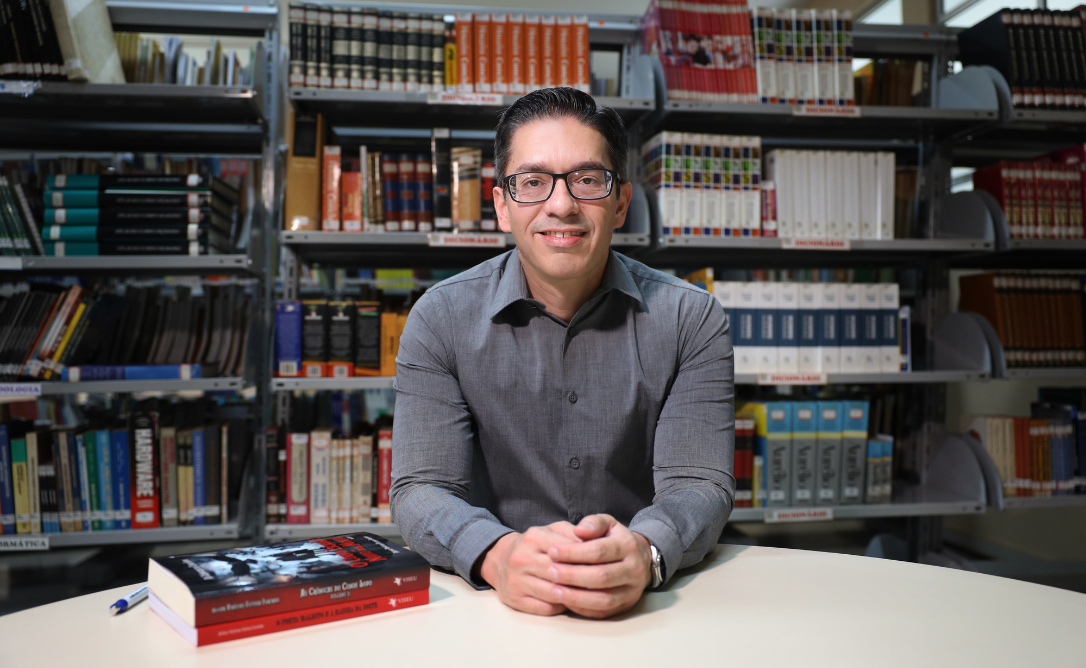
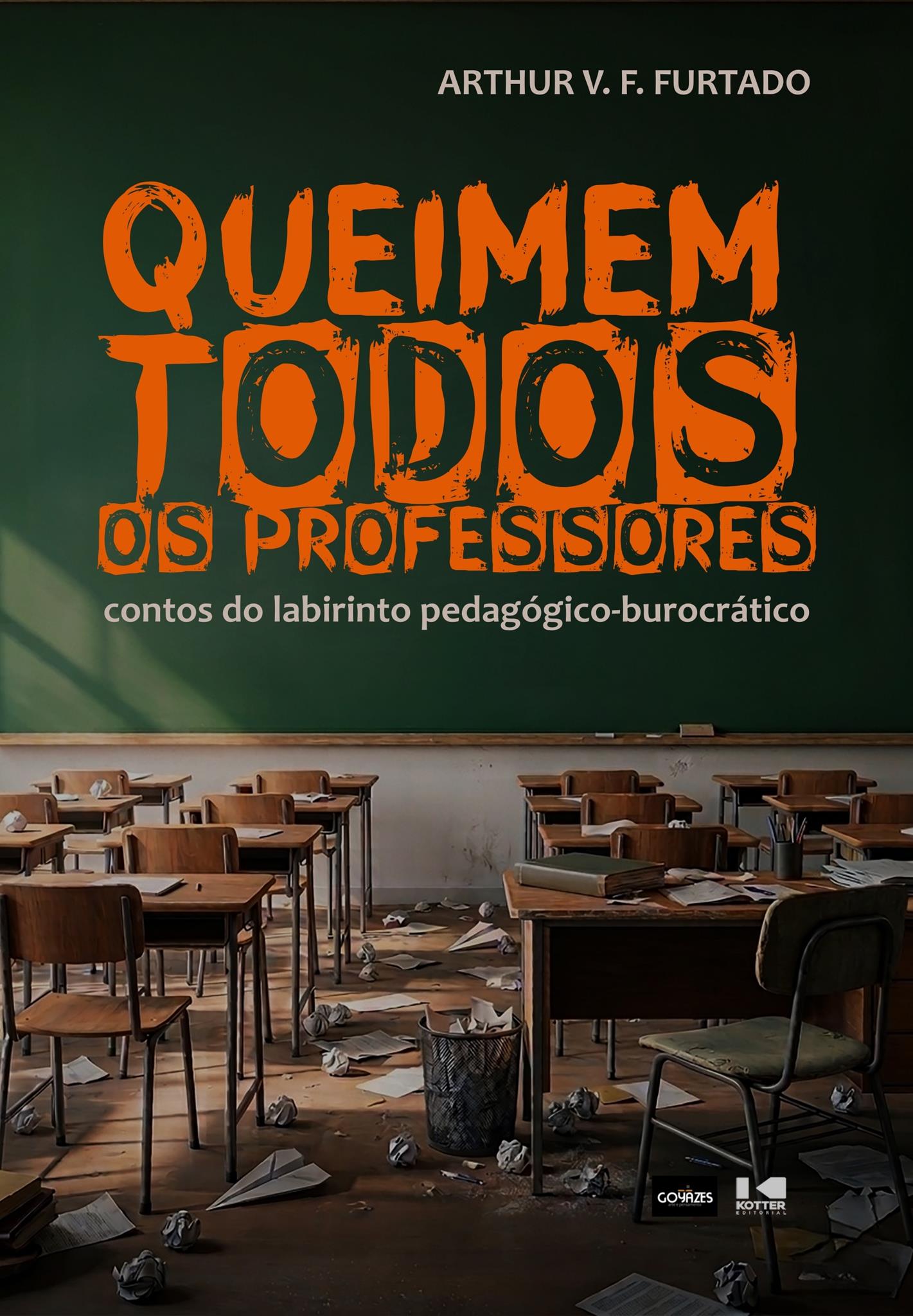
In a society where teaching has become an act of resistance, writer Arthur V. F. Furtado uses fiction to reflect on the challenges faced by contemporary education. In this book of eight interconnected short stories, the author imagines a future in which schools have been emptied of their primary function and teachers are seen as enemies of a system that rejects knowledge, authority, and critical thinking. Inspired by his experience as a teacher and researcher, Furtado addresses themes such as the precariousness of education, violence against educators, and the impacts of extremist discourse, inviting the reader to reflect on the value of education and the transformative role of teachers in society.
“Burn all the teachers” is a powerful, almost unsettling slogan to read. At what point did you realize you needed to begin the book with such a direct provocation about the place of teachers in society?
The persecution of teachers has been intensifying both inside and outside schools, reminding me of accounts of witch hunts and the hysteria of the Maoist period. Currently, we have a failed and precarious educational system, where all indicators are terrible and no solution is presented to guarantee the desired quality. Faced with such negligence, the perfect scapegoat has been found: the teacher. Even when ill, exhausted, and without support, they assume ever greater responsibilities, while being insulted, stigmatized, and undermined in every way. Thus, the book’s title serves as a cry of warning: “Reader, see what they are doing to our teachers!”
In the work, CULPE emerges as a dystopian force, but one very close to real debates about education. How was it to construct that boundary between fictional exaggeration and concrete criticism of the education system?
CULPE stands for “Pedagogical Cult,” because many of the current problems were created by fanatical academics who imposed their pseudoscientific ideas on public education policies. This group is quite influential and holds a view contrary to school knowledge, explicit teaching, and the application of scientific evidence to the field. Furthermore, it actively works to erode school rules and the authority of teachers, seen as forms of authoritarianism and oppression. Opportunistic politicians and ambitious bureaucrats complete the group. In real life, CULPE doesn’t formally exist as a group or organized entity, but it continues to act to destroy what little remains. In fact, I didn’t need to exaggerate much.
You mention that the book stemmed from your doctoral studies and your experience as a teacher. What did fiction allow you to say about education that perhaps an academic text couldn’t achieve in the same way?
Fiction provided a channel for me to share my professional life and express my anxieties as a Brazilian teacher, without the constraints of scientific methodology. This gave me the freedom to connect with many memories, fears, joys, and disappointments. Each teacher-character carries a piece of my experiences and readings, which lends a more realistic tone to the fictional prose. Even so, I made a point of beginning each story with an excerpt from a book or scientific article, in addition to including a great deal of data on education throughout the work, as a way to encourage further reading and informed debate.
In the work, teachers are persecuted by students, parents, and bureaucrats, but they still try to defend critical thinking. What do characters like Martha, Dirce, Henrique, and Eliete reveal about the silent resistance of educators?
Brazilian education only survives because many teachers persevere, even when tired and ill. I am not romanticizing suffering or the profession, but merely stating a fact. Like my characters, real teachers insist on teaching, even in the face of attacks on knowledge and explicit teaching; they continue to assess, even knowing that most students will pass against their will, without any pedagogical criteria; they continue to welcome and support students, even under fierce attack from many parents and bureaucrats; they continue to take money from their own empty pockets to meet the needs of crumbling schools, even knowing that the State shamefully fails to act.
The book criticizes attacks from both the left and the right, pointing to a constant blaming of the teacher. Why do you think the figure of the teacher has become such a recurring target in ideological disputes?
Both sides attack teachers, albeit in different ways. The attacks from the right are more direct and brutal, marked by insults, stigmatization—the infamous “indoctrinating teacher” and communist—and draconian cuts to funding for the education sector. Furthermore, they love to sell illusions like the civic-military school. On the other hand, the left attacks discreetly and silently, stripping teachers of their authority, normalizing school violence, and preventing the application of scientific evidence to the field. Their ideas are more sophisticated and, therefore, more dangerous. Education has many enemies, positioned on both sides of the trenches.
The absence of tests, rules, and hierarchies appears as part of the dismantling of schools in the work’s universe. In your opinion, what is the risk of confusing student empowerment with abandoning formative responsibility?

Inger Enkvist states that “a family and school education that accepts that young people do not strive is unethical because it does not prepare them well for the future,” while Hannah Arendt criticizes the fact that “modern education, insofar as it attempts to establish a world of its own for children, destroys the conditions necessary for their development and growth.” In an ideal world, tests and rules would not be necessary, and each student would arrive at school ready to construct their own learning; however, in the real world, in the absence of tests and rules, most students don’t even open their notebooks. Student protagonism should be encouraged—learning only occurs when there is mental engagement—but, as it has been imposed, it has become yet another weapon to undermine the work of teachers.
The stories blend formats such as lists, indexes, headlines, and recipes. How does this formal experimentation help to convey the chaos, bureaucracy, and fragmentation experienced within the school environment?
The teacher’s pedagogical work is constantly interrupted by the demands of state bureaucracy, materialized in reports, spreadsheets, lists, padlets, and all kinds of documentation. As time passes and educational results fail to improve, administrators, unable to solve real problems, invest in new forms of control over the teaching staff, resulting in more bureaucratic work. The problem is that this excess of paperwork is encroaching on pedagogical time, which should be dedicated to lesson planning, grading assignments, and teacher training. Thus, the lists, recipes, and commandments interspersed with these narratives illustrate the prevailing chaos and the weight that bureaucracy exerts on the teacher’s daily life.
Despite its dystopian and critical tone, the work seems to carry a very strong defense of education as a means of civic formation. After reading these eight stories, what kind of unease would you like to leave the reader with?
Despite the problems mentioned, throughout these fifteen years of professional activity, I have encountered dedicated and competent teachers and students with whom it was possible to establish a very productive partnership in favor of learning and education. I have also witnessed education changing the lives of many students, who have learned to love reading, philosophy, and history. Therefore, I remain certain of the essential nature of education for the integral formation of the human being. Finally, I would like readers to understand that the enemy is not the teacher, although it is very convenient for the system that people think that way.
Follow Arthur V. F. Furtado on Instagram