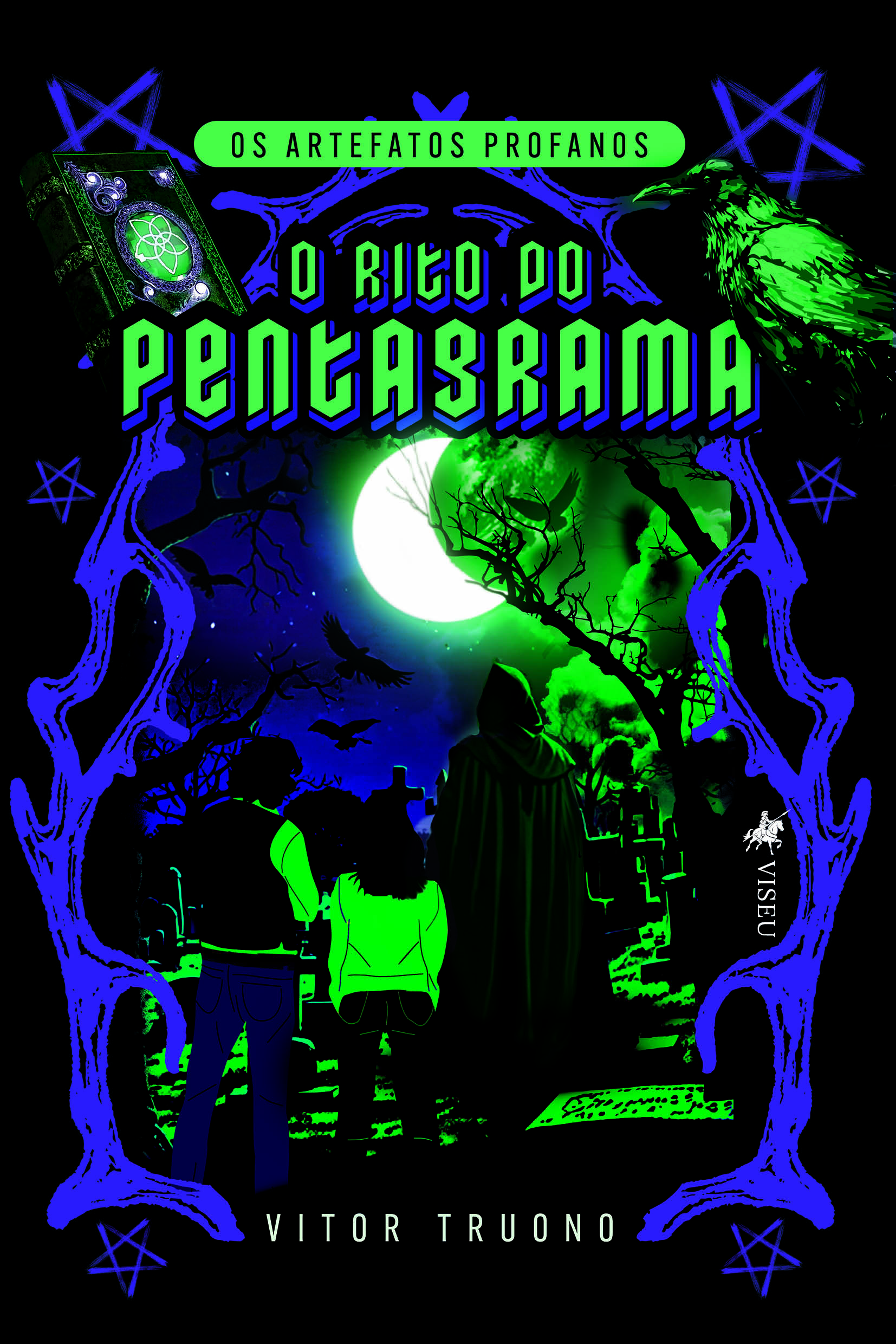
In the novel *The Rite of the Pentagram*, the first volume in the *The Profane Artifacts* series, author Vitor Truono leads readers through a plot that combines mysterious murders, supernatural elements, and the dilemmas of adolescence. While investigating a series of crimes linked to ancient rituals, young Sarah and Alex also face the awakening of their first feelings, discovering that growing up can be as challenging as confronting unknown forces. In an interview, Vitor discusses the inspirations that unite the investigative suspense of Agatha Christie with the juvenile horror of R.L. Stine, the process of creating a universe full of enigmas, and how themes such as mental health, chemical dependency, and personal growth intertwine with fantasy to engage with a young audience.
The Rite of the Pentagram blends adolescence, passion, terror, and investigation. At what point did you realize that Sarah and Alex’s awakening love could go hand in hand with such a dark plot?
I’ve always been an avid reader of horror, mystery, and thrillers, but also of various types of fantasy, drama, teenage conflicts à la “Gossip Girl,” and even chick-lit, with all its dose of humor—one of my favorite authors is Marian Keyes. I’ve never had any literary prejudices, and I believe that this has naturally been reflected in my writing and in the way I’ve incorporated elements from all the genres I consume. It was such an organic (and long) creative process that there wasn’t a specific moment when I decided to bring together romantic, dramatic, and dark elements in the same plot. From the beginning, I knew that these ingredients would be part of the recipe for “The Rite of the Pentagram,” the first volume in the “The Profane Artifacts” series.
Sarah begins to experience realistic nightmares and macabre visions as she tries to understand the murders around her. What else interested you in exploring this intersection of fear, intuition, and coming of age?
I sought to create a balance between what fascinated me in the macabre and unknown universe and what I knew to be important for teenagers and their daily dilemmas. Thus, I integrated elements from both sides: the frightening that lingers beyond the realm of intuition and the very real situations faced by a young person in the process of discovery and maturation. The most important thing for me was to work with all of this in the most believable way possible, leaving that impression of: “Did it really happen as the character described?” I wanted the reader’s own beliefs and point of view to interact with the plot, inserting them into the story and thus creating a unique and engaging experience.
The pentagram appears as a central element in rituals and connects love, danger, and sacrifice. How did this symbolic choice arise within the construction of the mystery?
My research on the pentagram fascinated me with its details, so the choice was natural. The perfect symmetry, the mathematics intrinsic to the form… It’s no coincidence that it has been used for thousands of years in rituals and scriptures of different cultures and religions. There is something enigmatic in its complexity, making it an immediately recognizable icon of power. My challenge was to deconstruct the commonplace that books, films, and TV series have established in order to reintroduce it as one of the profane artifacts—which will be explored in greater depth in the next volumes of the series—that possesses its own mythology. I took advantage of the impact that the symbol already evokes to present to the reader “my version of a pentagram”: the central piece of a power rite that demands the sacrifice of the noblest feeling, love. Similarly, only love can lead someone to unravel the mysteries and face the dangers necessary to end this obscure quest for power.
The protagonist decides to investigate on her own due to the lack of answers from the authorities. What does this attitude reveal about the courage, impulsiveness, and vulnerability typical of youth?
This aspect of the plot is extremely important to me on a personal level. Stories of people who are fully convinced of what they are experiencing, who are not taken seriously and yet continue to seek answers on their own, are extremely moving. They make you root for their victory and for the truth to be proven. There is an element of faith there, of absolute belief in oneself. This degree of authenticity, which persists despite the disbelief of others, represents, in my opinion, one of the greatest forms of courage. This is one of the messages I wanted to leave with readers: in a society where belonging to a group and being surrounded by friends is often synonymous with popularity and power, those who don’t change just to be accepted, who don’t give up their values and opinions and remain true to their own essence are the ones who are ten steps ahead.
The book moves between fantasy and horror, with amulets, supernatural gifts, and sensory experiences. How did you find the balance between the extraordinary and the common experiences of adolescence?
Since I was going through my own adolescence and self-discovery phase when I started writing this book at age 13, most of the typical events of that age and the scenes set at school were directly inspired by what I experienced at that time. I structured the narrative as a teenage romance full of conflicts that gradually approaches supernatural mystery until it collides with the horror of violent crimes and the perpetrator. This dynamic of “two worlds intertwining” was the way I found to balance these elements and make them work satisfactorily.
Music plays an important role in setting the scene, with references to artists like Pitty and Mariah Carey. How do these songs help to convey the characters’ feelings and the emotional climate of the story?

Several hit songs from the 2000s, both national and international, served as inspiration for the development of the characters, specific scenes, dialogues, and the overall atmosphere of the story. Some lyrics translate feelings and thoughts with enormous precision, such as “Equalize” by the band Pitty and “We Belong Together” by Mariah Carey, which capture the intensity of first teenage love, the idealization of the other, and the escapism characteristic of the youthful mentality. In the end, I selected 29 songs, one for each chapter, from all these hits that soundtracked the writing of the book, and created a…official playlist on Spotify.
Beyond the mystery, the narrative touches on themes such as drug addiction and mental health. Why was it important to insert these more realistic layers into a fantastic and frightening plot?
Having witnessed colleagues and acquaintances becoming involved with drugs, as well as cases of teenage pregnancy, I closely followed the difficult moments these young people and their families went through, as well as everything they had to sacrifice to take responsibility for their choices. I also witnessed countless episodes of bullying, anxiety, and depression at a time when little was said about harassment and mental health, and even less was done to address these problems. Therefore, recording raw scenes inspired by what I actually saw and experienced seemed necessary to me. In addition to enriching the adolescent setting, making it more multifaceted, these layers invite reflection on how much progress we have made in the face of these challenges, on how we deal with them, and on what we can still do to prevent them.
You mention influences like R.L. Stine and Agatha Christie, but you also say that the book was born from a creative flow guided by memories and emotions. What did this story reveal about you as a writer throughout the process?
This story is practically an autobiography dressed in various Halloween costumes. Many aspects of my personality were naturally transferred to the characters; inspirations and homages to real people appear on different levels, from names to an entire line taken from a real argument. “The Rite of the Pentagram” wasn’t the first book I wrote, but it was the first one I truly took seriously and consider my debut work. More than “a letter to my future self”—which I reread today and it makes me remember people, events, culinary preferences, and cultural references—this book proved to myself that I am capable of writing exactly the story I envisioned, mixing all the genres I want, breaking rules, doing everything my own way, and above all, creating connections and valuable moments with readers who like to venture into the different. Perhaps most importantly, this project allowed me to honor and fulfill the dream of little Vitor, who always wanted to be a writer.
Follow Vitor Truono on Instagram