In *The Song of the Promised Planet*, writer Antonio Alleoni Corrêa de Godoy constructs a universe where conflicts between science and religion threaten the survival of an entire civilization. Set on the planet Kor, the work uses elements of science fiction, fantasy, and philosophical reflection to address contemporary themes such as polarization, intolerance, ideological manipulation, and the difficulty of coexistence between different worldviews. In an interview, the author discusses the inspirations behind the narrative, the influence of great names in fantasy literature, and the role of fiction as a tool to discuss the social and human challenges of an increasingly divided society.
“The Song of the Promised Planet” begins in a world where collective hatred starts to alter nature itself. At what point did you realize that this image could fictionally translate the tensions of our time?
I started writing the book in 2013. Then my father died, and I went years without writing. The idea that the human psyche alters its own nature emerged as I wrote. At that time, world tensions weren’t so exacerbated. I see a prophetic tone in this work. I recently discovered that the yogi Paramahansa Yogananda had a similar idea: the planet can suffer along with us. Fantastic! I feel well supported!
The planet Kor is divided between the Pious, bound by faith, and the Enlightened Rationals, defenders of science. What most interested you in investigating this confrontation between spirituality, reason, and intolerance?
In the past, science and religion were more integrated. For example, astronomy and astrology formed a whole that was studied by wise men. Ancient scientists sought to understand God’s universe! However, with the advent of mechanistic thought, from around the 17th century, or even earlier, philosophers like René Descartes and Isaac Newton began to see the universe as a machine. And this thought developed until we reached the present day where we have a science hostile to religion. But this agnostic view is being questioned by scientists like the Indian physicist Amit Goswami, or the Greek physicist Menas Kafatos. Matter becomes spirit and vice versa.
The narrative shows that the collective mind of the population can influence natural disasters. How did this idea of transforming the psychological state of a society into a force capable of impacting the physical world come about?
Based on the concepts developed by C. G. Jung and Teilhard de Chardin, I created my narrative. For Jung, there is a collective unconscious that belongs to all of humanity. For Chardin, one day there will be a noosphere, the sphere of the mind, where human psyches will be part of one thing and unite with God at the end of time. Aren’t social networks today, in a way, fulfilling this role? Despite the personal conflicts we find there. Humanity has not yet become one, but it seems to be moving in that direction. If we allow it, of course! Or perhaps even without permission, shaping an inevitable destiny.
Trondoll is seen as a messiah by some and as an exceptional primate by others. What does this difference in interpretation reveal about how myths, science, and religion compete for truth?
These different worldviews reveal the following: man is an incomplete being. Science is incomplete. Religion is incomplete. The truth is much greater. And it lies in the integration of these differences. Religion doesn’t say everything. Science doesn’t say everything. That’s why I quote again those scientists and religious people who want to integrate the two worldviews. Spirit and matter. Body and soul. God and man. In the vicinity of the whole, we approach the truth.
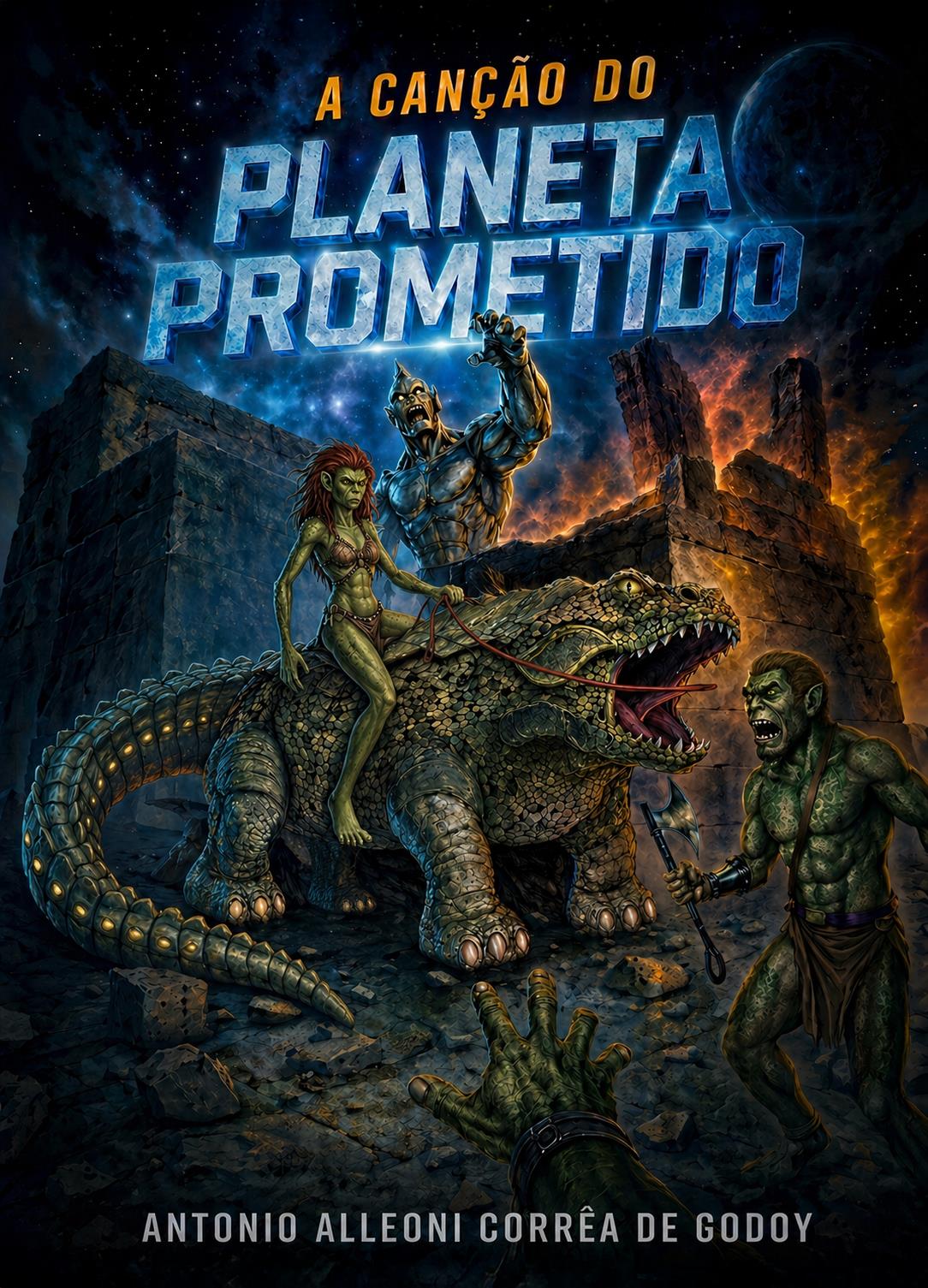
Daxxtor and Jeb try to build bridges amidst a radicalized society, but they also carry a secret capable of shaking the entire planet. What was it like creating characters who must choose between preserving order or revealing a transformative truth?
Human beings adapt to the laws of society for harmonious coexistence. However, aren’t there ideas within us that could change things? And that is distressing. We are afraid to express them. With his theories, Albert Einstein revolutionized Newtonian physics. He changed the prevailing worldview. Certainly, the process of challenging imposed and established concepts must have been somewhat distressing for him. That’s why many people today still believe the earth is flat. Every paradigm shift is painful. It was for me.
The work addresses themes such as racism, social polarization, ideological manipulation, and genocide through science fiction and fantasy. Why did this genre seem like the ideal way to discuss such human and current issues?

With this work, I wanted to broaden the target audience. These issues are usually limited to an overly academic and intellectual audience. They don’t reach the general population very well. Because of this, through a fictional adventure story, I decided to bring these important issues to the attention of ordinary people, taking them out of exclusively academic circles. I hope I have succeeded.
His background in Physics, Theology, Parapsychology, and Religion directly impacts the universe of the book. How did these different areas of knowledge influence the creation of Kor and his conflicts?
It was precisely because of my knowledge that I was able to write this work. It made that possible for me. For example, quantum physics has shown that the human mind intervenes in the structure of matter. When scientists, through instruments, observe an electron, it changes its behavior. So, because of these ideas, I was able to develop an interesting story. I wouldn’t know how to write a detective novel. It has nothing to do with my knowledge.
You state that only harmony can unite a divided and belligerent humanity. After the reader has experienced the conflicts in “Song of the Promised Planet,” what reflection would you like them to take away regarding dialogue, extremism, and coexistence?
Let the idea remain: we are all one! Planet Earth, seen from space, is a whole without borders. There are no countries, and there are no black or white people. Neither communists nor capitalists. There is only one race: the human race!
Follow Antonio Alleoni Corrêa de Godoy on Instagram