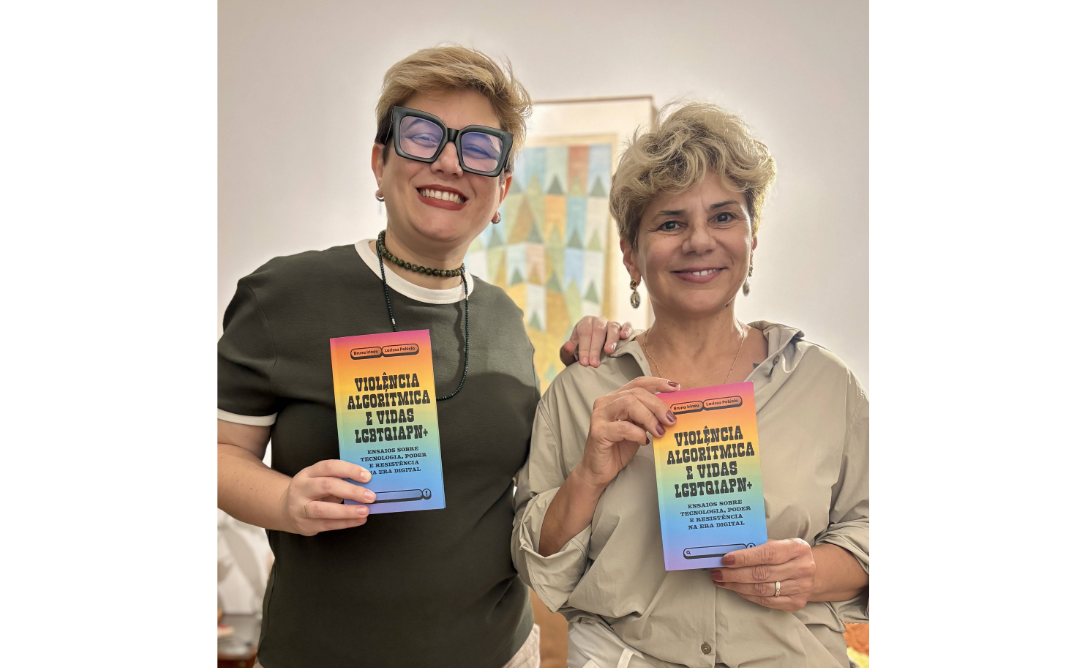
How do digital platforms influence who is seen, heard, or silenced on the internet? In Algorithmic Violence and LGBTQIAPN+ Lives: Essays on Technology, Power, and Resistance in the Digital Age, researchers Bruna Irineu and Larissa Pelúcio investigate how algorithms, artificial intelligence, and the data economy reproduce inequalities and impact the lives of LGBTQIAPN+ people. By combining critical analysis, practical examples, and proposals for resistance, the work invites the public to understand the digital environment as a space of political and social disputes. In an interview, the authors discuss the mechanisms of algorithmic violence, the challenges for building fairer technologies, and the importance of society’s participation in defending rights and democracy in the digital age.
“Algorithmic Violence and LGBTQIAPN+ Lives” starts from a very strong statement: technology is not neutral. At what point did you realize it was urgent to translate this debate to a wider audience?
We realized this urgency when it became clear that digital platforms were no longer just means of communication, but central infrastructures of social life. Today, they organize ways of appearing, working, desiring, consuming, denouncing, forming networks, and also experiencing violence. For LGBTQIAPN+ people, this is especially sensitive, because visibility can be both a condition of political existence and a factor of exposure.
The idea that technology is not neutral is still largely confined to certain academic, technical, or activist debates. But its effects are experienced daily by those whose posts are taken down without explanation, whose profiles are demonetized, whose complaints are ignored, whose bodies are deemed “inappropriate,” or whose identities are transformed into market niches. This book stems from this unease: it was necessary to translate this debate without simplifying it, showing that algorithms are created by people, companies, economic interests, moral norms, and political disputes.
The book shows that algorithms and digital platforms can classify, silence, and render invisible bodies, discourses, and affections. How can we explain, in an accessible way, that this violence often happens without appearing violent?
It often doesn’t appear as violence because it isn’t necessarily accompanied by insults, direct threats, or explicit aggression. It can appear as a “system error,” “drop in reach,” “violation of community guidelines,” “sensitive content,” “automated recommendation,” or simply as silence. A post stops circulating, a complaint goes unanswered, educational content about sexuality is mistaken for pornography, while hate speech continues to find ways to go viral.
That’s why we talk about algorithmic violence. It’s a distributed, opaque, and often normalized violence. It doesn’t depend solely on the intention of an aggressor; it operates through classification, moderation, ranking, and recommendation systems that define which bodies are considered safe, marketable, acceptable, or dangerous. For those affected, the effect is very concrete: loss of public voice, restriction of support networks, exposure to attack, illness, and the feeling that the platform is always an unstable space.
You treat the internet not only as a space for communication, but as a political arena. What is at stake today when we talk about the existence, visibility, and rights of LGBTQIAPN+ people in the digital environment?
The issue at stake is who can appear, under what terms, at what risk, and with what possibilities of recognition. The internet has become a political arena because it is where repertoires of belonging are formed, hate campaigns are conducted, public pedagogies are developed, memory is contested, care networks are formed, diversity markets are established, and sophisticated forms of surveillance also emerge.
For LGBTQIAPN+ people, existing in the digital world is not just about “having a profile” or “producing content.” It’s about contesting one’s name, image, narrative, affection, and the right to complexity. The problem is that this contest takes place in environments controlled by large private platforms, driven by profit, engagement, and data extraction. Thus, visibility can be celebrated when it is palatable, marketable, or compatible with certain consumer expectations, but punished when it becomes dissident, uncomfortable, erotic, radical, or politically confrontational.
The work explores how biased data can reproduce and deepen historical inequalities. What dangers arise when seemingly “technical” systems begin to decide who appears, who circulates, and who is silenced?
The main danger is the depoliticization of inequality. When a decision is presented as technical, it tends to appear neutral, objective, and inevitable. But automated systems learn from data produced in racist, cisheteronormative, misogynistic, ableist, and deeply unequal societies. If this data carries biases, the systems can reproduce these patterns with an appearance of efficiency.
This becomes even more serious because algorithmic decisions operate on a large scale. A bias that might previously appear in a specific institution begins to circulate across search engines, advertising, facial recognition, content moderation, policing, credit, healthcare, education, and employment. When these mechanisms decide who appears, who is recommended, who is suspect, who is monetized, or who is silenced, they help manage social life. In the case of LGBTQIAPN+ people, this can mean both the invisibility of dissident existences and their hyper-exposure to surveillance, consumption, and attack.

While denouncing algorithmic violence, the book rejects a paralyzing view and presents practices of resistance. Why was it important to show that technological loopholes, reappropriations, and insurgencies also exist?
Because we didn’t want to produce a book solely about capture, control, and harm. These elements are real and need to be named, but LGBTQIAPN+ lives are not just objects of technological violence. They also produce languages, disobey expected uses, create protection networks, invent pedagogies, hack formats, and transform platforms into spaces of dispute.
Showing the loopholes is fundamental to avoid falling into a fatalistic reading of technology. Platforms are powerful, but they are not closed wholes. There are deviant uses, alliances, denunciations, collective campaigns, digital literacy practices, memory production, and the creation of alternative infrastructures. Resistance does not eliminate the power asymmetry, but it shows that there is struggle. And where there is struggle, there is the possibility of political imagination.
Initiatives like TecnoCuir appear as examples of transfeminist hacker action and the construction of emancipatory alternatives. What do these movements teach us about imagining technologies from the perspective of other bodies, knowledge, and affections?
TecnoCuir teaches us that technology doesn’t need to be thought of solely from the perspective of Silicon Valley, corporate innovation, or the promise of efficiency. It can be thought of from the perspective of bodies historically marked as inadequate, excessive, deviant, or disposable. This completely changes the question. Instead of simply asking “what can technology do?”, we begin to ask “whom does it serve?”, “whom does it protect?”, “what worlds does it help sustain?”, and “what lives does it make possible?”.

Transfeminist hacking is not just a technique. It is an ethic and a politics. It combines critique, invention, care, improvisation, collaboration, and refusal. It teaches that technological emancipation means not only access to devices, but the ability to understand, question, modify, and contest the infrastructures that organize life. When queer, trans, feminist, Black, Indigenous, and marginalized knowledges enter this conversation, they displace technology from a place of neutrality and reposition it in the realm of justice.
The book also includes a glossary of concepts such as surveillance capitalism, data colonialism, algorithmic justice, and digital sovereignty. How can language be a tool for democratizing this debate?
Language is crucial because what we cannot name tends to seem natural. Many people experience the effects of algorithmic violence, but lack the words to recognize it as a political problem. The glossary was conceived precisely as a bridge: a way to make complex concepts more accessible without diminishing their critical force.
Democratizing language is not about simplifying it in an impoverishing way. It’s about creating conditions for more people to participate in the conversation. Terms like surveillance capitalism, data colonialism, algorithmic justice, and digital sovereignty help us understand that we’re not just talking about “internet,” “apps,” or “social networks,” but about economic models, power regimes, forms of extraction, and struggles for autonomy. Naming is a practice of denaturalization. And denaturalization is the first step in contesting.
After the reader has gone through the essays, cases, and concepts presented in the work, what kind of change would you like to provoke in the way they use, question, and engage with digital platforms?
We would like this reading to produce a shift in perception. We hope people will begin to see these platforms not as neutral, inevitable, or merely recreational environments, but as political territories traversed by economic interests, moral norms, and struggles for recognition. This doesn’t mean abandoning social media, but rather inhabiting it with greater critical awareness.
We also hope that the book will strengthen a collective attitude. Algorithmic violence cannot be confronted solely with individual solutions, such as better configuring privacy settings or being more selective about what to post. These actions matter, but they are insufficient. We need democratic regulation, transparency, platform accountability, the production of critical knowledge, digital sovereignty, and networks of care.
In the end, we hope that the reader understands that disputing technology is disputing the future. Platforms already participate in the organization of our lives, our desires, our vulnerabilities, and our forms of public presence. The question, then, is not whether or not we want to live with technology, but what technologies we want to build, under what principles, and to sustain what kind of lives.
Follow Bruna Irineu and Larissa Pelúcio on Instagram