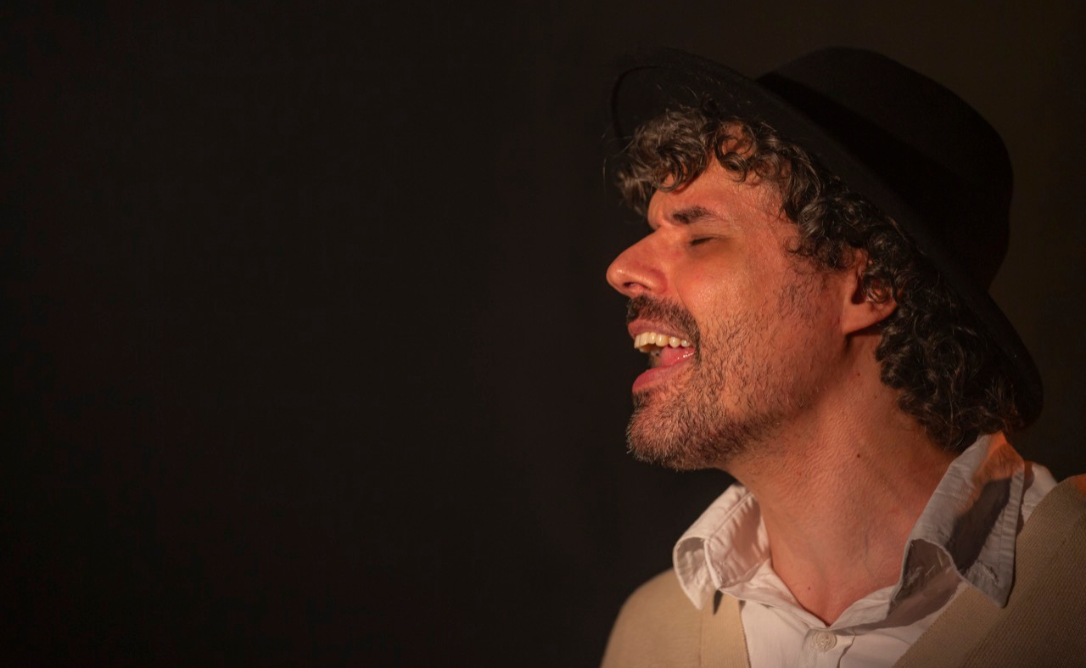
Inspired by philosophical reflections on existence, singer-songwriter Murilo Muraah presents “Farol,” a music video that expands the conceptual universe of his current artistic phase by uniting music, image, and symbolism. Drawing on references to the thought of Friedrich Nietzsche and an aesthetic built on the contrast between light and shadow, the work invites the audience to reflect on self-knowledge, presence, and spirituality. In an interview, Murilo discusses the creative process behind the video, the influence of philosophy on his work, the challenges of audiovisual production, and how he seeks to transform existential anxieties into an artistic experience capable of provoking new ways of looking at oneself and the world.
“Farol” (Lighthouse) was born from a reflection on an inquisitive mind, always searching for answers, but often distant from the present. At what point did you realize that this restlessness needed to become music and image?
This perception was the result of several processes and events I was experiencing during that period, mainly from 2010 onwards. It was a time of connection with different reflections, experiences, texts, and other elements that, on the one hand, questioned aspects that had long been part of my worldview and, on the other hand, presented other ways of interpreting reality. At the same time, these influences also began to appear in my song lyrics and other texts, which often helped me to better understand some of those ideas. “Farol” was one of those cases; it was born from the text “The Shadow,” present in Nietzsche’s “Thus Spoke Zarathustra,” but it also incorporates other elements that had been with me for some time.
The song engages in dialogue with Nietzsche’s “The Shadow” in “Thus Spoke Zarathustra.” What did this philosophical reference reveal to you within the creative process?
Like other songs and lyrics, “Farol” is a snapshot of the moment I created those lyrics. It was born very organically, mixing elements of Nietzsche’s text with elements of Hinduism, Buddhism, and other influences. In my composition process, I try to let ideas flow quite freely, without trying to control or fit them into a specific aesthetic result. In a way, I tend to value content more than form. So reading a text can trigger ideas and reflections that become my own texts. Some of these texts have more rhythmic aspects and can become songs, others are denser and become written records of my reflections at that moment. Of course, from the beginning, the way the text begins to emerge points to a path that may be more poetic, narrative, or philosophical. The focus is on the content, letting the ideas come freely, but the form of the text is usually what will determine if it can become a song later.
Perhaps that’s why Thus Spoke Zarathustra had such a great impact on me, influencing some of my writing, not just Lighthouse, and causing a major impact on my worldview. It’s a work that presents philosophical concepts elaborated in an artistic way, with a literary narrative, provocative characters, and poetic texts.
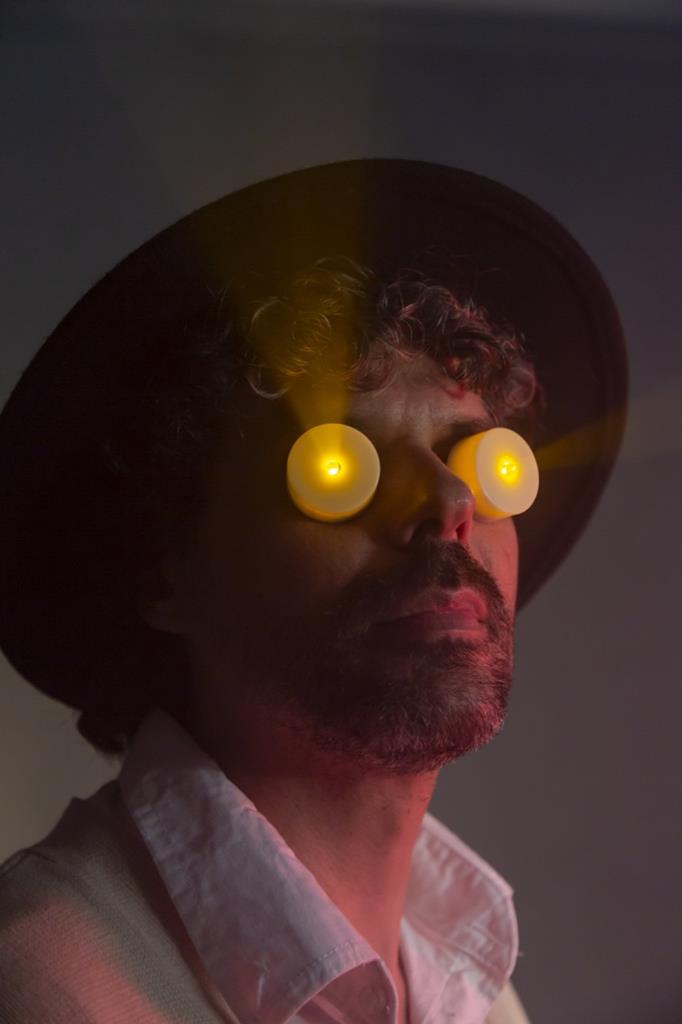
The video explores the contrast between light and body, an illuminated heart and eyes like beacons. How was it to transform such internal concepts—self-knowledge, presence, and spiritual seeking—into concrete images?
Before transforming them into concrete images, there’s the moment of creating the lyrics and music themselves. As I mentioned in the previous answer, the lyrics usually come first, in a very free and organic way. Since I like to use metaphors, the internal concepts take on a life of their own when the lyrics are born, which helps these concepts gain other meanings for those who come into contact with them. But musical creation also plays a fundamental role in this transformation of feelings and ideas that are so intimate into something that can also have meaning for other people.
The process of creating the aesthetic universe for the “Farol” music video was done with the Fruuto team, especially with Rodolfo Lacerda, who directed the video, and Mariana Lima, who managed my social media and also contributed to the project in other ways. The use of strong images as metaphors—the lighthouse, the heart, the eyes opening—all of this helped to build the images that are part of the video.
You mention that the gaze, like a beacon, represents both the ability to see the world with greater wisdom and the possibility of contributing to the spiritual search of others. What responsibility is involved in illuminating paths without imposing answers?
In a way, each person ends up living with their own answers to questions about life for which we will never be able to find concrete answers. Of course, this is profoundly influenced by where each person is raised, by the culture of their family group and the society in which they are embedded, by their religiosity, and by the experiences and connections they will have throughout their life. But each mind contains its own universe, its own search for answers.
Therefore, proposing reflections without imposing universal answers that should be followed by all human beings is nothing more than recognizing this complexity, this richness of experiences, cultures, and ways of interpreting reality. Humility is necessary when dealing with such gigantic themes as what life is, how our relationship with that which is beyond our comprehension is constructed, whether reality is transcendent or immanent, whether a creator god exists, and so many others that have accompanied humanity for millennia.
These and other big questions fascinate me; they’ve been present in some way since my childhood. I’m not a scientist, I don’t intend to theorize or present answers like a philosopher, much less do I have any pretension of offering the perspective of a religious person or a theologian. I’m an artist; my relationship with these themes comes through a lot of reflection, of course, but also through writing, music, images, during shows. That’s why I chose to present different ways in which I myself have interpreted reality, ways that are contradictory, sometimes even conflicting. I’m interested in taking the weight off certainties, playing with what we can’t access absolutely, with what we can only imagine, theorize, believe, dream.
Human experience is full of ways to explain the inexplicable, to use symbolism to probe the universe, nature, life. Accepting contradictions, playing with uncertainties, walking among differences, affirming the plurality of life… all of this interests me, this is the light that illuminates my path. By sharing my artistic work, perhaps the way I express my worldview, a constantly transforming vision, can make sense to other people as well? In a world that constantly tries to impose immutable certainties on us, that tries to tell us that we must conform to a single, correct way of living, embracing uncertainties can be a liberating stance. I don’t feel any responsibility to illuminate paths, but rather the desire to share my thoughts, my little follies, these cries for freedom.
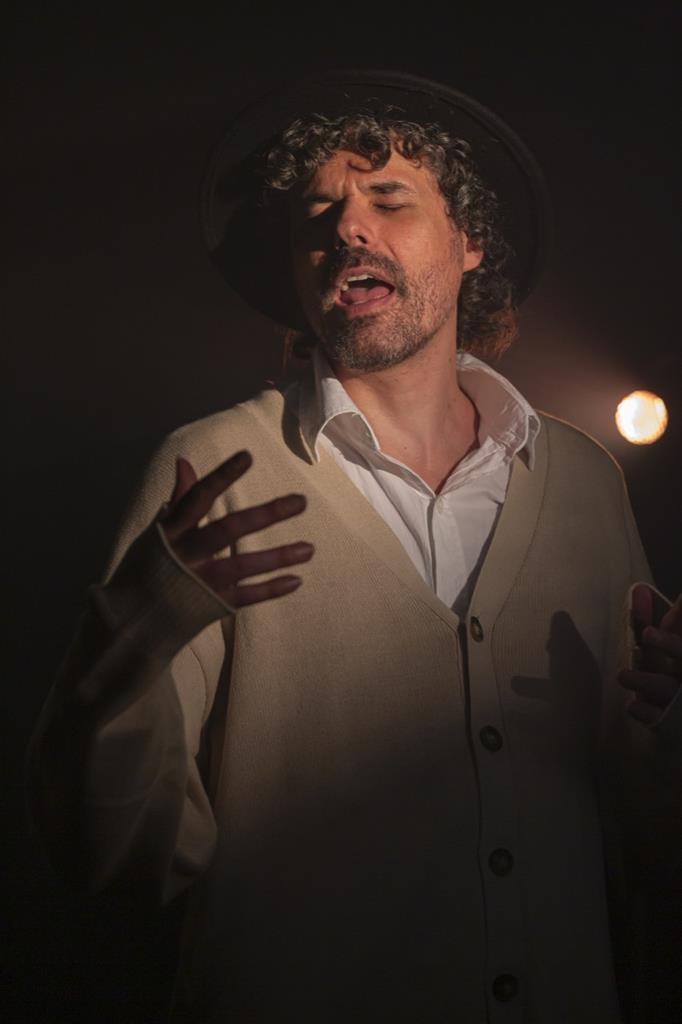
The creation of the music video happened organically with Rodolfo Lacerda and the Fruuto team. What did this collaboration bring to expand the symbolic universe of “Farol”?
Fruuto has a very effective way of achieving aesthetically interesting results using few resources. Creativity is their main strength; they managed to understand the ideas behind the music and build an impactful universe for the music video and its visualizers. The images are strong and representative, which has contributed to bringing many new people to follow my work on social media.
Rodolfo led the creative process for the music video, suggesting references for the images, and everything was discussed, refined, and then put into practice by the team, which in the case of Farol, in addition to Mariana Lima whom I already mentioned, also included Ale Machado (director of photography and editing), Ana Mori (art direction), Patricia Ferreira (executive production), and André Hoff (photography, stills, and production).
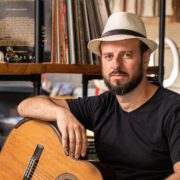
One of the most striking images involved filming with artificial candles attached over her eyes, making it impossible to see. What did this physical discomfort reveal about trust, surrender, and vulnerability in front of the camera?
I had already experienced a similar process with the Fruuto team, when we filmed several shots with different objects covering my face for the “Percepção” music video, which is also coming soon. In the case of “Farol,” the main image for the video was that one with the candles stuck to my eyes; there were several takes of me singing, moving around the room, playing guitar with them on my eyes. For this to work, you need to trust the team, not only to follow the instructions they give during filming, but also to put yourself in that more vulnerable position.
Lighthouse and Perception were the first audiovisual productions I made for my musical work, so these small challenges were great for testing myself, for me to realize not only that I can accomplish this other aspect of my work, but also that I enjoy it.
You state that “Farol” helped you understand that it’s not enough to have a questioning spirit; you need to live fully in the present. How does this perception relate to your current artistic and personal phase?
Returning to live performances after 16 years away from the stage was a shock of presence, in the best sense of the word. You need to be fully present to be able to perform in front of an audience. Each show is a different experience, the connection with the audience changes, the songs take on a new life. I always say that, even though I have more experience with studios, performing live is what I enjoy doing most. But not only that, all the preparation for this return to the stage, the rehearsals, the technical and artistic decisions, the contact with the band, all of that pulls me into the present and makes me enjoy this current phase of my career more.
The “Restless Wanderer” cycle seems to bring together music, philosophy, spirituality, and presence in the world. After taking these ideas from your head and putting them into audiovisual form, what kind of experience do you hope the audience will have when watching the video?
An experience of presence, without a doubt. I hope the video offers a good musical moment, but also that it can spark thoughts and reflections. To each person, according to their reality, according to their own experience in the world, but giving that jolt that it’s possible to go beyond what you already know, what you believe… that perhaps it’s possible to go beyond yourself.
Follow Murilo Muraah on Instagram