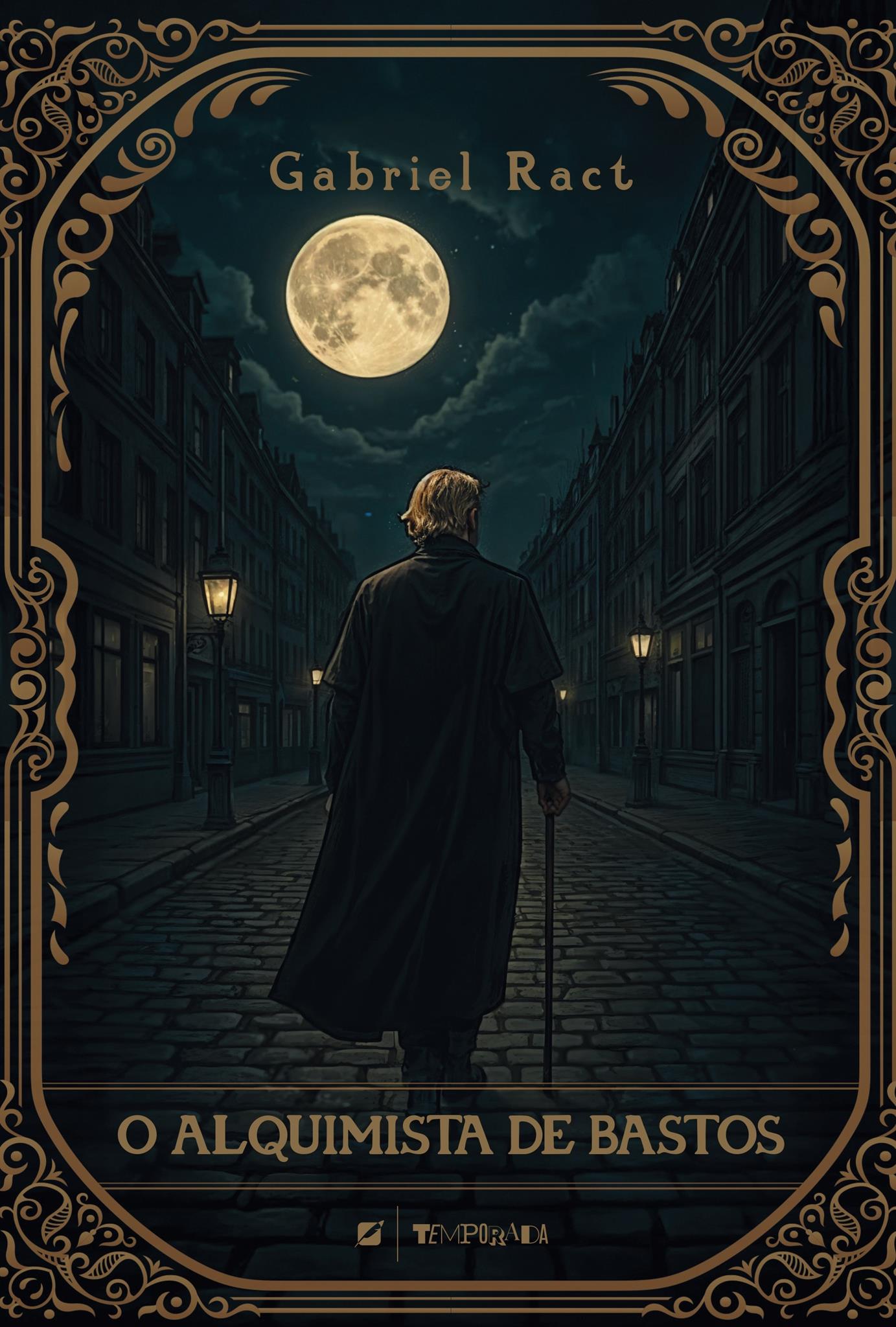
Amidst secrets, symbols, and flames of faith, writer and physician Gabriel Ract recaptures the fascination of alchemy in “The Alchemist of Bastos,” a novel set in 18th-century France, where science and spirituality intertwine in an intense narrative about power, guilt, and redemption. The work follows Damian Willard, a British journalist infiltrated into a Parisian university investigating the disappearance of esotericism students—and ends up plunging into a labyrinth of manipulation, faith, and self-discovery guided by the enigmatic Simon Durant, an immortal alchemist in search of the transmutation of the soul.
With refined prose and a symbolic atmosphere, Ract transforms occultism into a mirror of the human condition, revealing that true gold, as well as inner purity, is only achieved through the fire of choices.
“The Alchemist of Bastos” blends reason and mystery, faith and destruction. When did you begin to realize that alchemy could also be a metaphor for inner transformation?
Answer: When I considered using alchemy as a backdrop for this new universe, I had in mind that I wanted to do something that deviated from conventional approaches. During my studies on the subject, it wasn’t difficult to perceive the richness of the esoteric practices that dictated the workings of European alchemy. It was from this little-explored point that not only the particularities that would govern an alchemical France emerged, but also the guiding thread that would link the work to my previous publications.
The story takes place in a historical moment where mysticism and science intersected. Do you believe that, in a way, we are living through a new “18th century,” where the search for meaning is once again intertwined with technology and power?
Answer: Certainly. We are living through a period of rapid technological progress coupled with political and economic collapse on a global level, factors that justify a search for meaning that often surpasses the limits that religiosity should have. This is especially related to the polarized political scenario that we currently see in so many countries, including Brazil.
Simon Durant is a character burdened by both immortality and guilt. What was it like creating someone so enigmatic—and yet so human?
The book was created based on the character of Simon. From the beginning, he set the tone for the narrative and guided the story to its bittersweet ending. Because of this, I had a lot of freedom in creating such a complex character. Certainly an incredible experience.
The protagonist, Damian, begins as a skeptical journalist but ends up on a journey of faith and self-discovery. Is there something of Gabriel García Márquez in this conflict between the rational and the spiritual?
I’ll be completely honest: I still can’t write protagonists who don’t carry something of myself within them. Damian didn’t escape this; on the contrary. For me, this conflict between faith and rationality is central and ancient, and has already motivated many reckless actions and countless arguments with people I love. Unlike the protagonist, however, I don’t evolve spiritually through a traumatic self-discovery experience—thankfully!
In the novel, alchemy isn’t limited to gold, but also extends to the soul. What, for you, does this inner “transmutation” that the book proposes to the reader represent?
Throughout the narrative, the soul is presented as an energy capable of being manipulated by alchemists who understand its properties. This energy is unconsciously used to perform tasks essential to maintaining the human body, as well as serving as an important point of connection with the spiritual world. In the work, the “inner transmutation” mentioned in the question is much more related to the ability of another to manipulate another’s soul, generating variable results.
Your writing has a rare symbolic density—tarot, myths, archetypes, religion. How do you balance this fascination with the esoteric with a commitment to telling an accessible and engaging story?

Answer: However appealing the esoteric symbols present in the book may be, the narrative has always been the focus of the work, and its progression has been my highest priority as an author.
The duality between Marie and Simon is central to the plot—light and shadow, lucidity and fascination. Do you believe the human soul needs these two poles to fully understand itself?
In the work, Marie and Simon are presented as two figures of guidance who, despite representing opposing poles between reason and spirituality, share common characteristics in how they approach their professions. I believe that self-understanding requires a balance between the thoughts of the two characters. This balance, in the work, is only achieved by Akin’s character.
“The Alchemist of Bastos” is about power, guilt, and redemption. If you could summarize the essence of the book in a single question that the reader should ask themselves at the end of the reading, what would that question be?
How far would you go to satisfy desires that seem intrusive to you?
Follow Gabriel Ract on Instagram