
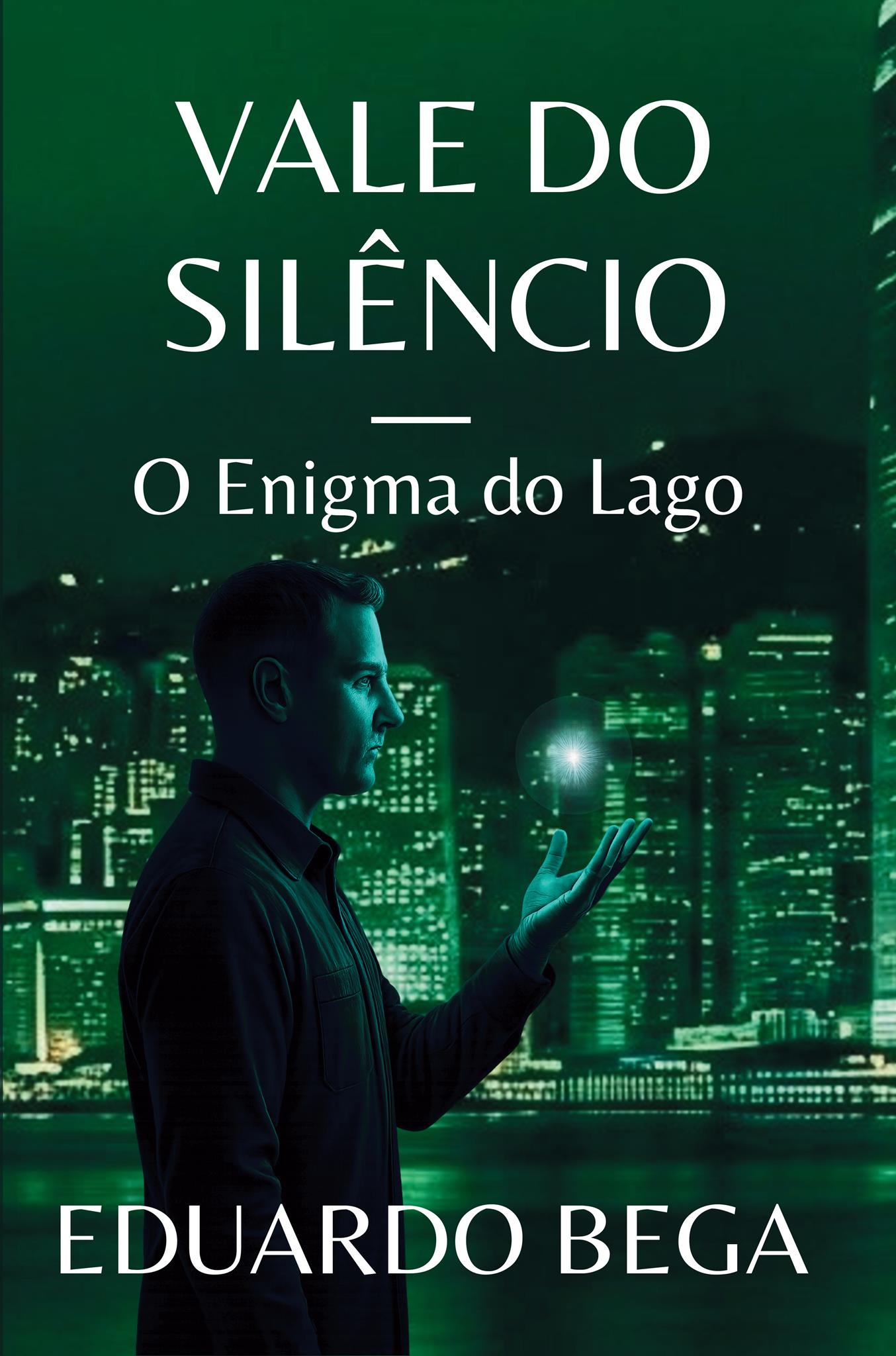
The inexplicable invades the routine of a small mining town in Vale do Silêncio – O Enigma do Lago (Valley of Silence – The Enigma of the Lake), a new thriller by Eduardo Bega that blends scientific suspense, urban legends, and cosmic mystery. Starting from a disturbing phenomenon—three blue lights that plunge into a lake without causing any visible impact—the author constructs a fast-paced and provocative narrative about the limits of human reason and the fascination with what science cannot yet explain.
The book starts with a mysterious phenomenon — three blue lights plunging into a lake without splashing. What was the “real trigger” that sparked your desire to transform scientific enigmas into provocative fiction?
The blue lights are “explained” in Valley of Silence and cease to be a mysterious phenomenon—but that’s just the beginning. Many surprising revelations arise from this scene, which functions as an initial detail. The “real trigger” comes from my very particular vision of how I perceive the universe that surrounds us: Earth as an experimental laboratory. Our past fulfills an alien agenda of evolution, and our future is already planned.
By combining cosmic mystery, humor, and magical realism, you create a very Brazilian atmosphere for themes normally treated with extreme seriousness. Why was it important for you to explore the unknown with lightness and irony?
Lighthearted, yes—but not ironically. Humor is a natural part of the work, a result of unexpected situations. As a Brazilian writer, this atmosphere couldn’t be any different. Set in Minas Gerais, due to the numerous sightings, the story was conceived as a thriller of surprising revelations and interplanetary journeys. It’s not a technical article about extraterrestrials: treating it with extreme seriousness would make the reading tedious.
Tony, Sarah, and Vicente represent three different ways of looking at the inexplicable. In which one do you see the most of your own perspective on the mystery?
Actually, I don’t directly identify with Tony, Sarah, or Vicente. The character who reflects my perspective is Raymond, the abductee. His disappearance functions as a myth, since he keeps alive a blog about utopian cities and interplanetary travel. The abduction, in this sense, is convenient: it fuels the mystery and sustains the suspense. Raymond is, in fact, my perspective on the mystery of Valley of Silence.
You grew up professionally in technological and industrial environments. To what extent does this experience shape your way of imagining phenomena that defy logic, engineering, and science?
I look at a colossal structure and immediately wonder how it was built. I see those megaliths of Puma Punku in Bolivia (H-shaped) scattered as if they had been thrown randomly. Sharp corners machined in low relief into the stones, curved holes in the corners. Precision in the cuts of enormous stones. They have been there for 1500 years for anyone who wants to see. It’s a fact, not fiction. Only those from the technological field understand the complexity of these results, which still challenge our engineering today.
The book questions humanity’s acceleration—from electric light to going to the moon—as if we were always chasing something we don’t fully understand. How did this reflection enter the writing process?
The accelerated evolution of technology doesn’t appear explicitly in Valley of Silence, but it’s present in the subtext of the narrative. Similarly, several aspects of our own natural evolution seem out of place and suggest a possible “planned intervention.” It is from this reflection that the first volume of the work is born.
The work touches on universal themes — fear, curiosity, the need to believe in something — but sets them in a small town in Minas Gerais. What does this choice say about the Brazilian way of dealing with mysteries?

The story connects to Minas Gerais through its UFO-related relevance, mining, and the supposed alien interest in rare minerals. Curiosity and fear arise from real sightings, filmed and viralized on social media. Tony, from the technology field, is impressed by the videos; Sarah doesn’t care much, but has her reasons; and Vicente Martins, a reporter in professional crisis, is drawn into the center of events almost as punishment. The city experiences an alien-themed tourist atmosphere—something very Brazilian.
Humor appears as a “scientific relief” in the face of the extraordinary. For you, is laughing at the inexplicable also a way of confronting it?
Humor is intrinsic to the work; it’s impossible to separate it. It stems from a very particular vision of how I perceive the universe, but it doesn’t manifest itself in jokes or satire. It arises from unexpected situations, such as the toxic relationship between the editor-in-chief and reporter Vicente Martins, where the pursuit of audience at any cost generates funny and everyday moments.
After decades working with logic and systems, what have you discovered about yourself by allowing yourself to write fiction that embraces the improbable?
Writing Valley of Silence was almost a calling. The work was born in about four months, as if it wanted to burst forth from within me, driven by the desire to share this vision with others. Some friends even asked if Planet Mirax really existed, because the narrative is impressive and seems plausible. There is no direct connection to my decades of work in logical reasoning: it is a work of fiction that embraces a very probable reality. And, in this process, I discovered that there are many missing links in the evolution of our planet.
Follow Eduardo Bega on Instagram