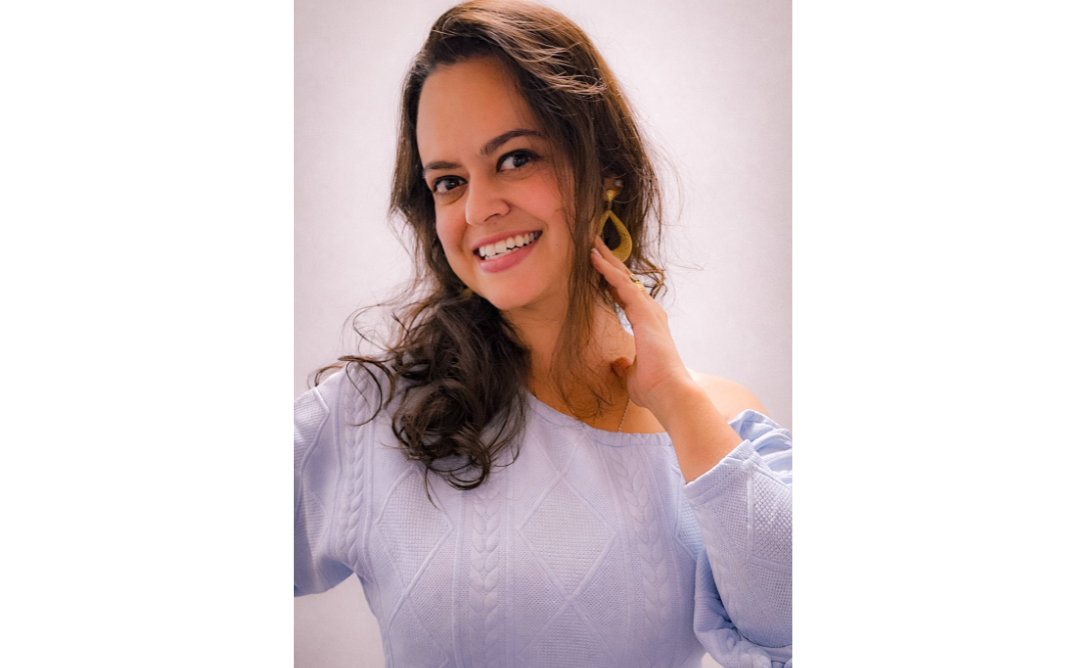
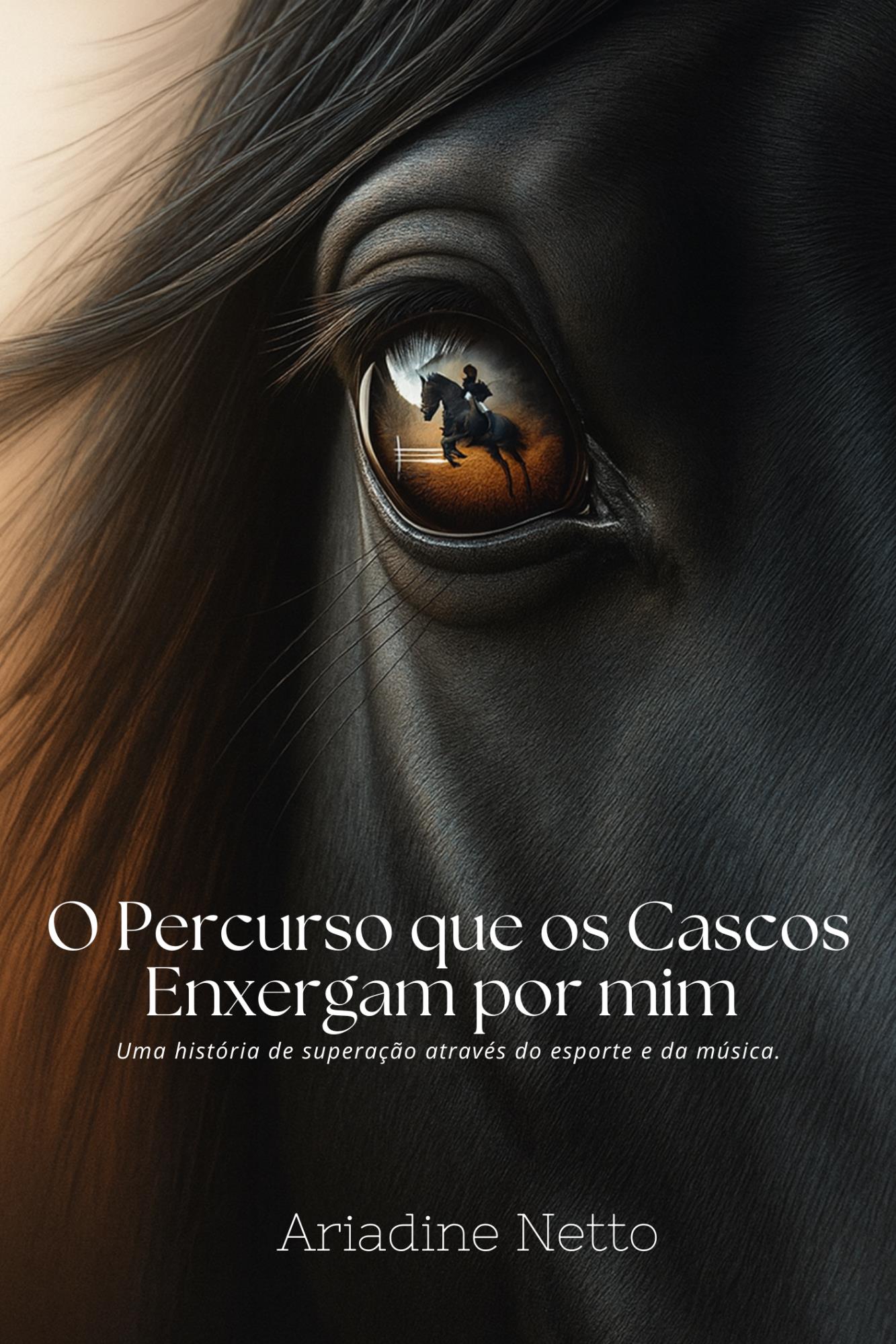
Inspired by personal experiences marked by pain and the need to redefine limits, writer and artist Ariadine Netto presents the novel *The Path That Hooves See for Me*. In the work, the young rider Daniel Oliveira sees his life drastically change after losing his sight in an accident, needing to rebuild his identity and his relationship with the world. Amidst horses, music, and the world of para-equestrianism, the author weaves a story about overcoming adversity, accessibility, and new ways of perceiving life, inviting the reader to reflect on how to transform adversity into possible paths.
Your book stems from personal experiences marked by pain, but also by reconstruction. At what point did you realize that these experiences needed to stop being just yours and transform into literature?
For a long time, I thought that talking about this would be victimizing myself, which is why it took me ten years to transform them into fiction. Over time, I learned that many people go through similar pain and don’t always have someone to understand, embrace, and help them through this process. I then understood that it was time to spread this information; art always finds a place to occupy in people’s hearts, so what better way than to transform it into literature? It’s the most genuine way I’ve found to help: offering my pain to heal others.
Daniel loses his sight and, with it, also loses the identity he had built around equestrianism. For you, what is more difficult in this type of rupture: the physical loss itself or the loss of who we believed ourselves to be?
From the moment we are born, we learn to plan our future. We study, we dedicate ourselves, we create personal goals, we give up many things to achieve what we want. When this is abruptly taken away, we lose not only who we were, but everything we had planned for ourselves. Starting from scratch on a different path seems too late to continue on the same one, impossible. This loss of identity is worse than any pain or physical condition, because it disconnects you, leaving you wandering without a reason worth facing.
The relationship between Daniel and the horse Conrado is described as silent and visceral. What have horses taught you, personally, about trust and about learning to “see” things in other ways?
I had the opportunity to have deep contact with horses during the Covid-19 pandemic. Having to work in person during this sensitive time, I found a different connection in equestrianism. I understood how horses communicate with us. In such a noisy world where people take a stand even when they don’t understand the subject or context, horses teach us to converse in silence. The feeling when we are galloping or jumping is an act of mutual trust between the horse and us. If either of us hesitates, both make mistakes. If we are anxious, the horse becomes anxious; if we are stressed, it becomes stressed. But if we love them, they reciprocate, they care for them, they protect them, but above all, they make us feel something. Whether through a look or a touch, the horse doesn’t fight for your attention; it offers you its presence.
Music appears in the narrative as a path to reconnection with the world. How was your own encounter with music in this process, and how did it influence the emotional construction of the work?
I fell in love with music very early on, especially classical music, starting with my first keyboard and later moving on to the piano. Throughout my life, music has saved me and rescued me many times. But curiously, or perhaps not, when I went through the experience I recount in the book’s introduction, I had distanced myself from music; I had followed a path that, theoretically, would be safer and more prudent. And when I was hospitalized for forty days, they left my headphones by my bedside, but I wouldn’t pick them up. It was as if I didn’t feel worthy of approaching music again. Chapters 3 and 4 of the book contain many of my feelings from that time. But music always finds a way, and it did, it invaded me again, and suddenly I was fighting, reacting. Music gave me back the pen so I could write my own story, which would later be embodied in Daniel’s.
You address themes that are still relatively unexplored in fiction, such as para-equestrian training and Braille music notation. Was there a conscious desire to broaden the reader’s perspective on accessibility and inclusion?
Yes! I believe that the social duty of the artist is to use their art to highlight relevant issues that people often don’t consider. Using literature to address these themes is building a bridge between the reader, in their busy daily life, and a reality that sometimes seems impossible. Many, even musicians, have no idea of the existence of a Braille language for reading sheet music, just as it would seem improbable that people with disabilities, especially visual impairments, could ride a horse and even compete, but this is not fiction, it’s real. And it proves to us that people with disabilities can do anything they want, requiring only a few adaptations. Therefore, inclusion is about understanding all human beings, just like ourselves.
The book’s title is deeply symbolic. When did it come about, and what does this idea that “hooves can see” mean to you?

Choosing a title is always the hardest part for me. I usually do it at the end of each book, and this one specifically carried an even greater responsibility; it was necessary to explain, without saying it, all the sensory intensity that would be presented in this book. The hooves, as the horse’s “feet” are called, are used figuratively, as if, when the strength to continue fails, the horse’s hooves would continue; when sight fails, the horse’s eyes would dictate the path, highlighting the connection between man and animal. While it’s true that other meanings were considered for this title, such as the use of the word “hoof” in architecture and nautical terms, the main one was that of the horse.
Writing about pain can be as transformative a process as reliving those experiences. Was there any part of the book that was particularly difficult to write—or that surprised you emotionally during the process?
I was surprised by the question, because it actually happened. Whenever I mention a song in my books, I usually listen to it while I write. I believe this lends honesty to the feelings the music conveys within the context of the book. In chapter 5, with the Miley Cyrus song, I would start writing and instantly begin to cry, so profusely that I couldn’t continue, putting myself in the place of the character I created, connecting it to what I actually went through. It took me three whole days to get through that part.
At the end of the reading, one is left with the feeling that the book is less about losing one’s sight and more about finding a new way of existing. What do you hope the reader will see within themselves after going through this journey with Daniel?
Everyone, at some point in their lives, will feel lost due to some overwhelming event or news. The book doesn’t romanticize this pain; it considers it as a pillar for reconstruction (the shell of architecture). Sports, animals, music, arts, literature, love—and here we can extend to culture, religion, friends, and family—they won’t have the power, on their own, to transform your pain. They will support you, they will be the triggers that will give you lapses of rationality amidst the chaos, that will make you see why it’s worth fighting for. But just like Daniel, you will need to decide to risk leaving your room, facing the uneven ground, the shame, the falls. Perhaps there you will find the root of what reminds you of who you are, of what you are capable of. Thus, the journey will be even more important than any destination, because it will teach you to walk again and to see things that will change your life, things that previously seemed irrelevant.
Follow Ariadine Netto on Instagram