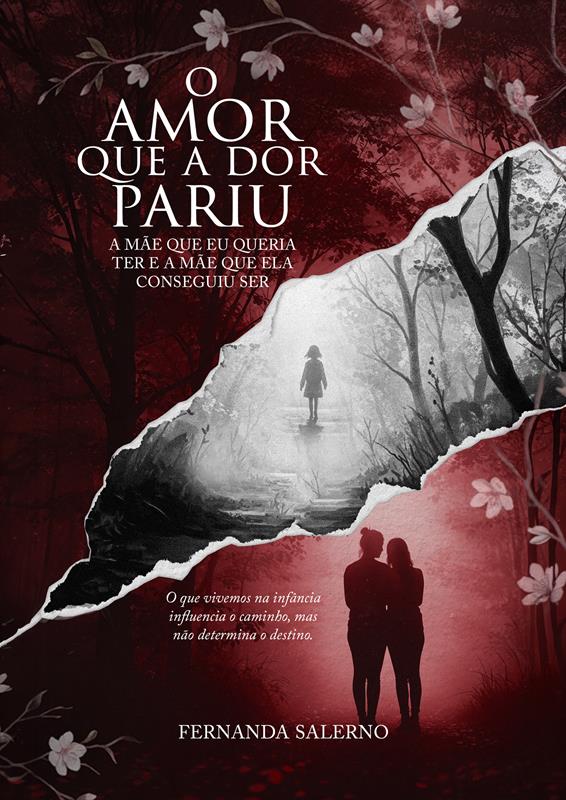
In “The Love That Pain Gave Birth To,” writer Fernanda Salerno revisits memories marked by silences, absences, and emotional wounds to propose a path of self-knowledge and liberation. With an intimate and sensitive narrative, the author reflects on patterns built throughout life—such as the search for approval and the fear of rejection—and shows how understanding these pains can open space for healthier relationships and more conscious choices. By addressing themes such as grief, identity, depression, and family ties, the work invites the reader to face their own history with courage and to recognize that true reconciliation begins within.
In “The Love That Pain Gave Birth To,” you revisit very intimate and painful memories. At what point did you realize that these experiences needed to be transformed into a book?
After it was already written, I started writing to organize my thoughts. When I finished, I noticed that, although the story was mine, the scars I carry are similar to those of many people. That’s when I understood that publishing it could provoke reflection and help other people look at their wounds with more care and compassion.
One of the most striking aspects of the work is the process of seeing the mother beyond her maternal role, recognizing her own wounds. What was it like to emotionally navigate this process of understanding?
It was a long and painful deconstruction. I only began to understand my mother as a human being when I saw her vulnerabilities. Seeing her suffer, feel fear, and need care, I replaced judgment with compassion. When I removed the demand for perfection from her, I was finally able to see the real woman who existed there, with her own wounds and limitations.
The book addresses profound themes such as grief, cancer, depression, LGBTQIAPN+ identity, and rebuilding self-esteem. How did you find the balance between exposing these pains and transforming them into a path of reflection and healing?
Balance emerged from my process of understanding and making sense of what I experienced. I didn’t write from the open wound, but from the scar. Thus, the book is an invitation to reflection, not to remain in pain or relive it, but to face it consciously—recognizing that, when processed, it can cease to be a prison and become a starting point for a real healing process.
Your writing is described as honest, intimate, and at the same time, permeated by moments of humor. How has humor helped you deal with such delicate themes?
Humor has always been one of my survival strategies. I have this tendency to joke about almost everything—not as a way to deny the pain, but to be able to breathe within it. Laughing at myself breaks the rigidity and doesn’t diminish the depth of delicate topics; on the contrary, it humanizes them and allows them to be experienced with more lightness.
Throughout the narrative, you show how behaviors like perfectionism and the constant search for approval can stem from old wounds. At what point did you notice these patterns in your own story?
When emotional exhaustion turned into depression, it forced me to understand what was behind my behaviors. That’s when I understood that perfectionism and the constant search for approval were strategies I learned to avoid rejection. I realized I didn’t need to repeat those patterns because what protected me in childhood was making me sick in adulthood.
As a mathematics teacher for over two decades, you interact daily with young people and their emotions. How has this experience influenced your sensitivity when writing about relationships, affection, and vulnerability?

School is a place where emotions appear intensely and in a disorganized way. Being around teenagers has made me develop a more sensitive perspective, allowing me to listen beyond words. When I talk about vulnerability, affection, and relationships, I’m not just drawing from my own experience, but from everything I’ve observed over these years.
The book invites the reader to revisit their own history and give new meaning to memories. During the writing process, were there moments when you were also surprised by new understandings about yourself?
All the time. Throughout the entire writing process, and every time I reread the book I discover new conclusions and insights. Writing organizes thoughts and feelings. Revisiting our history from different points of view, at different times, is liberating. It reveals emotions, choices, and memories that previously seemed immutable.
At the end of the reading, what is the main message or feeling you would like each reader to take away after experiencing your story?
I would like the reader to feel that pain is not destiny, but a starting point. An invitation to reflect in order to identify patterns and triggers, so that they cease to dictate behaviors and choices, transforming painful experiences into tools for healing and self-knowledge.
Follow Fernanda Salerno on Instagram