

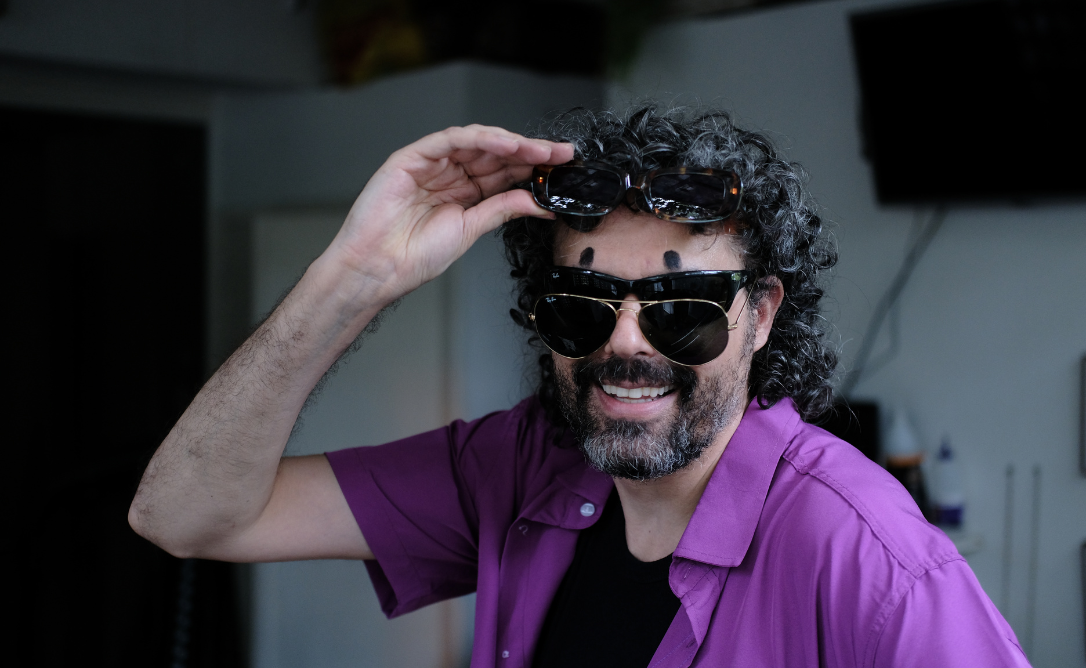
Singer-songwriter Murilo Muraah presented the session “Murilo Muraah Live at Gugastro Studio,” a project launched on May 1st that marks his artistic return within the “Restless Wanderer” cycle. More than just a musical recording, the performance proposes a dialogue between art, spirituality, and contemporary social issues, addressing themes such as democracy, extremism, and freedom of thought. In an interview, Murilo discusses the decision to return to the stage during a time of political and social crises, the collective construction of the repertoire, and the desire to transform music into a space for reflection and human connection.
“Restless Wanderer” marks an artistic comeback at a time of social, economic, and political crises. What within you demanded this return now, and not before?
In previous years, especially after 2018, my professional and activist work placed me at the center of important struggles, such as the defense of democracy and the right to culture. Even so, I greatly missed artistic creation, which adds another dimension to these struggles and allows for the construction of different perspectives on life. More than fighting against inequalities, injustices, and the loss of our rights, it is also necessary to point towards other paths. I often say that being incapable of wanting a future different from what the current socio-political system offers us is not only a lack of humanity, given the immense injustices and inequalities in Brazil and the world, but also a tremendous lack of creativity. The return of my artistic project stemmed from this desire to question the past and the present, pointing towards other futures, other ways of being in the world.
You speak of music, spirituality, and politics as parts of the same experience. How did these dimensions come to intersect so organically in your work?
My compositions almost always originate from writing. First, I have something to say, only then does it take on a musical form. So, for me, making music has always been a way to express different thoughts, sensations, feelings, perceptions, doubts…
My exploration of spirituality has been with me for many years, so it’s natural that it’s the central point of my artistic work. The political dimension has always been present in some way, though not in a propagandistic manner. It arises from a critical questioning of the world we live in or of specific events. One example is the song “Esperando Seu Fim” (Waiting for Your End), present on the album Mundo Dual (2006) and in the live session Ao Vivo no Gugastro Estúdio (2026), which sharply expressed a humanist concern about what was happening in the world following the terrorist attacks of September 11, 2001. Another example is the song “Bélico, Fálico, Falho” (Warrior, Phallic, Flawed), also from Mundo Dual, which narrates a femicide in a way that criticizes a violent model of masculinity decades before these issues gained the importance in public debate that they have finally achieved in recent times.
In recent years, religion has been instrumentalized for political purposes in Brazil, the USA, and other Western countries. Therefore, the desire to unite spirituality and politics in this return to my musical work came naturally to me. Faced with attempts to suppress different worldviews in order to impose a single religious experience, I understood that it was time to express my ideas about building other ways of experiencing spirituality, valuing doubt, skepticism, and even atheism. To see spirituality as a constantly evolving process, enriched by different experiences, whether religious or not. Treating spirituality in this way in the current context is, without a doubt, also a political choice.
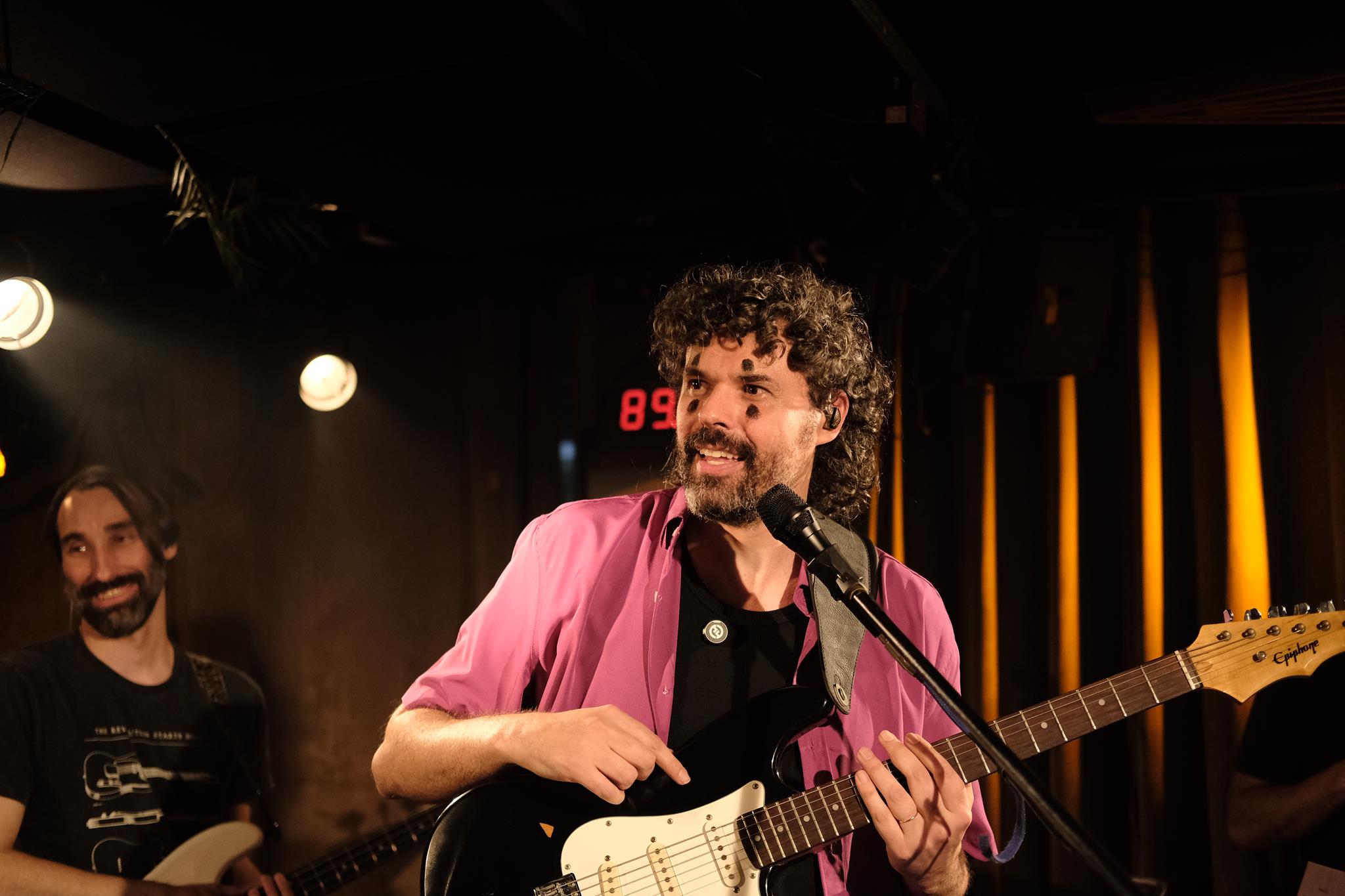
Your spirituality appears in the project as something philosophical, free, and non-dogmatic. What interests you in this more open path of reflection, and how does it permeate your songs?
We are accustomed to understanding spirituality always from a religious perspective, but this is only one of the possible dimensions of spirituality. Furthermore, it is necessary to interpret dogmatic religious practice from a perspective that is not only historical but also political. The political instrumentalization of different religions has already led humanity to commit countless unjustifiable acts of cowardice. How many power projects have used faith as a tool for control and subjugation? How many still do?
My compositions aim to broaden this understanding of spirituality, including self-knowledge and an investigative approach as fundamental points. Religion, in this context, can be a personal choice, capable of providing important knowledge and insights from stories, practices, and thoughts full of symbolism. Free from impositions, spirituality presents itself as a path to be freely followed, without a final destination, where the journey itself offers the deepest opportunities for connection with life and with the potential of the human being. With this freedom, the teachings of different religions can be embraced as expressions of different cultures on aspects of spirituality. The differences add up, they don’t exclude each other. There is immense beauty in this. In part, it is these questions and this beauty that I try to present in my music.
Throughout the session, you intersperse music with talks about democracy, extremism, and the use of religion as an instrument of power. What motivates you to transform the stage into a space for thought and expression?
I understand that the stage is not transformed; it is, first and foremost, a space for thought and positioning. Who is stepping onto it, on which stage, for what reason, for which audience… all these points are part of a political context, whether we are aware of it or not.
In Brazil in 2026, stepping onto the stage without this awareness would be to uncritically reproduce a perverse logic that unites various injustices and social inequalities with the global escalation of an exclusionary, inhumane, authoritarian, and ultra-violent political project. The far-right has repeatedly demonstrated what it is capable of doing. Given this, I believe that anyone who has a voice, who has the ability to speak to others, should use that ability to build greater political and humanitarian understanding and awareness.
It’s not easy, since for years a barrier has been built that hinders attempts to communicate with people who have become victims of this extremist project. When the only permitted sources of information are fed by the extremists themselves, anything outside of them is rejected. Even so, it’s necessary to keep trying, to keep searching for points of connection, and art, without a doubt, can offer good opportunities.
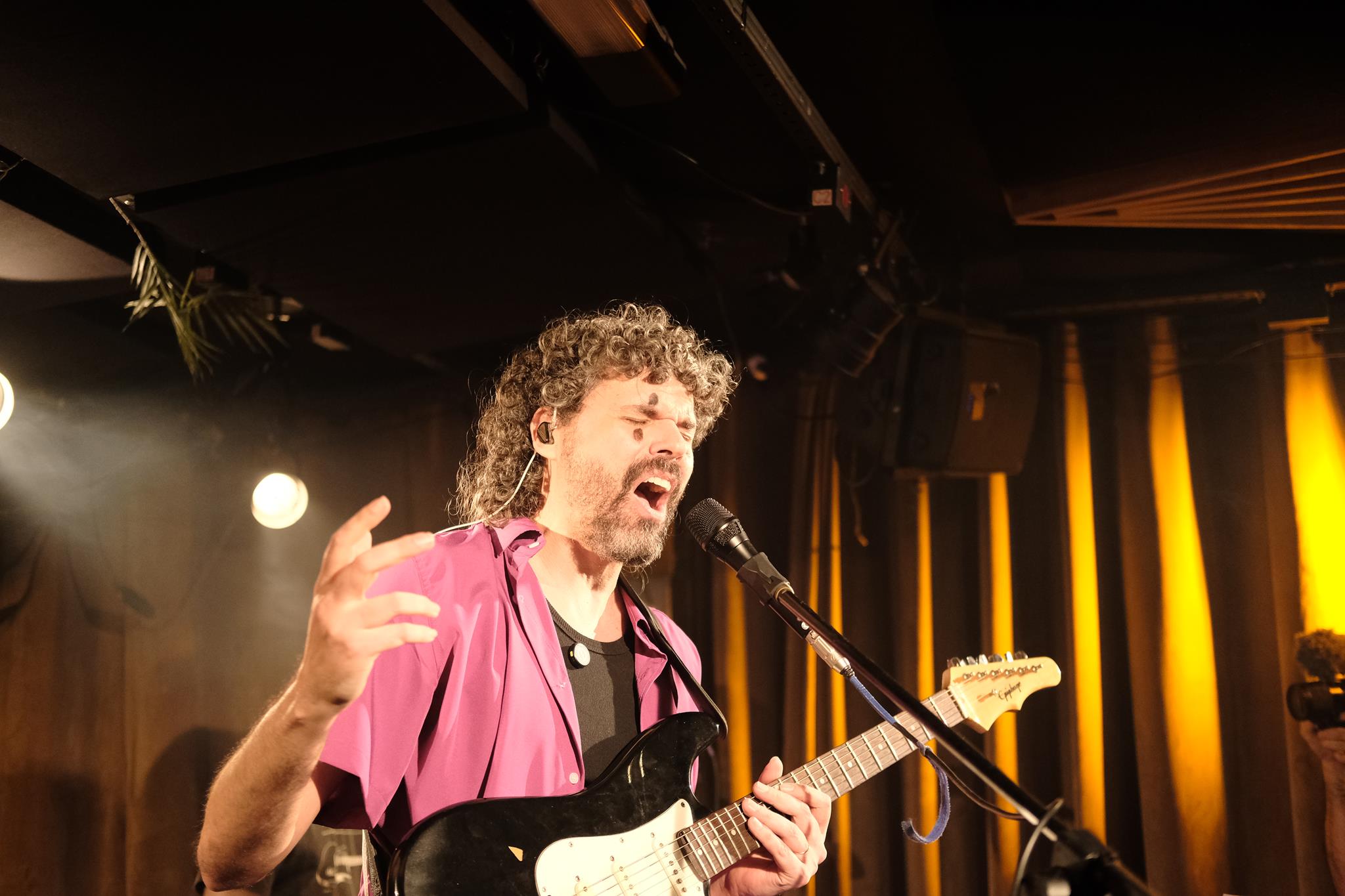
The repertoire includes recent compositions, tracks from Mundo Dual, and medleys that cross different references. What does this dialogue between past and present reveal about the artist you were and who you are today?
The tracks on the album Mundo Dual demonstrate that some of what I present in my work today was already present more than two decades ago, both in ideas and sounds. But there are also many differences, a greater understanding of themes I’ve already addressed, and greater musical ability in the creation and execution of the songs.
Reverence for the past has always been present; it’s no coincidence that songs like Cristina (Tim Maia and Carlos Imperial) or Ai Que Saudade D’Ocê (Vital Farias) were already being played in shows back then and remain in my repertoire. The connection with contemporary independent artists has also been a hallmark of this return; I always try to include recent songs in my shows, such as Quem Vai Apagar a Luz (Sophia Chablau) or Vampiro (YMA). This is a result of my greater musical curiosity today, but also of my desire to celebrate the Brazilian independent scene, which is incredibly rich and generates, year after year, countless artists and compositions of immense quality.
You mention that each song starts as a studio version, but gains a new life with the band. What does the live experience allow you to say or feel that the studio alone cannot achieve?
Direct contact with the audience completely transforms not only the music, but the artist themselves. It’s not always what is said that changes, but how it is felt and how it is translated, even using the same words. The studio is often a space for sonic experimentation, for trial and error, for refining each song. When it comes to the live show, the music usually already has a well-structured base, but each performance still manages to be unique. The difference can come from improvisations, from subtleties in the execution, from the response to what the audience demonstrates at each moment. Despite having built a professional life within studios, live performance provokes and moves me in a unique way, making me wonder how I managed to spend so many years away from the stage. I was away from a very important part of my life, and it’s wonderful to be back.

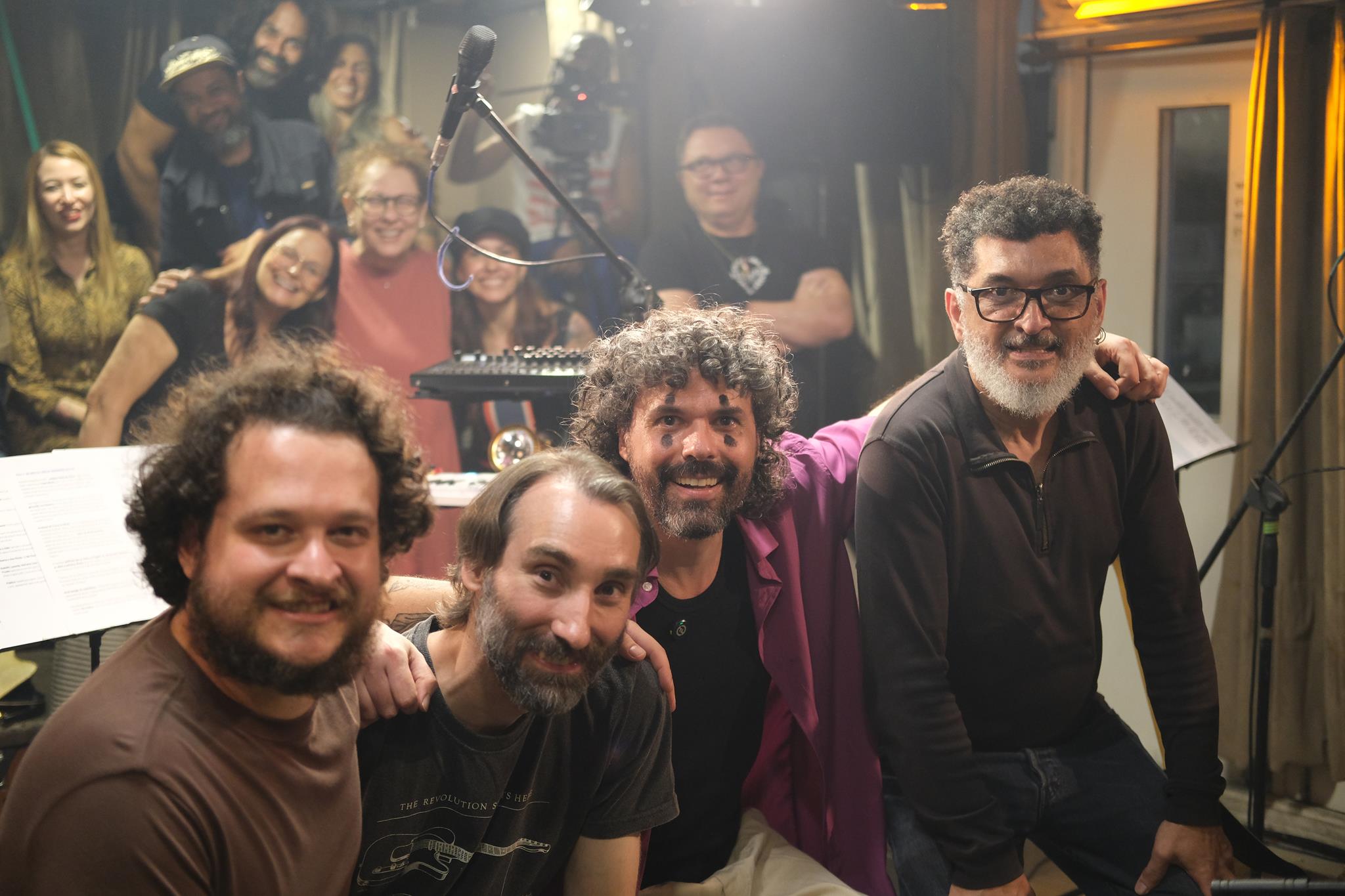
There’s something very beautiful about the intention to document this phase with quality, almost as a way of making up for the lack of records from your first stage. What emotional significance does this project have for you in that sense?
This lack of recordings has always bothered me a lot. I did unforgettable shows and played alongside icons of Brazilian music, but I only have photographic records of those moments, in a quality far inferior to the capabilities of today’s digital cameras. I practically have no videos of the performances I did between 1999 and 2009. Therefore, it was natural to want to record the comeback show, even more so because it was held at Gugastro Studio, which already has a great audiovisual setup, managed by Renato Soares.
More than that, this recording has a bit of a leap into the dark about it. It was my first show in 16 years, alongside a band that was together on stage for the first time. So of course I had technical difficulties, and that’s visible in the recording of the show, even because of the emotion of returning to the stage. I knew it would be like that, but I wanted to record it anyway; it was a very important moment not only in my artistic career, but in my life itself.
Releasing the EP and the live session “Ao Vivo no Gugastro Estúdio” was a way to expose this return to a wider audience. Seeing this recording now reaching the Music Box Brasil channel is something that has immense value for me. Anyone who has been on stage knows how insecurities can bother you, even more so after so much time away. It’s great to see that this first performance has already sparked so much interest; it only increased my enthusiasm to do more and more shows, always studying and practicing to make them better and better.
Alongside her music career, she has worked in cultural management and activism in defense of democracy. How have these experiences offstage transformed her way of creating, singing, and presenting herself artistically to the world?
As I said before, I usually write the lyrics before creating my music. In a way, this also applies to my role as a cultural manager and activist. Before acting, there is a reason that makes me want to act. This means that, before working for 10 years as a technician and then manager of the Fábricas de Cultura studios, I already had the desire to work with music within a context of social transformation. Since joining the program, I have been aware of my responsibility for working on a public policy capable of impacting so many people, especially young people, in a situation of high social vulnerability. While I was there, I always wanted to deliver more and better opportunities for action for the public, which enabled the construction of several strategic partnerships and the expansion of the actions offered by the studios. At the same time, I always maintained an openness to doing things differently from what I thought, seeking to respond to demands and ideas that came from the public and the teams themselves. It was a unique opportunity for personal and professional growth, it transformed my worldview, and put me in contact with different people and realities. This undoubtedly influenced the creation of the Restless Wanderer cycle, which I build not from personal certainties, but from the importance of being open to differences, to the diversity of life.
As an activist, I began by engaging in struggles within the cultural sector, but the country’s situation led me to fully immerse myself in the fight to defend democracy. I helped found Direitos Já! Fórum pela Democracia (Rights Now! Forum for Democracy) and served as coordinator for formulation and articulation of civil society between 2019 and 2023, carrying out eleven major events, the national campaign Abrace a Vacina (Embrace the Vaccine), and various other actions. I helped build dialogues with leaders and organizations of different profiles, seeking not only to protect democracy but also to highlight the need to improve it. I left the movement in 2025 because I no longer saw a commitment to these purposes within it, but this experience was undoubtedly of immense importance to me.
My songs are original and fearlessly portray what goes through my head, my feelings. I was away from my project and the stage between 2009 and 2025, but that was fundamental for me to develop other parts of my life. So it’s natural that everything is now mixed together with such force and a sense of urgency, which can be seen in the recorded show, in the performances I’ve been doing and, undoubtedly, in other stages of my project that are yet to come.
Follow Murilo Muraah on Instagram

![[in] DEFENZA](https://popsize.co.uk/wp-content/uploads/2026/05/in-DEFENZA-1-370x355.png)