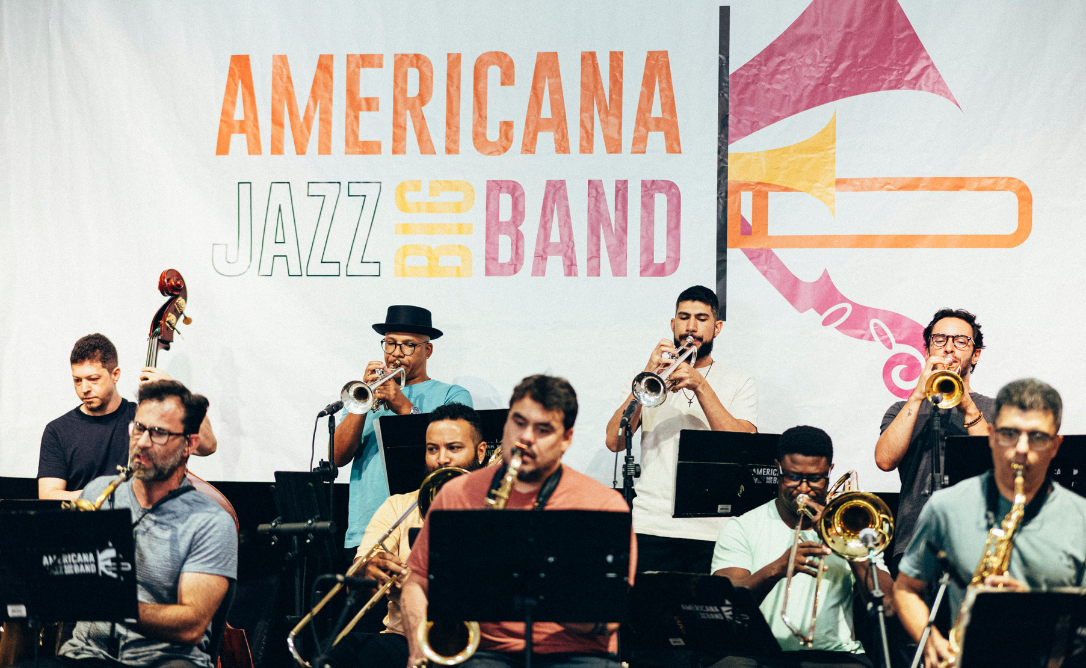
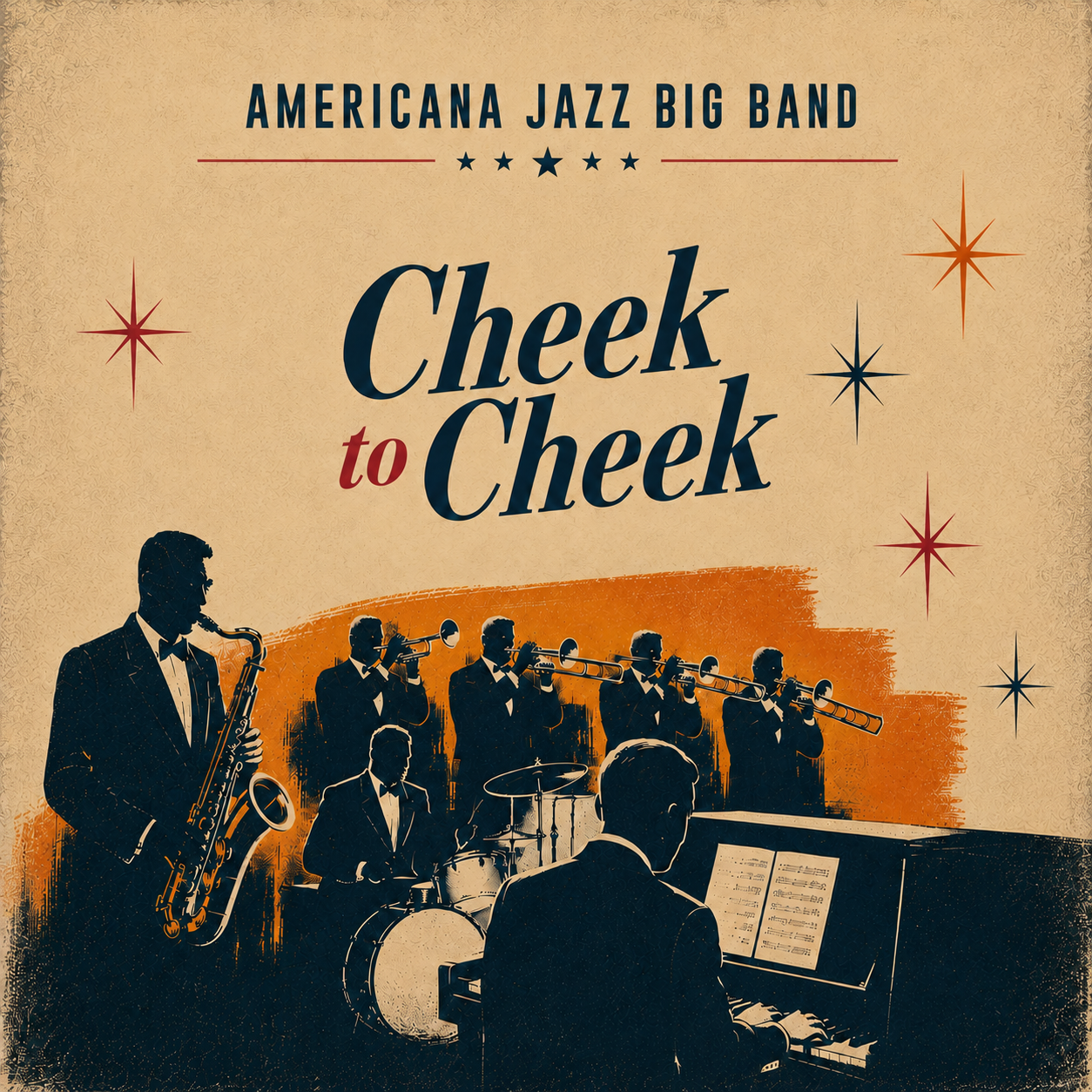
The Americana Jazz Big Band presents, on July 10th, a new version of “Cheek to Cheek,” a classic from the American repertoire, with a special interpretation by singer Mila Barros. Inspired by Ella Fitzgerald’s acclaimed recording and Paul Weston’s historic arrangement, the track is part of the group’s first album and reaffirms its commitment to preserving the language of great bands. In an interview, the musicians discuss the challenge of revisiting a landmark of vocal jazz, the importance of historical arrangements for the formation of a big band, and the collaborative atmosphere that marked the recording.
“Cheek to Cheek” is a song that transcends generations and carries a very strong imagery within vocal jazz. What made the Americana Jazz Big Band feel that this classic should be part of the creation of their first album?
Cheek to Cheek represents a very important moment in the history of jazz and big bands. When we thought about the repertoire for our first album, we wanted it to showcase not only the identity of the Americana Jazz Big Band, but also to pay homage to the works that helped build this language over time.
The inclusion of this song on the album directly aligns with this purpose. It’s a classic from the Great American Songbook and embodies the elegance, balance, and sophistication that characterized great orchestras. At the same time, it creates a very interesting counterpoint to our original arrangements, showing that preserving tradition and producing new interpretations are paths that can go hand in hand.
The choice of Paul Weston’s arrangement, immortalized in Ella Fitzgerald’s interpretation, reveals a desire to engage directly with the history of jazz. How was it to take on the responsibility of revisiting such an emblematic recording without losing the band’s identity?
We approach this responsibility with great respect. There is no intention to replace or reinvent an arrangement that has already become a global benchmark. Our goal was to study this composition in depth, understand Paul Weston’s musical choices, and present this work as faithfully as possible.
At the same time, no two interpretations are the same. The musicians’ personalities, the sound of the Americana Jazz Big Band, Mila Barros’ participation, and the fact that we recorded everything live give this version its own identity. We believe that preserving a tradition doesn’t mean reproducing it mechanically, but keeping it alive through new interpretations.
You talk about historical arrangements as true works of art for large ensembles. What does a big band learn, technically and artistically, by immersing itself in this repertoire?
You learn practically everything. The great arrangers built a language that continues to be a reference for those who write for big bands to this day. When we study these arrangements, we are learning about orchestration, voice leading, balance between sections, dynamics, articulation, use of harmonic tensions, and the construction of musical moods.
But there is also an artistic learning aspect. These arrangements reveal a way of thinking about music collectively, in which each instrument has a very specific function within the ensemble. This knowledge ends up directly influencing our own arrangements and helps us develop a more consistent authorial language.
The track seeks to preserve the elegance of great vocal jazz recordings from the 1950s and 1960s. How did you balance this respect for tradition with the energy of a contemporary Brazilian ensemble?
I believe this balance happens quite naturally. The arrangement preserves all the elegance and characteristic writing of the great recordings of that era, but the musicians playing are Brazilian, with their own experiences, references, and unique way of making music.
There is a great deal of spontaneity in the way we interact within the big band. This collective energy ends up appearing naturally in the performance, without it being necessary to modify the essence of the arrangement. The result maintains respect for tradition, but also reveals the personality of the Americana Jazz Big Band.
Mila Barros’s participation stands out as one of the central aspects of the recording. How did her voice transform the atmosphere of the track and its interaction with the sections of the big band?
Mila brought exactly the elegance that this song demands. She possesses a very refined interpretation, with great mastery of phrasing, dynamics, and intention—fundamental characteristics for a work like Cheek to Cheek.
Furthermore, the relationship between the voice and the instrumental sections is one of the most beautiful elements of this arrangement. The big band doesn’t just function as accompaniment; it constantly converses with the singer, responding to phrases, building textures, and expanding the musical narrative. Mila’s presence made this dialogue very natural and gave the recording a very special identity.
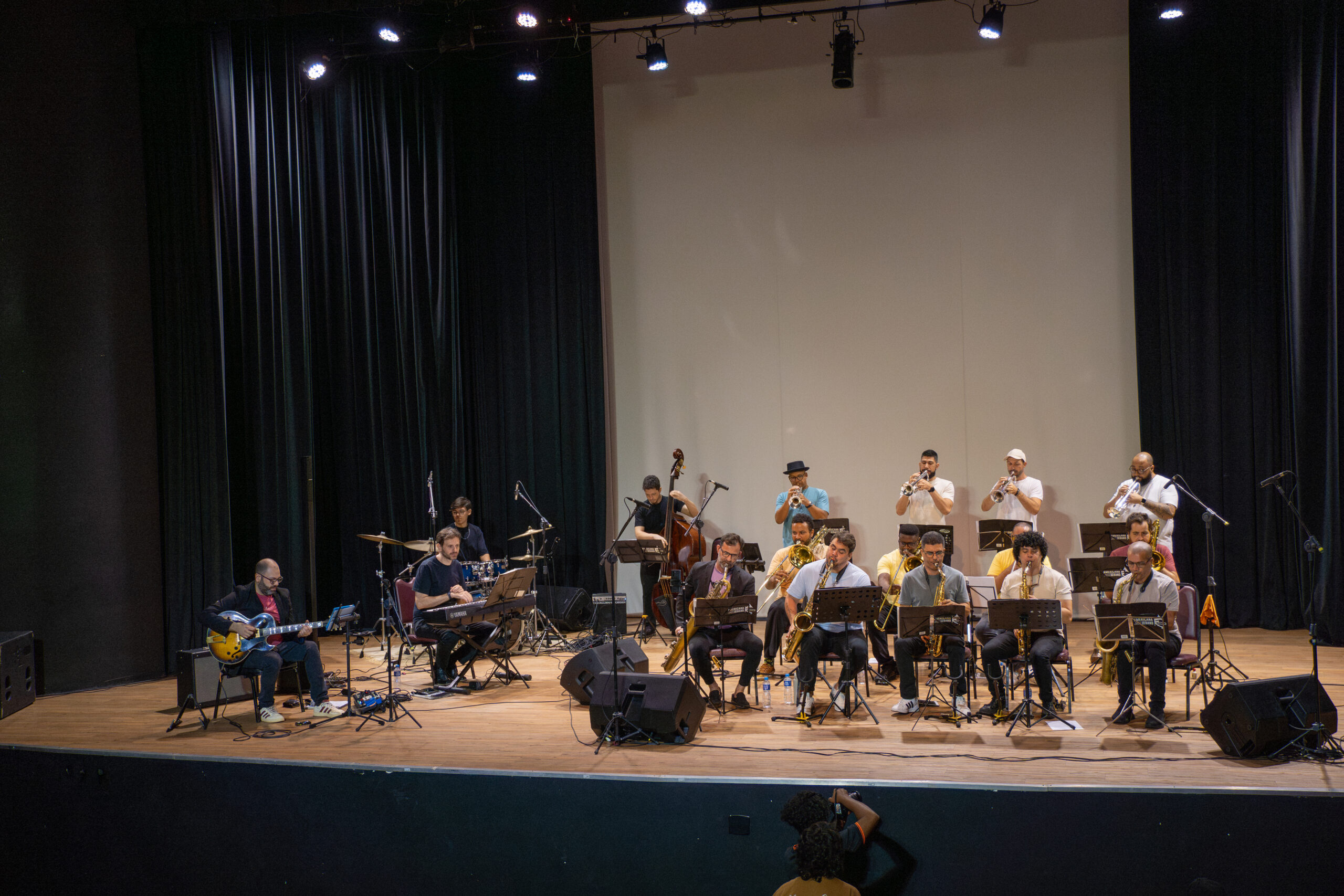
The live recording was made during the recording sessions for the first album, in a church in the city of Americana. How did the acoustics of that space and the atmosphere of that day influence the sound and emotion of the project?

They were a complete influence. The church offered very favorable acoustics for a formation of that size, allowing the big band to sound expansive, balanced, and natural. From the beginning, we wanted to avoid an overly processed sound and preserve the feeling of listening to an orchestra playing in the same space.
There was also a great deal of emotional weight involved. We were recording the first album of the Americana Jazz Big Band, so everyone was aware of the importance of that moment. The natural tension of a live recording ended up transforming into concentration and commitment, and I believe that this can be perceived in both the audio and the video.
The Americana Jazz Big Band was born in the interior of São Paulo, with the aim of strengthening large instrumental ensembles outside of major urban centers. What is the importance of building this type of musical scene originating from Americana?
There is both symbolic and practical importance to it. For a long time, major musical productions were concentrated in the capital cities, but the interior of São Paulo state brings together extremely qualified musicians, excellent music schools, and an audience that is increasingly interested in instrumental music.
Building a big band in Americana means showing that it’s possible to produce high-level art outside of major urban centers, creating opportunities for local musicians, and encouraging the development of new audiences. It’s also a way to strengthen the cultural identity of the interior, demonstrating that artistic excellence can emerge in different places when there is continuity, planning, and a commitment to quality.
“Cheek to Cheek” can reach both jazz lovers and people who may be discovering this universe now. What door do you hope to open for the public with this recording?
We hope this recording sparks people’s curiosity. Those already familiar with jazz will certainly recognize the importance of this piece and the arrangement we chose to interpret. Those discovering this world for the first time may find it an extremely accessible, elegant, and captivating piece of music.
If we can get someone to listen to Cheek to Cheek and want to discover Ella Fitzgerald, Paul Weston, the great big bands, or even explore other works by the Americana Jazz Big Band, we will have already fulfilled an important part of our mission. We believe that preserving this tradition also means creating new connections between this historical repertoire and today’s audience.
Follow Americana Jazz Big Band on Instagram