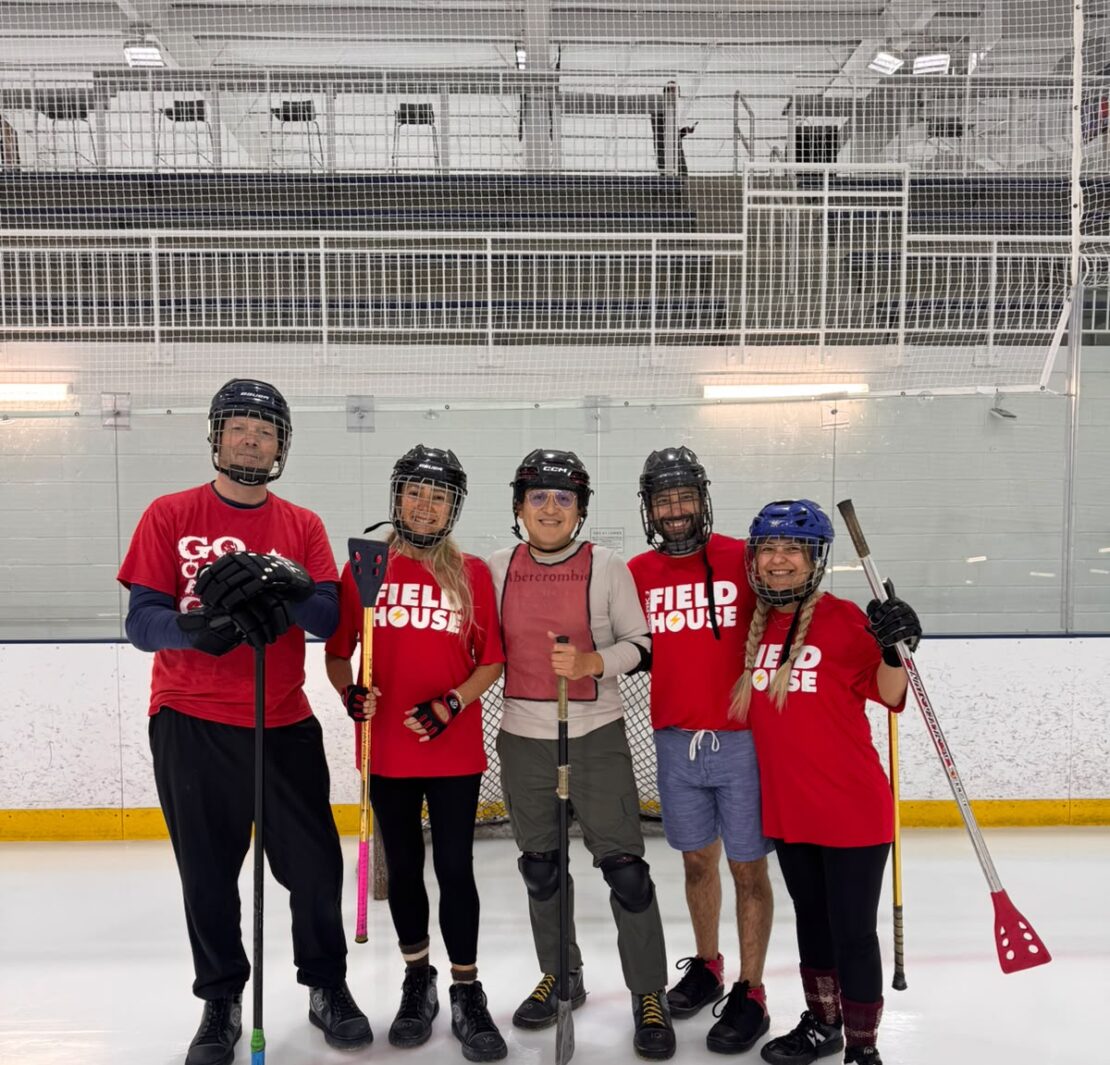
Have you ever heard of broomball?
Have you ever come across that name before?
If the answer is “no,” you’ve just discovered one of the most fascinating, exciting, and surprising sports played on ice. Despite being more than a century old, it remains virtually unknown to much of the world.
Picture a game played on an ice rink. Now take away the players’ skates. Replace the puck with a ball. Swap the traditional hockey sticks for sticks with a rubber head that resembles a small broom. The result is not a casual winter pastime, but an officially recognized sport with its own rules, national championships, international tournaments, and a passionate community of athletes.
Welcome to the world of broomball.
At first glance, it may seem like a distant cousin of ice hockey. But after watching just a few minutes of a game, it becomes clear that the resemblance is only superficial. Broomball has a character all its own. It combines the speed of hockey, the teamwork of futsal, the passing precision of handball, and the strategic thinking of basketball—all on a surface where balance becomes even more important than strength.
The story begins in Canada in the early twentieth century. During the country’s harsh winters, when lakes and rivers froze solid, local residents took advantage of the ice to organize informal games using whatever they had on hand: a ball, pieces of wood, and straw brooms. What began as improvisation gradually evolved into tradition. Over time, the straw brooms were replaced by equipment designed specifically for the sport, the rules were standardized, and broomball developed organized leagues, governing bodies, and international competitions.
One of its most remarkable features is also the first thing most people notice: no one wears skates.
Instead, players wear specially designed rubber-soled shoes that provide traction on the ice. This completely changes the dynamics of the game. Rather than gliding continuously, as in ice hockey, every sprint, stop, and change of direction demands explosive power, balance, and coordination. Watching a match is like watching a high-intensity race across a surface where a single misstep can turn an attack into a counterattack within seconds.
Another major difference is the ball. While ice hockey is played with a rubber puck, broomball uses a ball, allowing for a wider variety of passes, more unpredictable shots, and even more creative offensive plays.
Teams typically consist of six players, including the goalkeeper. The objective remains familiar: score goals. The game features offensive zones, defensive strategies, penalties, substitutions, and sophisticated tactical systems. Physical contact is generally more controlled than in traditional ice hockey, making the sport especially welcoming to women’s leagues and mixed-gender competitions, both of which are highly popular throughout North America.
Today, broomball is played by thousands of athletes in countries such as Canada, the United States, Japan, Australia, and several European nations. In American states like Minnesota, it has become an integral part of the local sporting culture. Clubs organize full competitive seasons, travel to national and international tournaments, and maintain a vibrant and active community.

Perhaps the most surprising aspect of broomball is that it has never needed to reinvent itself.
It has simply remained outside the spotlight.
At a time when new sports can become global sensations through social media in just a few days, broomball has followed the opposite path: more than a century old, firmly established, technically sophisticated, and yet still a brand-new discovery for millions of people.
After all, not every discovery has to be something new.
Sometimes all it takes is for someone to shine a light on something extraordinary that has been there all along—simply waiting for its next spectator, or better yet, its next curious player.