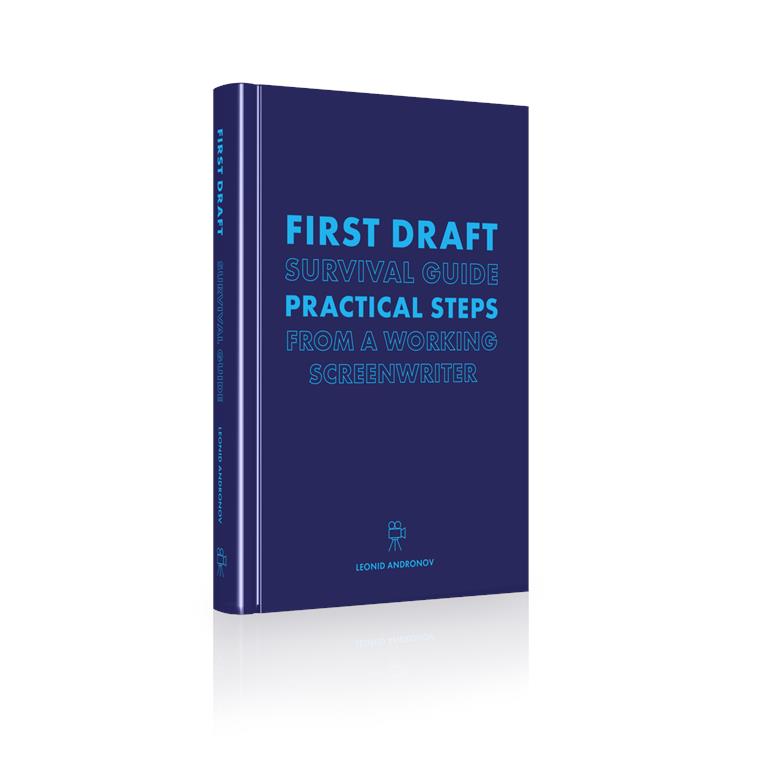
In First Draft Survival Guide, Leonid Andronov turns the fears, blocks, and uncertainties of the creative process into a practical reflection on how to survive the most difficult stage of writing: the first draft. In the interview, the writer, director, producer, and novelist reflects on imperfection, world-building, the audiovisual industry, and his desire to help emerging screenwriters understand that writing does not begin with perfection, but with discovery, persistence, and courage.
Your book First Draft Survival Guide focuses on one of the most challenging stages of writing: the first draft. What inspired you to turn that experience into a practical guide for other screenwriters?
The idea came to me while I was teaching screenwriting seminars in my hometown in Russia. I realized that general advice, rules, and clever tricks can be useful, but they don’t really help when someone sits down to write their first full-length screenplay. That stage is a journey of its own and, to be honest, it can be brutal.
Most screenwriting books teach you how to write a great script. They often use brilliant examples from big Hollywood movies, and of course those examples are inspiring. But at the same time they can be discouraging, because a first draft almost never looks like that. First drafts are usually rough, imperfect, and messy. So when new writers compare their own early pages to great scenes from famous movies, they often feel that something is wrong with them or their talent. Some even give up right there.
But they shouldn’t. Every screenwriter, even an experienced one, begins with something imperfect. The first task is not to write a masterpiece. The first task is to get through the story, to find the beginning, the middle, and the way to the ending. Once you have a complete draft, you have something real. It may not be brilliant yet, but it can be changed, shaped, rewritten, and polished. There will be a second draft, a third draft, maybe a tenth. And each one can bring the script closer to what it is supposed to become. I think writers need to hear that. That was the reason I wrote First Draft Survival Guide.
You speak about creative fear and writer’s block. In your view, why is the first draft often the hardest stage for so many writers and screenwriters?
I think the first draft is so difficult because it is the stage where everything is still unknown. And the unknown is probably what scares us the most. You may have strong ideas, you may clearly see certain scenes, you may even feel that you understand your characters, but the moment you face a blank page, everything suddenly becomes fragile, or silly, or doesn’t make sense. You realize that, in practical terms, you don’t really have anything yet.
Let’s compare it to building a house. Imagine you come to the place where your dream home is supposed to be built, but you have no blueprint, no concrete, no bricks, no wood. Nothing. How are you supposed to build it? In real life nobody starts construction without some kind of plan, but with a screenplay, many writers do exactly that. They try to build the whole thing out of excitement, fear, instinct, and hope. Those things are important, but they are not the same as bricks, wood, or a blueprint.
In First Draft Survival Guide, I talk a lot about how to begin before the actual writing begins. I don’t think this stage is discussed enough in many screenwriting books. Writers are often told to start with a logline, but for some people, especially at the beginning, a logline can feel like torture. It forces you to define the story before you have truly discovered it.
I believe there are more natural and enjoyable ways to enter a story. One of them is to begin with images. Create a folder on your computer and start collecting pictures that resemble the world of your film: locations, characters, clothes, objects, streets, rooms, colors, faces. If you have two main characters, create separate folders for them. Start casting the film in your imagination. Look for actors who could play them. Think about where they live. Find images of their city, their apartment, the streets they walk through.
It may sound simple, but cinema is a visual art form, so it makes sense to start visually. And very often, while looking at these images, you suddenly begin to hear dialogue, imagine scenes, discover jokes, conflicts, details, relationships. You are not forcing the story anymore. You are inviting it to appear. That is only one example, of course. But for me, the main idea is this: the first draft becomes less frightening when you stop treating it as a test of your talent and start treating it as a process of discovery.
As a screenwriter, director, producer, and novelist, you move between different forms of storytelling. What changes in your creative process when you are writing a screenplay compared to a novel?
Honestly, the creative process is almost the same. It doesn’t really matter what I write — a novel or a screenplay. A story is still a story. As a writer, you need to understand the world, the characters, their intentions, the theme, the subtext. Basically, you need to dive into this new world, the one you are creating.
For me, it starts with research, and this stage is almost the same for a script or a book. I make questionnaires for myself, write bios for my characters, collect articles, images, books, references. The bigger the story, the more folders you have.
Then, when you start writing, you are still telling a story, but you are telling it in a different language. It’s important to understand that a novel, or any other piece of prose, is a final product. Your reader is a regular person who opens the book and enters your world directly.
A screenplay is different. A screenplay is a blueprint — a document for a film that may be shot in the future. It still has to be emotional, entertaining, and alive, but it also has a practical function. It will be read by film professionals: producers, directors, actors, cinematographers, production designers, and many others. They need to see the movie through your words.
So yes, the creative process is similar, but the form changes your responsibility. In a novel, you can give the reader the whole experience yourself. In a screenplay, you create a map for other people to build that experience with you.
Your work combines artistic creation with reflection on the industry itself. What do you believe emerging screenwriters most need to understand today about the audiovisual market?
I think emerging screenwriters need to understand that today they are not only writers. They are also entrepreneurs. Maybe many writers don’t like to hear that, but it’s true.
Of course, the script comes first. If you don’t have a good story, nothing else will save you. But a writer should also understand the business side of the profession: who does what in the industry, how projects are developed, what producers are looking for, what kind of budgets exist, what “marketable” really means, and why people may love your script but still say no.
I also think writers should learn the professional language of the industry. Otherwise, very quickly, you become the only person in the room who doesn’t understand what is really being discussed.
And, of course, networking matters. It may take a long time before someone serious finally reads your script. That’s normal. But when that moment comes, it is always better to have more than one project. If they pass on the first one, you should be able to say, “No problem. I have another.”
At a time when so many writers feel pressure to make something perfect from the beginning, what is the importance of embracing imperfection as part of the creative process?
That’s exactly what nobody really talks about enough. There is a reason many writers call the first draft “the shitty first draft.” It sounds funny, but it is also very healthy to understand. The first draft cannot be perfect, and it doesn’t need to be.
The purpose of the first draft is not to create a masterpiece. The purpose is to find the core of the story, understand your characters better, and somehow reach a more or less coherent ending. That is already a huge achievement.
You don’t get a perfect diamond straight from the ground. There are stages. The first one is usually the hardest because you are still discovering what the story really is. But the good news is that later drafts are often easier and even more pleasant. Now you are not staring at nothing. You have material. You can change it, shape it, cut it, polish it. You can finally work with something real.

Beyond the book, you are also the author of Amulet: The Chamber of Stolen Hearts. How do fantasy and world-building influence the way you think about storytelling across different genres?
Fantasy teaches you one very important thing: every story needs a world. Of course, in fantasy it is more obvious. You may have kingdoms, magic, strange creatures, ancient rules – everything that makes this world feel real. But honestly, even the simplest realistic story requires world-building.
If you are telling a story about two friends sitting in a kitchen, you still need to understand the world around them. Who are their families? Where were they born? What did they study? What do they like? What are they afraid of? What do they believe about life, people, money, love? The more you know, the more alive the story becomes.
Even if you never mention the parents of your main character, you should know who they are. You should know what kind of relationship they have with their son or daughter. You should know what your character dreamed about as a child and what they want now. These things shape people. They make characters specific, and specific is always better than generic.
So for me, world-building is not just about fantasy maps or mythology. It is about creating the invisible structure behind the story. The world you create – or the lore, if we use that word – gives your characters rules. It determines where they can go, what they can say, what they cannot say, what they hide, what they want, what they would never do.
That is why fantasy has influenced the way I think about all genres. It reminds me that a good story does not happen in empty space. It happens inside a world. And the more you understand that world, the more naturally your characters can exist inside it.
Looking at your journey across film, literature, and screenwriting education, what kind of legacy do you hope to build as a storyteller and creative mentor?
I don’t really think about legacy in a big, monumental way. I just try to do what I feel I have to do – write the stories I need to write, make the films I need to make, and share whatever I have learned with other writers.
Of course, I would be happy if my work could help someone in some way. Not necessarily change the whole world. That would be too much to ask. But maybe help one person to continue writing, or to understand themselves better, or to feel less alone in their creative struggle.
I remember that a few years after my first feature film was released, one of the actors who had worked on it told me that the experience had forced him to rethink his life. He made serious changes in his life and focused more deeply on music and teaching. Of course, it was his life and his decision, so I don’t want to take credit for that. But I was part of that moment, and it reminded me that stories can touch people in ways we never fully control.
So maybe that is the kind of legacy I would hope for. Work that helps someone move, change, write, create, or simply not give up. If that happens, then my efforts were not in vain.
Follow Leonid Andronov on Instagram