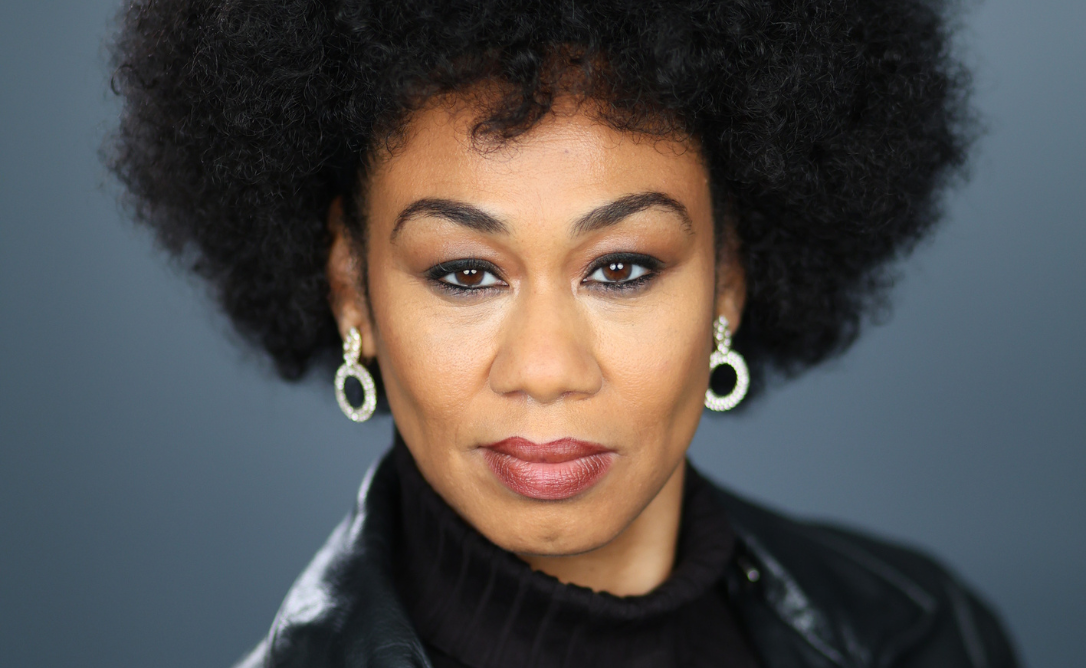
In I Play Rocky, J Nycole portrays journalist Diana Lewis, who appeared as herself in the original 1976 Rocky. What began as another acting role became something far more personal for the actor, producer, and storyteller: as Nycole learned more about Lewis, she realized she was portraying a woman whose significance risked being diminished or overlooked once again. That realization led her to push for Lewis to be identified by name in the film’s official credits. “I could not let this woman be forgotten or overlooked.”
In the interview, Nycole reflects on the responsibility of portraying a real person, the importance of preserving Black women’s identities within history, and how that instinct has been part of her life since age 12, when she interviewed her uncle about his experience during the Great Depression. She also discusses her theatre background, her move into writing and producing, and the projects she is now developing to recover the stories of women who have too often been left outside the narratives considered “respectable.”
In I Play Rocky, you portray Diana Lewis, a pioneering journalist who appeared as herself in the original Rocky. What most intrigued you about realizing you would be playing a real person who was part of that history, but whose name may not be immediately familiar to much of the audience?
I think the realization that she was playing herself! Anthony Ippolitio actually helped me realize that! There was a discrepancy in the script, so he looked into it. Then on set when the discrepancy came up, he and I had a private conversation where he basically explained what it was and that she was playing herself. So, in essence, he (and I) ensured we kept our characters true to what actually happened back in 1976.
You spoke with Peter Farrelly and Peter Gamble about the importance of honoring Diana Lewis by name, and she is now listed by name in the film’s official cast. Why did that detail matter to you, and what does it say about the difference between simply showing someone in history and actually preserving their identity within it?
That detail mattered to me because she was a real person. This is a biopic; she’s a real person; and her name was mentioned 3 times across the three different scenes we shot. Too often Black women are undervalued, marginalized, or even “invisible”. I didn’t want that to happen on MY watch. As the only Black woman in the film, I wanted to make sure that didn’t happen to Diana Lewis. The least we could do was honor her by putting her name in the credits. After working with both Peters and getting to know them, I was confident that I could bring this to them, they would hear me out, and be willing to make that adjustment… and of course they were. They’re fantastic.

Your bio mentions that, at 12 years old, you interviewed your uncle about his experience as a Black man living through the Great Depression simply because you wanted to preserve his story. Looking back, do you see a direct connection between that young girl and the artist you are now, drawn to stories that have often been forgotten or overlooked?
Absolutely! I learned about The Great Depression in school, but at 12 years old, I was clear that I hadn’t really learned how it affected the already impoverished Black community at the time. I figured I had a direct source, so I wanted to take advantage of that while I could. And now, I’m developing a film called The Woman Who Knew about a Harlem sex worker in 1928 who learns from her white vice officer client that they plan to raid the Black nationalist meeting she’s quietly funding. She’s tormented over how she can save the people fighting for her community without losing the movement she loves. No one except historian Lashawn Harris is talking about how sex workers, numbers runners, and other “disreputable” women funded these “respectable” movements, like the Black Nationalist and Civil Rights movements because these women weren’t deemed worthy. So their role in this important part of history is lost. There are no direct sources still living, like there was when I got to interview my uncle, but I’m doing my best to restore this part of history using the information I’m finding in Harris’ book, Sex Workers, Psychics, and Numbers Runners: Black Women in New York City’s Underground Economy.
Diana Lewis is another example. I didn’t audition for the role or even come into it after booking it with the mindset of telling the story of this woman that had been forgotten or overlooked, but it kind of unfolded that way. I just started working on it without fully understanding her significance, but as I got to know her more and more, I was blown away. She could be dismissed as “just a reporter” or “just an actress,” but we’re talking about a multiple Emmy Award-winning journalist- a Detroit legend- here and her scene in the Rocky movie is iconic, so much so that it has a pivotal role in I Play Rocky. I could not let this woman be forgotten or overlooked.
You have built a career across Broadway, television, and film, while increasingly stepping into writing and producing as well. Was there a moment when you realized that performing stories was no longer enough and that you also wanted a voice in deciding which stories get told?
Yes! When I realized that I wasn’t getting cast in the types of stories that I REALLY wanted to tell- stories that spoke to ME. So that’s when I created my first project, Working Out the Kinks- a comedy series about an actress who feels the industry is asking her to erase or “modify” her Blackness. It won many awards on the festival circuit, then got picked up and aired on BlackOakTV, and later on KweliTV (where it is still streaming).

From The Book of Mormon and West Side Story on stage to a film production like I Play Rocky, how have those different mediums shaped you as an actor? Is there something theatre taught you that you continue to carry into your work on screen?
Yes! It’s funny that you ask that because literally on set of I Play Rocky one of the acting coaches asked me between takes if I was theatre trained. I, of course, said yes, and he said, “Yeah, we can tell. You’re nailing it every time.” So I think theatre has taught me to know my role extremely well and be super prepared because in theater, there is no “CUT!” In theater, we rehearse and rehearse and rehearse because when it’s time to perform, no matter what happens, the show must go on. No actor wants to go out there not knowing what they’re doing, not knowing their lines, not knowing their intention, not knowing their character, or not embodying the character. The audience is right there. They’ll be able to tell. There’s no “CUT” to save you. There are no edits to save you. There’s no cutting away to another character to save you. There’s no “we’ll fix it in post” to save you. You MUST be on. AND you must do it time and time again- every night; 8 shows a week. Pete (Farrelly) was thoroughly impressed with how “solid” (his word) I was to the point that after a few hours of shooting, I did fumble my words during one take. He looked at me, winked, and said “Well, it was bound to happen. Nobody’s perfect.”
Producing and developing your own projects gives you greater control over which characters and perspectives receive space. How do you balance the desire to preserve important stories with the need to first create characters and narratives that connect emotionally with audiences?
Honestly, I don’t think there’s a balance that I have to find because important stories that I connect with emotionally seem to come to me, and I figure that if I connect with it emotionally, I won’t be the only one. There will be an audience that connects with the story emotionally, as well.
You seem to return often to the idea that some stories can disappear if no one chooses to record them. Today, as an actor, writer, and producer, what kind of legacy would you like to build through the stories you choose to preserve and put into the world?
I’m building and continuing my parents’ and grandparents’ legacy of education, upliftment, bringing awareness, empowerment, activism, and Womanism to and about the Black community and our history.
Follow J Nycole on Instagram