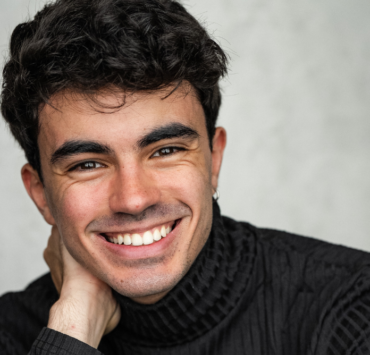
Taking on Katniss Everdeen in The Hunger Games: On Stage, Elizabeth Anderson tried, for a moment, to set aside the weight of playing one of pop culture’s most recognizable characters and look at her for what she sees as her core: a sixteen-year-old girl who was forced to grow up far too quickly. Amid the violence of the Games, the expectations of the Capitol, and the symbolic role she never set out to claim, Anderson found an intensely sensitive Katniss whose strength comes largely from the need to protect the people she loves.
In the interview, Anderson discusses finding her own emotional truth within the character, revealing vulnerability to an audience of 1,200 people, and building Katniss’s very different relationships with Peeta and Gale alongside Vinnie Copeland and Nathan Stokes. She also explains how moments of breaking the fourth wall feel almost like journal entries and why one idea continued to guide her performance beneath the scale of the production: “She’s just a sixteen-year-old girl who has been thrown into a world where simply staying alive is her biggest fight.”
Katniss Everdeen is a character millions of people already picture in a very specific way. When rehearsals began, how did you find room to create your Katniss without feeling that you had to reproduce previous interpretations?
Through my experience and training, finding the emotional truth of a character is something that I prioritise and is really key to my process. Katniss is a character, specifically in our stage adaptation, that tells the audience what she really thinks through subtext, and that unspoken truth will be different for everyone who plays her. But I’ve found it really exciting and fun sifting through the source material; it’s not every day that you play a character with so much traction. Throughout the process, I have also stopped looking at the story as The Hunger Games, the household story we all know and love, and instead I’ve started looking at the story at face value. This is a story about a young girl who had to grow up incredibly quickly, and we watch her journey to becoming an activist standing up to a corrupt society that, ultimately, has failed her.
Katniss spends much of the story trying to survive while also becoming a symbol for other people, often without choosing that role for herself. What interests you most about the tension between who she is privately and what the world demands that she represent?
Katniss is a private person, so seeing what happens when she is put in front of a crowd is really interesting. I think what’s important to remember is that all of her decisions are fuelled by the intention of protecting her family, most importantly her little sister Prim. Her eventual affiliation with the Mockingjay I always find incredibly clever and something I think she really revels in. They are both accidental creations by the Capitol due to a failed system. Privately, Katniss has had to think very logically and efficiently for the majority of her life. Through just her name itself, ‘Katniss’, which refers to a self-sufficient plant that saves people from famine, we understand that food and survival are vital. The Latin name for the same plant literally means ‘arrow ’, which I always find quite satisfying from Collins character building. She’s a girl who had to think solely about retrieving the basics for her family. But then, parading her in front of the Capitol’s public with people who are grotesquely indulgent and have never had to worry about anything is a really fun thing to play. It’s a completely different world that, I think, Katniss sees right through.

On screen, a camera can capture the smallest glance, while on stage you have to reach a live audience of up to 1,200 people. How does that shift in language affect the way you express Katniss’s vulnerability and strength?
It’s definitely been a challenge throughout the rehearsal process. Katniss hides her emotions and often covers them with a scowl, so on stage I’ve had to focus on physicality and body language to communicate those smaller shifts to a large audience. There are also moments where she breaks the fourth wall and speaks directly to the audience, which I see almost like journal entries. They allow us to see Katniss as herself, rather than the guarded, fierce and independent girl she presents to everyone else.
Because theatre is live, those moments can never be exactly the same twice. Unlike film, you can’t rely on the camera to capture the smallest glance, so I have to make choices that are clear enough to reach 1,200 people while still feeling intimate and truthful. There is so much happening in the production, but my priority is always telling Katniss’s story and making sure her vulnerability doesn’t get lost within the scale of the show.
The Hunger Games contains action and danger, but much of Katniss’s strength comes from deeply personal bonds — with family, friends, and the people she wants to protect. What have you discovered about her through building those relationships in rehearsal?
I think I’ve discovered that Katniss’s relationships reveal just how sensitive she actually is beneath all that strength. She sees the world quite literally and, in her mind, relationships can be very transactional: you help me, I help you; you save my life, I owe you. She really struggles with owing people because, to her, it creates a debt and therefore a vulnerability.
I think a lot of her strength comes from her father and what he taught her about survival. Even with Prim and her mother, she feels she has to maintain this facade that everything is okay. Gale is probably the person she can soften with the most, although even then she’s confused about her feelings towards him. Through building those relationships, I’ve realised that her instinct to protect people comes from how deeply she feels things. She’s incredibly sensitive; she just doesn’t always know how to express it.

You are joining an established production as part of a new company. What has it been like developing your own dynamic with Vinnie Copeland and Nathan Stokes for relationships audiences already know so well between Katniss, Peeta, and Gale?
It’s been really fun developing Katniss’s relationships with Gale and Peeta because they bring out completely different sides of her. With Gale, there’s a familiarity and shared understanding; they’ve grown up together and have this instinctive, almost unspoken connection. With Peeta, there’s much more uncertainty; there’s a lot of complicated emotion between them, and Katniss doesn’t always understand what she feels towards him or how to respond to the patience and kindness he shows her.
Vinnie and Nathan both bring so much warmth and individuality to their characters, which makes Katniss’s guardedness such an interesting contrast. I’ve really enjoyed collaborating with both of them and seeing what they bring into the rehearsal room. Even though audiences know these relationships so well, we’ve found our own dynamic within them, and I’m really excited for audiences to see what we’ve created together.

Suzanne Collins created a heroine who often resists what others expect of her, including conventional ideas of heroism. After spending time with Katniss in rehearsal, is there something about her that you now understand differently?
I think the biggest thing I understand differently about Katniss now is just how young she actually is. We can forget that because she’s had to grow up so quickly. Suzanne Collins draws on a long tradition of literary heroines, particularly Bathsheba Everdeen in Thomas Hardy’s Far from the Madding Crowd. You can see that influence in Katniss; both are fiercely independent, resistant to the roles society tries to place them in, and determined to make their own choices. But Katniss is having to navigate those instincts in a world where survival is at stake, while still being a young girl asked to make decisions that even adults would struggle with. She lives in constant survival mode; there is no off button, and I think that has completely shaped the way she sees the world.
Something else we’ve discovered in rehearsal is a real sense of community in District 12: there’s this instinct to put other people before yourself. You see it across so many of the characters, and Katniss embodies that completely. She never sets out to be a heroine or a political symbol; she’s simply trying to protect the people she loves and survive. Understanding how much her environment has shaped her has given me a much deeper understanding of why she makes the choices she does, and why her journey from young girl to heroine feels so powerful and relevant.
When you first step on stage as Katniss on October 23, what do you hope audiences immediately recognize in the character — and what do you hope they discover anew through your interpretation?
The braid! Ha! Joking aside, I hope audiences immediately recognise the fiery, headstrong and witty Katniss they love. But I’d also like them to discover the softness and sensitivity underneath that side of her which is completely overwhelmed by the enormity of what’s happening to her.
Ultimately, I hope they see a young girl doing whatever she can to “stay alive”. That phrase is so important to her it’s Haymitch’s first and last piece of advice, and it’s something she keeps coming back to. I’ve found myself coming back to it throughout this process too, because it cuts through everything else. Beneath all the spectacle, she’s just a sixteen-year-old girl who has been thrown into a world where simply staying alive is her biggest fight.
Follow Elizabeth Anderson on Instagram