What if intelligence has never been the problem?
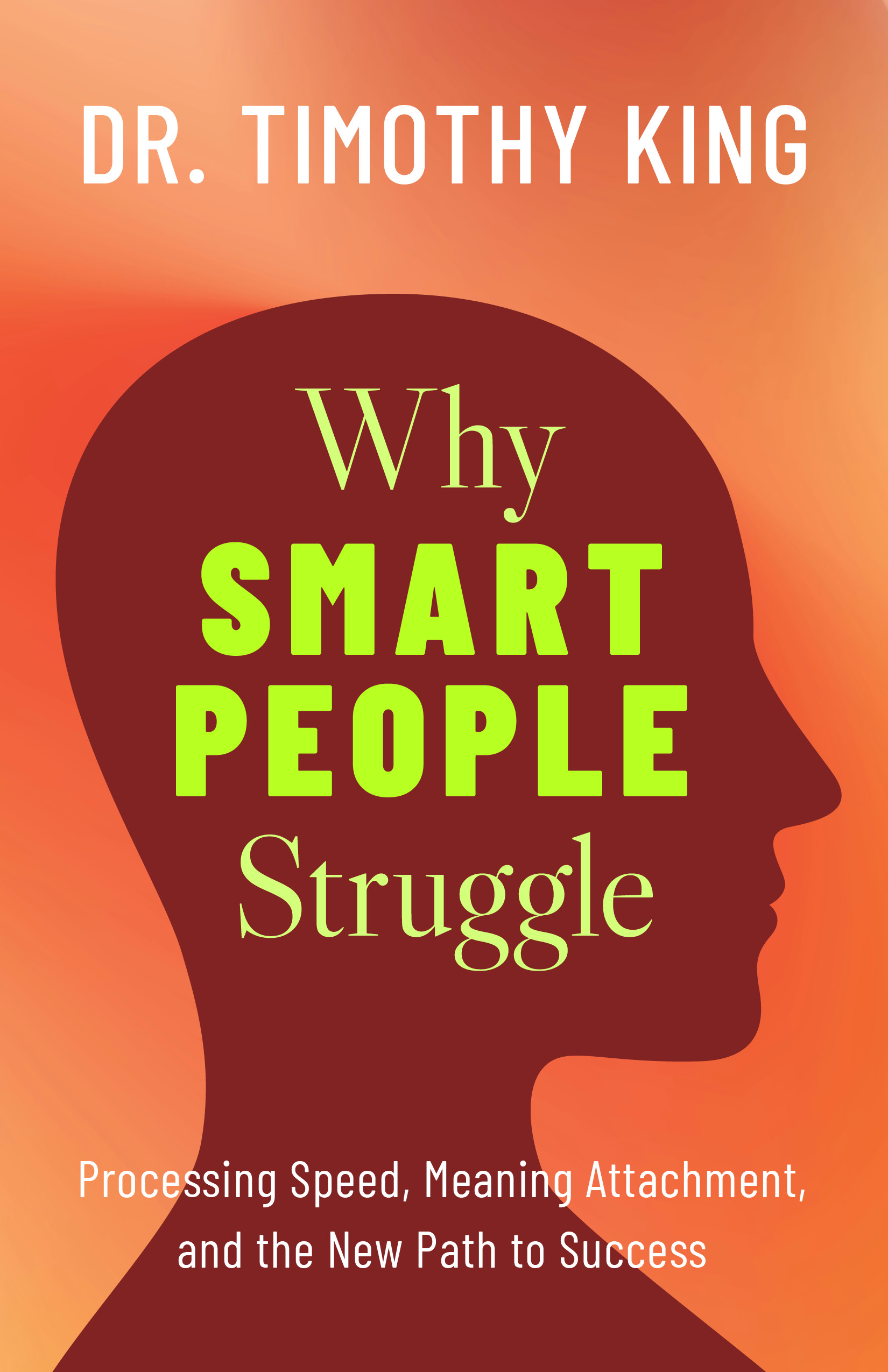
That provocative question sits at the center of my forthcoming book, Why Smart People Struggle: Processing Speed, Meaning Attachment, and the New Path to Success. Its newly revealed cover captures the paradox immediately: a bold human profile contains a title that speaks to millions of students, professionals, parents, teachers, clinicians, and families who have watched intelligence and performance travel in very different directions.
The title is not suggesting that intelligence creates struggle. It asks why intelligence so often fails to protect capable people from it.
Every day, bright students spend twice as long as their classmates completing assignments. Professionals leave meetings believing they understand what was decided, only to discover later that an important detail never became part of their understanding. Children solve a difficult problem one day and miss an apparently simple instruction the next. Adults who possess sound judgment, strong language skills, and extensive knowledge may still struggle to organize, retrieve, or apply information under time pressure.
The visible outcome can be disappointing. The conclusions drawn from it can be devastating.
“He was not listening.”
“She can do it when she wants to.”
“He needs to try harder.”
“She is careless.”
“He is unmotivated.”
For more than forty-five years, I’ve evaluated thousands of children, adolescents, college students, professionals, and adults. Again and again, I’ve found that such judgments frequently mistake the consequence for the cause.
Intelligence describes a person’s capacity. Performance reflects how effectively that capacity can be accessed and expressed under specific conditions. Those are not always the same.
When Information Does Not Become Understanding
This may sound deceptively simple, but receiving information is not the same as understanding it.
A person may hear every word of a lecture, conversation, medical consultation, or business meeting without fully incorporating the meaning of what was communicated. Information arrives, but it may not become sufficiently connected, organized, and integrated to guide accurate reasoning and action.
I call that process “meaning attachment.”
For many people, information and meaning move together. A direction is heard, interpreted, connected to prior knowledge, and understood with little conscious effort.
For others, meaning may arrive more slowly.
They need additional time to reread, reflect, organize, or formulate a response. These slow processors frequently know they need more time. They say:
“I understand it eventually.”
“I know the answer. I just need another minute.”
“I need to read that again.”
Their difficulty is often visible, both to themselves and to others.
I’ve also identified another experience I call “distorted processing.”
In these instances, the individual may sincerely believe understanding has occurred even though important pieces of information remain missing or were inaccurately integrated.
This is not dishonesty. It is not intentional distortion nor the same as the cognitive distortions associated with biased or irrational thinking. The person does not know that something has been missed.
The brain naturally searches prior knowledge, experience, expectations, and logic to create a coherent interpretation of incoming information. Most of the time, that predictive ability is extraordinarily useful. It helps us recognize a familiar face from a partial glimpse, complete an unfinished sentence, and anticipate the next step in a routine process.
Trouble begins when prediction quietly substitutes for information that never became understanding.
The resulting interpretation can feel complete. It may even be sophisticated and logical. Yet it rests upon an incomplete foundation.
This explains one of the most consequential observations in my upcoming book, Why Smart People Struggle:
Confidence and comprehension are not synonymous.
Confidence is a person’s subjective sense of certainty. Competence is demonstrated through accurate explanation, application, reasoning, and performance.
The two often develop together, but not always.
A person may feel entirely confident because the gap itself remains invisible.
By the time the misunderstanding is discovered, it may already have affected an examination, a project, a medical decision, a relationship, or an opportunity.
As I convey in the book:
“The most dangerous processing gap may not be the one someone recognizes. It may be the one they never knew existed.”
The Question That Makes Understanding Visible
Most of us have been taught to ask a familiar question:
“Do you understand?”
The problem is that people experiencing an invisible gap will usually answer honestly.
“Yes.”
They believe they do.
I propose a more revealing question:
“What did you understand?”
The difference is profound.
“Do you understand?” invites reassurance.
“What did you understand?” invites explanation.
It makes comprehension visible by asking the listener to organize, express, and apply what was received.
That question can transform communication in classrooms, homes, workplaces, medical settings, and relationships.
It also shifts responsibility away from blaming the listener alone. Communication is not complete merely because information was delivered.
It is complete when both people have reached sufficiently shared meaning.
That principle becomes especially important when performance is inconsistent.
A student may complete one assignment beautifully and misunderstand the next. An employee may master a complicated procedure and later miss a seemingly obvious instruction. A child may demonstrate extraordinary insight in conversation yet struggle to recall information heard only moments before.
Such inconsistency is often interpreted as proof that the individual could perform successfully all the time if sufficiently motivated.
I urge you to consider another question:
What changed in the processing demands of the task?
Fatigue, anxiety, time pressure, distractions, complexity, working-memory demands, and the way information is presented can all affect processing accuracy.

The inconsistency is real, but it is not necessarily evidence of inconsistent effort.
Invisible misunderstandings produce visible consequences.
Observers see the error.
They rarely see the processing gap that preceded it.
A New Path to Success
Why Smart People Struggle does not stop at explanation. It offers a practical path forward.
Slow processors may benefit from additional time. Distorted processors need methods that verify and deepen understanding.
Previewing information, recording key discussions, summarizing, discussing, writing, teaching, and applying material can provide another opportunity for meaning to take hold.
Repetition and reprocessing are not the same.
Repeating the same words may send information along the same unsuccessful route.
Reprocessing asks the individual to engage with the material differently: explain it in personal language, connect it to an existing experience, draw it, teach it, compare it, or use it.
Appropriate accommodations do not make a task easier or reduce the standard.
They create conditions under which ability can be demonstrated more accurately.
That shift can also change how people understand themselves.
Years of inconsistent results often produce beliefs that extend far beyond performance. Capable people may conclude that they are lazy, careless, unintelligent, incapable, or destined to disappoint themselves and others.
Anxiety, perfectionism, avoidance, self-criticism, and diminishing confidence can follow.
When the source of the struggle is finally understood, the individual no longer must treat a processing difference as a character flaw.
Strategy can begin replacing shame.
Effort can feel worthwhile again because success no longer seems arbitrary or unreachable.
More than a book about learning differences, Why Smart People Struggle is a book about human potential.
It asks readers to look beneath outcomes, question easy labels, and become more curious about what happened between receiving information and trying to use it.
Be sure to look for it in the fall of 2026!
About the Author
Timothy King, Ph.D., is a psychologist, educator, and recognized authority on cognitive and information processing.
For more than forty-five years, he has evaluated thousands of children, adolescents, college students, professionals, and adults, helping families, schools, universities, employers, attorneys, and other professionals understand the hidden processing differences that influence learning, performance, communication, and opportunity.
Drawing on clinical practice, research, evaluation, advocacy, and expert testimony, Dr. King has devoted his career to challenging misconceptions about intelligence and achievement.
His work has helped individuals secure appropriate accommodations, overcome years of misunderstanding, and recognize that their struggles often reflected differences in processing rather than limitations in ability.

With over 30 years of experience in television, Claudia has worked as a reporter, producer, and editor. One of her books was publicly endorsed by the President of Brazil, earning her lifetime seats in literary academies in Brazil, the United States, and Europe. Having lived in Cuba, Mexico, the United States, and across Europe, Claudia speaks fluent English, Spanish, Italian, and Portuguese. With a career involving government, media and education, Claudia believes that communication is a bridge, and her mission is to make it human, strategic and transformative. She possesses BAs in Journalism and Advertising, an MS degree in Political Science and International Relations, and an MBA in Marketing. She was a UN fellow at the Hebrew University of Jerusalem and an alumna of Brazil’s Superior War College. She is currently doing a Ph.D. in Strategic Communications.