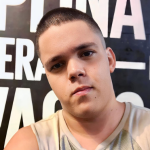
Singer-songwriter Che Romaro will release the single “Vagabundo” on February 27th through Marã Música, marking a new phase in his artistic career. For the first time, the artist records a song not of his own authorship—originally composed by Ariel Rot—and also presents his first fully acoustic recording. In an interview, Che talks about his deep identification with the song’s narrative, which addresses mistakes, searches, and new beginnings, and reveals how the translation into Portuguese was born spontaneously during the pandemic. With voice and guitar in the spotlight, “Vagabundo” reinforces a more intimate and direct aesthetic, highlighting the strength of the lyrics and the emotional connection that runs through his artistic journey.
“Vagabundo” is your first officially released song that isn’t your own composition. How was it, emotionally, to give voice to a story that originated from another artist, but that you feel is your own?
I discovered Ariel Rot’s music in 2012 and immediately loved it. Both his solo career and the songs from his band Los Rodríguez. It was a pleasant surprise. And since then, he’s been a staple in my playlist. Some time later, I found the song “Vagabundo,” which became my favorite. I started playing it on the guitar, still in the Spanish version. But I have a habit of trying to translate the songs I like most into Portuguese. This is one of them, one of those songs I wish I had written. When I played it with friends, they always asked if it was mine. And I always make a point of saying no, that I only translated it and recommend that they listen to Ariel Rot; I think it’s a way to introduce other artists’ music to people who prefer listening to Portuguese. It’s been working.
You mentioned that this song seemed to tell your own life story when you first heard it. At what points in your journey do you most see yourself in this character who wanders in search of meaning?
“Vagabundo” (Vagabond) speaks of someone who has walked a long way, who has succeeded, failed, found themselves, gotten lost; it talks about living and encountering obstacles, loves, stories that transform us into who we are. As the lyrics say, “better to have a bad story than nothing to tell.” I’ve walked quite a bit, I was born in São Paulo, lived as a child in Salvador, then spent my adolescence in Rio, returned to São Paulo at 15, started Envydust, dismantled Envydust, fell in love, had my heart broken, then lived for a while in Madrid (when I discovered Ariel’s music) and in Lisbon. Always making music and telling stories. Always trying to make good choices, not always succeeding. But moving forward.

The decision to translate the song came about in an unpretentious, almost intimate way. At what point did you realize it had the potential to conquer the world and stop being just something shared among friends?
I gradually became familiar with the song, it became part of my repertoire, and I wanted to share it with more people, hoping that Ariel Rot would like it… Recording this acoustic version, just the way I usually play it with friends, is a way to honor this artist I follow and who follows me without knowing it. I hope he likes it when he hears it.
Recording a track with just guitar and vocals takes courage, because everything is more exposed. What did this acoustic format reveal about you as a performer and as an artist?
I liked the result; we’re really more exposed with just the guitar and vocals. But I really like the arrangement I made—simple and direct. It’s a song that captivated me with its vocal melody and lyrics; I think that, in its raw form, it emphasizes those two things.

The term “vagabond,” in the song’s original sense, speaks more of searching than of loss. Do you feel, in some way, like an artistic wanderer, someone still under construction and discovering paths?
In Spanish, the term “vagabond” doesn’t have the pejorative connotation it has acquired in Portuguese. A vagabond is someone who wanders, a wanderer, a Don Quixote, who goes after what he believes in even at the risk of being considered crazy. I wander around, and I tell, in my songs, the stories I’ve encountered along the way; they are about encounters, people, pain, injustice, joy. About living.
Even though it’s not your own composition, you seem to have created a deep connection with the narrative. What touched you most in the story told in the song: the mistakes, the successes, or this idea of moving forward without knowing exactly where you’re going?
I think it’s all of that together. You can’t get it right without making mistakes. The idea of the wandering knight is very symbolic. You have to keep going, despite the mistakes, despite the successes. The path is forward, but always relying on what we’ve learned along the way.


The recording of the live session under the jaboticaba tree, in such a personal space, suggests an artist who values his roots and his daily life. How much does this intimate environment influence his way of creating and expressing himself?
I think one of the most special things about walking around is finding places where we feel at home. The mansion where I’m living is one of those places. The jaboticaba tree, a centuries-old character, is a witness to so many stories that have taken place there, in these and other times. The mansion is about to be demolished; I don’t know if the tree will remain, but I want to immortalize this landscape. It will be beautiful.
I’ll miss that place, and being able to revisit the video, I know, will be a happy moment.
This release marks two debuts at once: your first interpretation of a song by another composer and your first completely acoustic track. Do you feel that “Vagabundo” opens a new phase in your artistic identity?
I’m composing more songs that, together with “Lamento” and “Vagabundo,” will showcase my next phase. I’m writing songs in Portuguese and Spanish, exploring more Latin American rhythms and starting to talk more about the things I observe and how I feel about them, unlike my first and second albums, which deal a lot with my internal issues, heartbreak, who I am. This next stage, I believe, will bring images of the places I’ve been, the friends I’ve made. A more outward-looking album, but of course, always based on my journeys and point of view. Recording a song by another composer, translated into my mother tongue, I think that’s already part of this new phase; it’s only just beginning.
Follow Che Romaro on Instagram