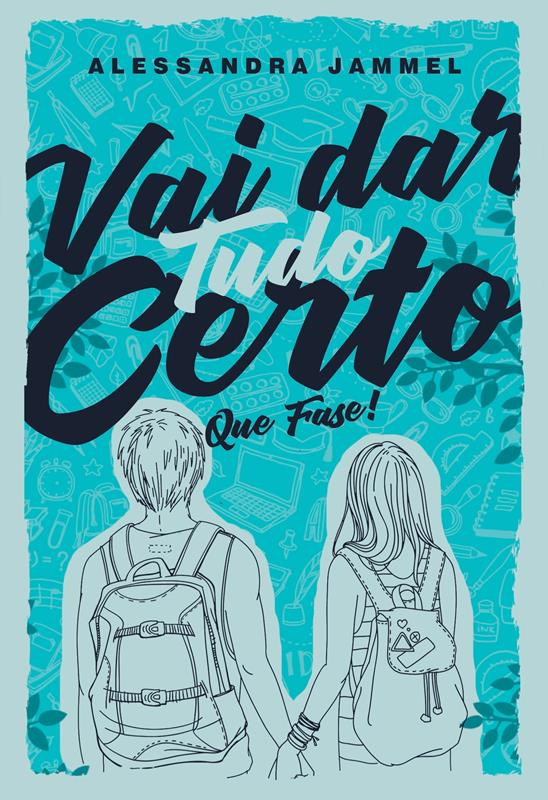
In the book “Everything Will Be Alright: What a Phase!”, Rio de Janeiro-based writer Alessandra Jammel delves into the emotional dilemmas of adolescence through the story of Mariana Dieckmann, a young woman facing anxiety attacks, insecurities, and the typical challenges of school life. By also following the perspective of Hugo, her boyfriend, the narrative broadens the view on self-esteem, social labels, and mental health among teenagers. With sensitivity and moments of humor and romance, the work concludes the “What a Phase!” trilogy and invites the reader to reflect on growth, self-discovery, and the importance of talking about feelings even in the most difficult moments.
Alessandra Jammel addresses anxiety and teenage maturation in “Everything Will Be Alright: What a Phase!”
In the book *Everything Will Be Alright: What a Phase!*, Rio de Janeiro-based writer Alessandra Jammel delves into the emotional dilemmas of adolescence through the story of Mariana Dieckmann, a young woman facing anxiety attacks, insecurities, and the typical challenges of school life. By also following the perspective of her boyfriend, Hugo, the narrative broadens the view on self-esteem, social labels, and mental health among teenagers. With sensitivity and moments of humor and romance, the work concludes the *What a Phase!* trilogy and invites the reader to reflect on growth, self-discovery, and the importance of talking about feelings even in the most difficult moments.
In “Everything Will Be Alright: What a Phase!”, we follow Mariana as she deals with anxiety, insecurities, and discoveries typical of adolescence. What motivated you to explore the emotional issues of young people in such a sensitive way?
My greatest motivation comes from observation and listening. I have the opportunity to interact very closely with teenagers in my daily life, and I realize that this is a phase where everything overflows. But, at the same time, young people carry insecurities and anxieties that they often don’t know how to express. Exploring these emotions through Mariana was my way of embracing this reader. I wanted her to be a real young person, so that whoever was reading could think: “she understands me, I’m not alone.” My goal is to validate what they feel and show that feeling fear or anxiety is part of the process of discovering who you are.
The protagonist’s anxiety crisis right at the beginning of the book presents the reader with a very realistic portrayal of the pressures experienced by teenagers. What was the process like in constructing this scene and giving voice to feelings that are often difficult to express?
Building this scene required a profound exercise in empathy and observation. Anxiety is not just a feeling; it’s a physical and mental reaction that paralyzes. I wanted the reader to feel what Mariana feels: the tightness, the racing thoughts, the disarray. Giving voice to this is transforming the silence of these young people into words, showing that what they experience is not “nonsense,” but something real that deserves to be acknowledged.
The story also shows Mariana’s difficulty in communicating what she is feeling. In your view, why is it still so complicated for many young people to talk openly about emotional health?
Teenagers have an enormous fear of being judged or having their feelings seen as “drama.” I wanted to show that, although taking the first step is difficult, opening your heart to parents and trusted people is what changes the game. Talking about emotional health shouldn’t be taboo, but a habit. When a young person asks for help at home, they are building a bridge of safety. It’s vital that they know their parents and close friends are their greatest allies, and asking for help is, in fact, an act of extreme courage.
By also including Hugo’s point of view, the book broadens the narrative beyond the protagonist. What does this narrative choice add to the understanding of the conflicts and insecurities experienced by the characters?
Bringing Hugo into the story was a deliberate choice to show that boys also feel, suffer, and experience insecurity. Society often imposes the idea that young people need to be strong and decisive all the time, but Hugo humanizes this process. Sometimes Mariana thinks she’s the only one who’s lost, but when the reader enters Hugo’s mind, they realize he also has his own battles. This shows that behind a calm exterior, there can be a whirlwind of emotions. Dialogue is the only way to truly know each other and understand that our insecurities are often shared.
Adolescence is often portrayed as an intense phase, full of contradictions between fun, romance, and personal challenges. How did you seek to balance these elements throughout the story?
I sought balance by looking at life as it is: a mosaic of moments. Adolescence has the lightness of first love and laughter with friends, but it also has the weight of discoveries and internal demands. In the book, moments of romance and fun are not just pauses; they are what gives Mariana the strength to face her personal challenges. Balancing these elements was the way I found to respect the complexity of this phase, where laughter and tears often occupy the same day.
This book concludes the “What a Phase!” trilogy. Looking at Mariana’s entire journey, what do you think has changed most about her from the first book until now?

What changed most in Mariana was the way she faces her own storms. In the first book, she was a girl trying to understand the world; now, she is a young woman who understands herself. She hasn’t stopped feeling fear or anxiety, but she has learned not to be a prisoner of those feelings anymore. The biggest change was gaining her voice: she learned to speak, to ask for help, and to accept that she doesn’t need to be perfect to be happy.
Her own relationship with reading began in childhood, among the shelves of bookstores in her neighborhood. How have these experiences influenced her writing for young audiences today?
In the bookstores of my neighborhood, I learned to recognize which stories truly spoke to the heart. Today, when writing for teenagers, I strive to maintain that same honesty I sought on the shelves. It has influenced my writing style in the sense of not underestimating the young reader; I write for their intelligence and sensitivity, knowing that a book read at the right time can be a turning point in someone’s life.
Upon finishing this trilogy, what message would you like readers—especially teenagers who identify with Mariana—to take away after closing the last page?
I hope readers emerge from this journey knowing that growing up isn’t a straight line, but a process full of ups and downs. I want them to take away the idea that being imperfect is human and that it’s okay not to be okay all the time. Mariana discovered her strength in her own vulnerabilities, and I hope that every teenager feels they also have that power within themselves. May they close the last page feeling more accepted, kinder to themselves, and ready to embrace their own story.
Follow Alessandra Jammel on Instagram