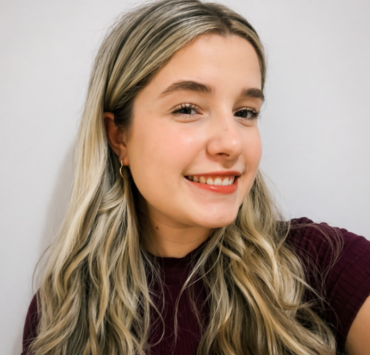
Actress Isabela Faleiro takes a new step in her career with her film debut in “Minha Melhor Amiga” (My Best Friend), starring Mônica Martelli and Ingrid Guimarães, scheduled for release on May 28th. In the film, she plays a Portuguese TV producer, a role that connects her performance to personal memories and family references. In an interview, Isabela reflects on her experience on set, the contrasts between theater and audiovisual media, and this moment of expansion in a career marked by artistic versatility.
Her film debut was in My Best Friend, surrounded by many well-known names. What was it like to take that first step in the film industry in such a large and symbolic production?
I confess that at first I was a little intimidated. In the middle of that huge set, I felt like a small cog in a machine. It was so cool to see such a large team, all working towards the same purpose. It gave me hope to see so many audiovisual professionals… So many qualified people, but often without a place to showcase their expertise. It was transformative to see the filmmaking machine working at full steam firsthand. I talked a bit with Monica, Susana, the crew, and everyone shared their experiences and difficulties within the profession. It was somewhat comforting to know that it’s difficult even for giants like them.
There’s something very emotional about using your Portuguese grandmother’s accent as a reference to create the character. What did this encounter between family memory and artistic work awaken in you?
I think it further reinforced the connection between my artistic work and my bonds, my memories, and my history. Especially when it comes to affective, familial, and female dynamics. There’s a complexity there that I’m very interested in exploring. I’ve always had a very close relationship with my family, and that has made me see the world through a lens of the past. Looking back, through the generations, I can see my own history, and that gives me the power to reclaim what I value and abandon what no longer serves me or the world around me.

You mentioned the impact of arriving on a film set and realizing the speed and scale of everything. What surprised you most about this difference between the “craftsmanship” of theater and the machinery of filmmaking?
In theater, I got used to getting my hands dirty and being part of every aspect of the process. Working with Coletivo Rasga, my theater company, over the years, I learned the step-by-step process of production, costumes, set design—everything beyond the stage as an actress. When I stepped onto the set and saw that each person has their role, I felt a bit detached, too still… I wondered, “Do I just have to do my scene? And that’s it?” I wanted to get up and help someone set up the lights, or iron the costumes (laughs)… But at the same time, it was satisfying to be able to focus on just one thing… It was a good exercise in presence, being on set. When everything happens so fast around me, I realized that the best thing to do is to bring my attention back to the present as much as possible. That way I don’t miss anything—and I enjoy it more!
Her career path reveals an artist who moves between acting, directing, playwriting, costume design, writing, painting, and production. Amidst so many mediums, how do you understand your artistic identity today?
For a long time I wondered if I shouldn’t choose and focus on two or three languages to really delve into them. Today, I see that life asks me to have all these cards up my sleeve. Sometimes a test, a job, or an opportunity comes up, and being able to move between these areas is very useful. I also realized that the impulse to create doesn’t always come to me in the same way: sometimes it’s an image that comes to me, or a melody, or a phrase… It’s good to have an arsenal of tools to execute the idea and bring it to life in the best possible way. To translate it from the world of ideas to the real world.

In addition to working on the film, you’re also behind the scenes of Dear Mom as an assistant director. What changes in your perspective when you step away from the set and start observing the work of other actresses so closely?
In directing, the work is much more cerebral than when you’re on stage. Of course, there’s a logic to it; it’s not just about arriving on stage and feeling it. But when you’re directing, you evaluate what your actresses are proposing on stage with a more critical eye. Only then can you understand what needs to be adjusted within that proposal, and find ways to help them get to the heart of the scene. It was very interesting to follow Nívea and Regiane’s process… there are things you only learn by watching someone else do it.
Your new short film, Mysterious Magic of Motherhood, also delves into conflicts between daughter, mother, and grandmother. How do the themes of memory, generation, and affection, so present in your work, continue to permeate your creations?
When I started writing the short film, I wanted to explore the hidden side of the emotional life of a mother and daughter at two different points in their lives: childhood and adulthood. Listening to stories within my family, I realized there’s a great silence about the “ugly” sides of motherhood. In films, there’s a lot of talk about love, but rarely about guilt, fear, anger, depression. I borrowed some of these accounts and developed the short film to address these neglected pains of these two mothers and the generational, emotional, and psychological disparity between them, to explore this relationship to its fullest extent.

You say you miss things even before they’re gone. That’s a very beautiful and powerful phrase. How does this relationship with nostalgia influence your way of acting, writing, and looking at the world?
I seek beauty in everything, and I think I see my passage through the world as a beautiful memory. For example, when I’m spending time with the company, or an afternoon at the beach with friends, or I finish a great book, I always think about how the Isabela of the future will feel when she remembers that day. Sometimes I wonder if that’s healthy! (laughs) I want to record the things I feel, see, and imagine because I think they won’t come back. Things are always changing, and I always feel change very deeply. I want to record the beauty and the tragedy of things as they are now, because tomorrow everything could be different.
At a time when you are also sharing reflections on time, presence, and creation on YouTube, what do you feel you have been most focused on preserving within yourself as an artist and as a person?
I’ve been desperately trying to preserve my time away from screens. It’s been my daily battle: while a large part of my life is online, I think social media has already stolen enough of my time. There’s a chasm between the person I want to be and the person I am, and I feel less like myself when I spend all day consuming content. Finding the balance between consuming and creating is difficult for me, but I believe that focusing on creating will bring me more rewards and happiness.
Follow Isabela Faleiro on Instagram