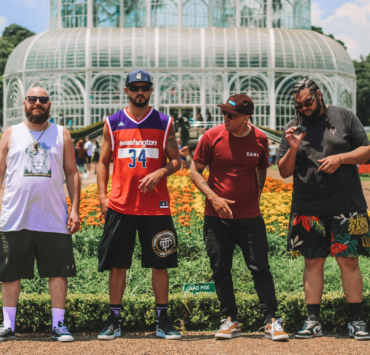
The band Drenna presented the single “Guerra” (War), released on May 1st by Marã Música, transforming indignation and pain into a work marked by tension, weight, and a stance. Inspired by a real case that occurred in the Complexo do Alemão favela, the track uses dense guitars and a raw narrative to question the normalization of violence in Brazil and the silence in the face of recurring tragedies. In an interview, the group talks about the visceral composition process, the intention to provoke discomfort in the audience, and the role of music as an instrument of denunciation and social reflection.
“Guerra” (War) stems from a very painful real-life case, but it expands on that episode to address a type of violence that has become routine in Brazil. At what point did you feel that this song needed to exist?
We’re from the suburbs of Rio, I grew up in Complexo do Alemão. Violence has always been part of everyday life. When you’re exposed to it all the time, at some point it stops impacting you in the same way. Not because it becomes truly normal, but because human beings end up creating ways to move on.
“Guerra” (War) was born precisely from that. It’s not an isolated idea; it’s a burden that had been carrying for a long time. And I strongly believe that music has the power to interrupt that automatic process a little, to make someone stop and look again at something that had already been left behind.
When I wrote it, I already knew that it couldn’t stay just with me. It had to go out into the world somehow. As a warning, not in the sense of providing answers, but of reminding people of the obvious that sometimes gets erased: Violence is not normal. And it should never be treated as if it were.
You describe the song as a portrait of an “undeclared war” that happens every day. What bothers you most about this social attempt to treat these tragedies as something normal?
What’s most disturbing is precisely this collective numbness. Tragedies lose their impact because they are repeated, and this creates a kind of normalization of the absurd. When a life is lost and it becomes just another news story, something breaks down in a very serious way. The music attempts to confront this normalization.

The image of a father screaming for his son seems to have been a very strong starting point for the composition. How was it to transform such a visceral feeling of revolt and helplessness into music?
It’s not something you can change lightly. When I heard this story, I was very impacted, and it stayed on my mind for a long time. It made me think and rethink a lot of things.
The image of a father in that moment doesn’t just become an idea for a song; it becomes a shock that stays with you. And the song wasn’t created to explain that, but to prevent it from becoming silence. To prevent it from passing by as if it were just another statistic.
We grew up seeing the State trying to deal with violence through force. And, honestly, to this day that hasn’t solved anything. But what’s almost never talked about is how those who live in communities end up in the middle of all this, exposed all the time, becoming targets—not because they want to be, but because they have no choice.
In the end, it’s a mix of outrage and helplessness. Outrage because this shouldn’t exist, and helplessness because there’s no way to undo it.
In “Guerra,” the instrumental seems to have the mission of carrying the same emotional weight as the story that inspired the lyrics. How did you work with this dense sound so that it wouldn’t soften the message?
When we were thinking about the arrangement, we tried to be as careful as possible. The lyrics already carry a lot of weight, so we knew the sound shouldn’t be soft. We went into the studio with that direction very clear.
The entire construction was built upon this tension. I think we arrived at a result that aligns well with the concept of the track.
And Jorge Guerreiro, who produced the track, played a very important role in this. He helped us refine the sound and get exactly to where we were looking for.

You say this isn’t a song meant to go unnoticed, but to take the audience out of their comfort zone. What kind of reaction or reflection do you hope to provoke in those who listen to the track?
I believe this song can help shed light on how we normalize things that shouldn’t be normal. This happens gradually, day by day, until it becomes part of the norm.
I strongly believe in the role of music in this sense: to take people out of autopilot, to make them look at other images, other ways of seeing what is around them.
Ultimately, we are part of a society and everything is connected. What happens to one person, in some way, affects everyone. That’s why there’s also this responsibility not to get used to what hurts, not to let certain things become commonplace.
And perhaps that’s what evolution is: not something grand or distant, but small changes in how we see others and the place we occupy in all of this. So that life isn’t just about surviving what’s already there, but about managing to build something a little more human along the way.

The single’s cover uses a highly symbolic contrast between the sacred and urban violence. What does this image reveal about the collapse of the idea of peace in a reality so marked by fear and brutality?
This image speaks volumes about the clash between what symbolizes peace and what is experienced in practice. When these two worlds appear together, what becomes evident is a kind of rupture: the idea of peace ceases to be something stable and begins to seem fragile, almost in conflict with reality.
What the cover reveals to us is precisely this collapse of this idealized notion. Not in the sense that faith or symbols cease to exist, but that they begin to coexist with a context that permeates them all the time, leaving no room for neutrality.
And this directly relates to the music: the feeling that there is a “peace” that is spoken of, but that does not hold up when confronted with what is lived. The image lays bare this contradiction and reinforces that this tension is not abstract, it is everyday life.

The music video relies on real faces and a raw aesthetic, which brings the narrative even closer to everyday life. What was important for you was to show visually that perhaps the music alone wouldn’t fully convey the message.
The music video stems from this desire not to “represent” in a distant way, you know? The music already carries a lot, but the image has a different impact. So it was important to bring real faces, real expressions. There are things that the music suggests, but when you put that into images, you leave no room for abstraction. It becomes more direct, closer, harder to ignore.
The raw aesthetic also stems from that. We didn’t want to embellish anything, nor create a layer that would soften what was being said. It was more about shortening the distance between the viewer and what was being experienced.
By releasing “Guerra,” you transform pain into a stance. Today, what role do you believe music can play in the face of such a harsh reality: denunciation, remembrance, confrontation, or mobilization?
Music can be all of that at once, depending on how it originates and how it reaches people. In our case, it begins as a way of preventing certain things from being lost in silence.
It has a memory aspect, because it speaks of stories that exist and cannot be erased or treated as something fleeting. It also has a denunciation aspect, because it points to something that is often ignored or normalized. And there is confrontation, yes, in the sense of facing what is disturbing.
But above all, we believe that music has a role in affecting perception. If this at some point generates reflection or even mobilization, that’s already an important outcome. Because when art manages to make someone look again at something that had been overlooked, it has already fulfilled its function.