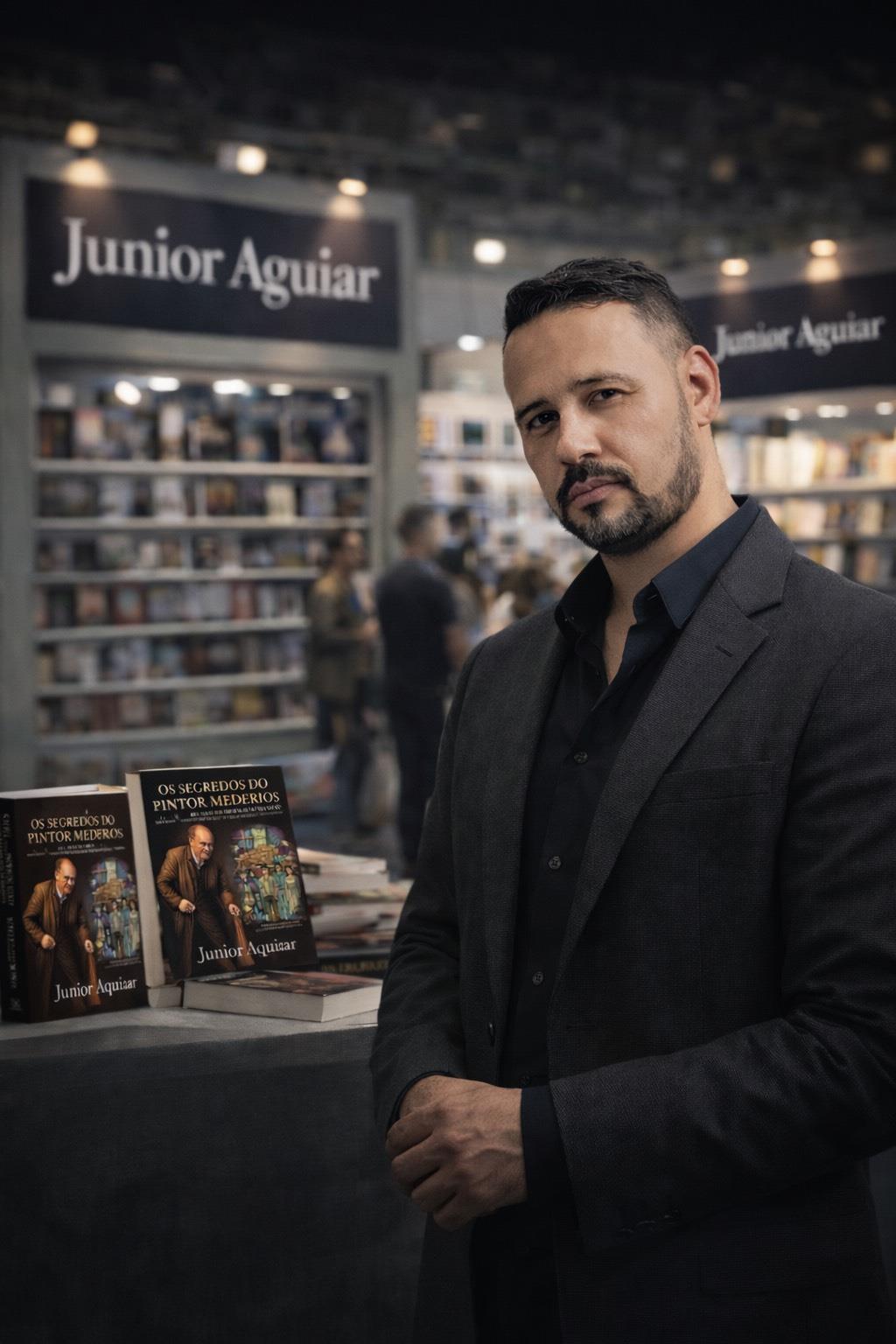
In the book *The Secrets of the Painter Medeiros: The Mysteries of the Silent Grotto*, writer Junior Aguiar constructs a suspenseful plot spanning decades to investigate the impacts of silence, collective traumas, and hidden truths. Set in Caririaçu, in the interior of Ceará, the narrative follows the encounter between a history researcher and a painter marked by a crime he witnessed in childhood, revealing how memory, art, and identity can become paths to confront secrets of the past. In an interview, the author discusses his inspiration from the traditions of Cariri, the role of art in preserving memory, and the relationship between individual stories and the scars left on communities over time.
The Secrets of the Painter Medeiros arises from the encounter between image, silence, and territory. At what point did Caririaçu cease to be merely a setting and begin to reveal itself as a character within the narrative?
Caririaçu became a character when I realized that the story couldn’t happen anywhere else. I’ve known the city for over twenty-five years and I’ve always been impressed by the strength of its oral tradition, popular religiosity, and the memory preserved by its people. Many stories remain alive because someone still tells them. The novel is born precisely from this atmosphere. The city not only hosts the events; it influences the choices, the silences, and the way its inhabitants interpret the past.
Medeiros witnessed a crime as a child and spent his life transforming silence into art. What else interested you in investigating this relationship between trauma, memory, and artistic creation?
What interested me most was understanding how a traumatic memory continues to live within someone even when it ceases to be verbalized. Medeiros witnessed a life-changing event as a child, but grew up without finding a safe way to talk about it. Art emerges precisely in this space between memory and silence. More than investigating the trauma itself, I wanted to explore the human capacity to transform pain into creation. His paintings are born not only from talent, but from the need to preserve a truth that he fears to forget and, at the same time, fears to reveal. For me, Medeiros represents someone who has spent his life trying to negotiate with his own memory.
The protagonist’s canvases function almost like maps of light, indicating hidden treasures and buried truths. How did this idea of making painting a form of testimony come about?
I’ve always been fascinated by the idea that art can reveal things that the artist themselves doesn’t realize they’re revealing. When I created Medeiros, I didn’t imagine someone trying to leave clues or consciously record a secret. On the contrary: he spends his life trying to live with a memory he has never been able to let go of. The paintings emerge from this need to repeatedly return to the grotto and to that night that marked his childhood. Over time, I realized that this repetition transformed the canvases into a kind of involuntary testimony. They don’t just preserve a landscape; they preserve the memory of the person who lived it. That’s precisely why they end up pointing to truths that have remained buried for decades.
The novel deals with a community marked by secrets, unjust condemnations, and collective wounds. Why did you want to show that silence, even when it seems to protect, can also sicken an entire city?
Because I don’t believe that silence is always an act of cowardice. Often it stems from fear, trauma, or even a sincere attempt to protect someone. What interested me was exploring what happens when this silence spans decades. In everyday life, many people believe they are avoiding suffering by not addressing certain truths. But, over time, what is hidden continues to influence lives and families; when it comes to the work itself, it even influences how the city understands its own history. I think one of the central questions of the book is precisely this: to what extent does silence protect, and at what point does it begin to exact its price?
Miguel arrives in Caririaçu as a researcher, but ends up encountering something far more human than just documents and legends. What does his relationship with Medeiros reveal about the importance of listening?
Interestingly, Miguel’s journey begins because he decides to listen. Before arriving in Caririaçu, he hears an elderly woman in a Recife nursing home recount the story with impressive conviction. In a time when we are often more concerned with scrolling through screens, consuming quick content, and seeking immediate validation, Miguel does something simple: he stops to listen. And it is this listening that sets the entire narrative in motion. Throughout the novel, he discovers that some truths survive not in documents, but in people’s memories. In a way, the book is also a reminder that when we stop listening to our elders, we risk losing stories that no archive will be able to recover.
The cave appears as a sacred space, linked to faith, memory, and the mysteries of the region. What role does this place play in the symbolic construction of the work?
The grotto in the novel was inspired by a real place in Caririaçu that continues to be visited by people who pray, hold novenas, and leave their prayers there. In reality, no murder has ever occurred in that place. The fiction begins precisely from this already existing space of faith. What fascinated me was the contrast between such a small place—where only one person can fit at a time and whose function is to house an image of Our Lady of Lourdes—and the immense symbolic weight it holds for the community. In the novel, the grotto becomes the meeting point between memory, faith, silence, and truth. It represents how human beings transform places into repositories of their stories, their fears, and their hopes.
The book blends suspense, history, popular religiosity, banditry, and traditions of the Cariri region of Ceará. How did you balance the mystery of the plot with the care taken to preserve the cultural strength of this territory?
My greatest concern was not to transform the Cariri region into an exotic setting, nor to use its cultural elements merely to serve the plot. The suspense arises from the people, the history, and the memories of that territory. The cangaço, for example, was not a random choice. The Cariri region was profoundly marked by this historical period. Caririaçu was on routes traveled by cangaceiros and dissidents from Lampião’s gang, who also passed through the region on journeys connected to Juazeiro do Norte and the figure of Padre Cícero. This presence left marks on the collective memory, in the stories passed down through generations, and in the popular imagination. I didn’t try to write a story about the Cariri. I tried to write a story from the Cariri, respecting its culture, its memory, and the humanity of its people.
You claim that art can preserve what words alone cannot sustain. After the reader delves into Medeiros’ secrets, what kind of peace or unease would you like to leave them with?
I would like to leave one question hanging in the air: does what we choose to hide truly disappear? The novel speaks of memory, silence, guilt, faith, and reparation, but above all, it speaks of the marks that the past continues to leave on the present. If the reader finishes the story reflecting on the memories they have inherited, the stories their family told—or failed to tell—and the value of listening to those who came before us, I believe the book will have fulfilled its purpose. More than offering answers, I hope it awakens a greater awareness of what remains alive, even when it seems forgotten.
 Follow Junior Aguiar on Instagram