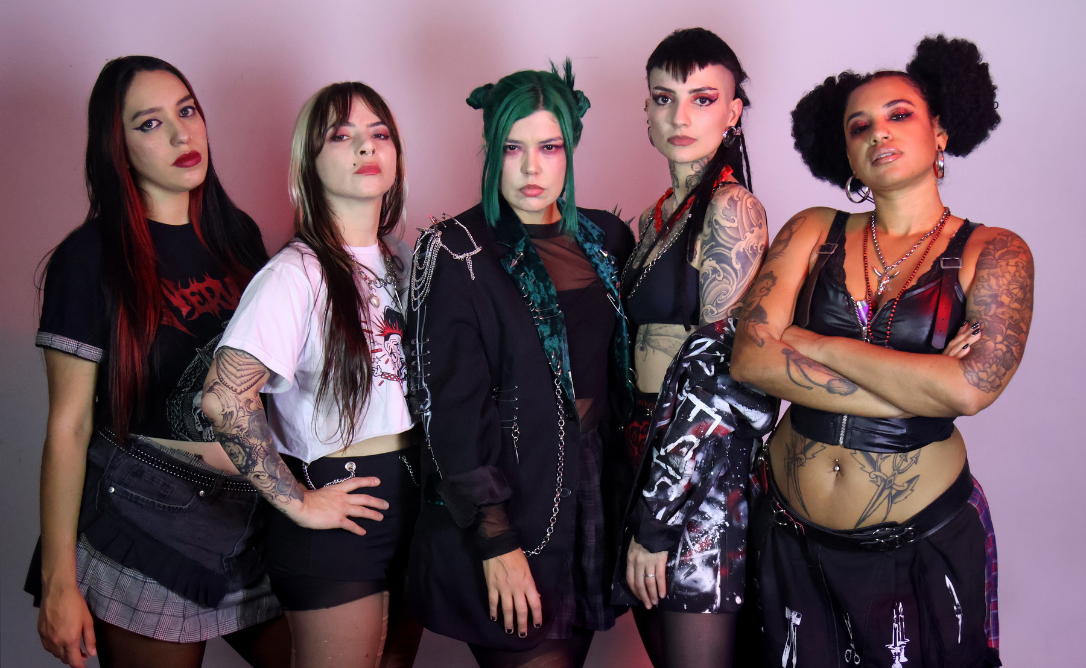
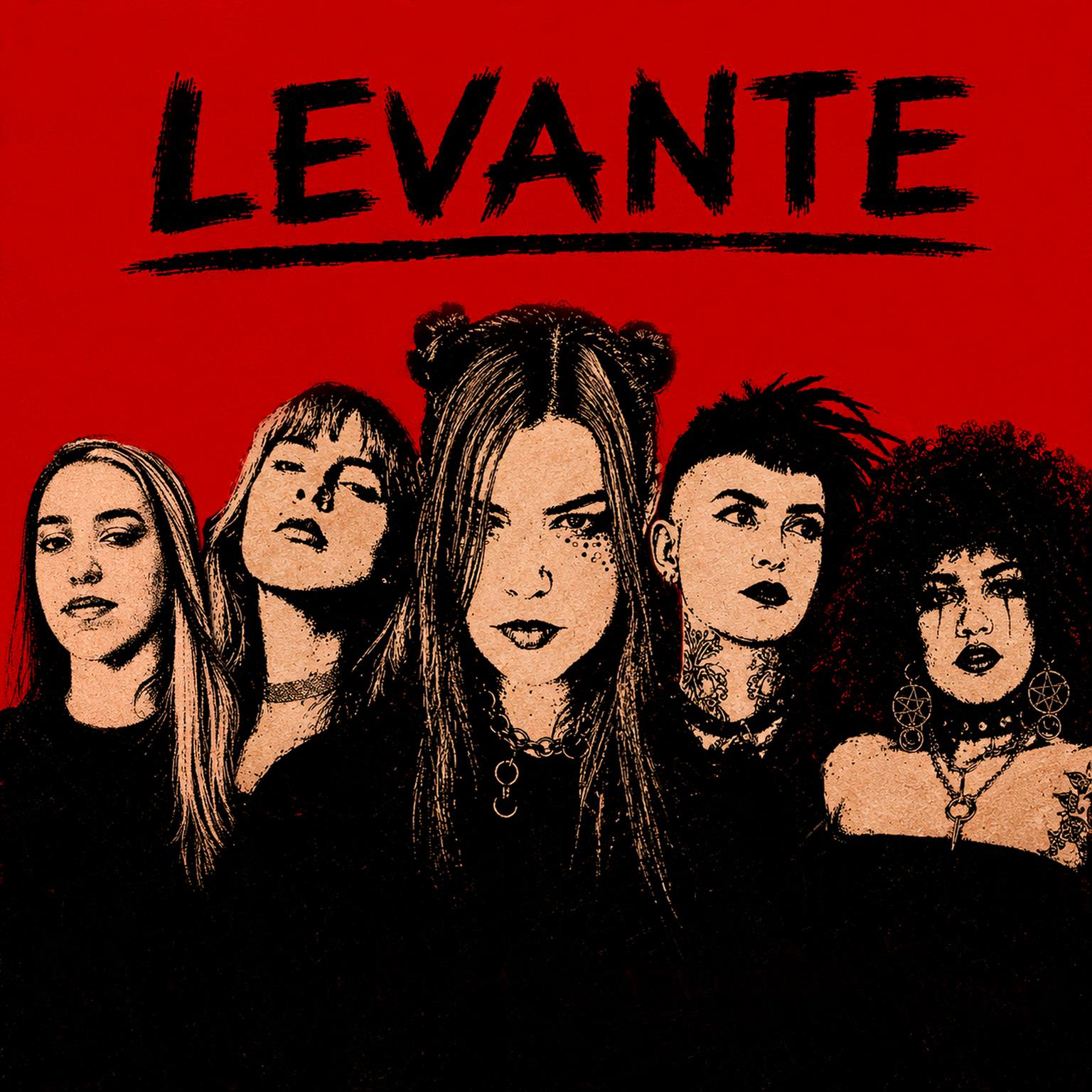
The band Drenna brought together different voices from Brazilian music to transform experiences of silencing, control, and resistance into a collective manifesto. Released on August 14th, the single “Levante” featured Dani Buarque, Ada Bellatrix, MC Taya, and Yasmin Amaral, who joined vocalist Drenna Rodrigues in a track that blends alternative rock, punk, hardcore, and rap rock. In an interview, the band discusses the creation of this collaboration, the choice to directly address the struggle of women, the process of transforming different experiences into a single chorus, and the intention to make the music not only a denunciation but a call for unity, the occupation of spaces, and transformation.
“Levante” was born as a feminist manifesto in the form of rock, bringing together harassment, censorship, judgment, silencing, and control in a single call to action. At what point did you realize that this song needed to exist within the narrative of “Interregno – O Mundo Depois da Certeza”?
InterregnumIt speaks precisely about this moment of transition that we are living through. The very concept of the album stems from this idea of a period in which…Old certainties are beginning to lose their power, but what will take their place is still being built.It’s a space between what no longer works and what is yet to come.
And for me, when we talk about transition, we also need to talk about evolution. That’s when I realized that “Levante” made a lot of sense within that narrative.
The song examines structures and behaviors that have long shaped women’s lives and questions the persistence of these things in a society that claims to be transforming.We cannot talk about progress while we continue to carry into the future structures that should have already been left behind.
So “Levante” occupies that place withinInterregnumShe acknowledges that we are in a time of change, but also states thatThe future is not predetermined; it is up for debate.And if we are living through a moment in which old certainties are no longer sufficient to understand the world, we want to actively participate in building what comes next and ensure that this movement takes us forward, not backward.
The song starts with your voice, but it’s only complete when it becomes a collective cry. What changed in the power of the message when Dani Buarque, Ada Bellatrix, MC Taya, and Yasmin Amaral joined the track?
It completely changed the dimension of music.
I could sing “Levante” alone and defend every word of the lyrics, but I think it would lose precisely an essential part of what it wanted to say. Because it wouldn’t make sense to write a song about unity among women and construct that message as a solitary voice.
When Yasmin, Dani, Ada, and Taya join in, the music ceases to be just my narrative. Each one arrives with a story, an artistic personality, and a different way of putting their own voice into the world. And that comes through in the recording.
I didn’t want five women trying to sound alike. I wanted the exact opposite: five different women finding common ground without having to erase their differences.
From that point on, the music takes on a different meaning. It’s no longer someone saying “I think this.” It’s a chorus saying “we no longer accept this.”
You mention that “Levante” doesn’t intend to speak for all women as if there were only one experience. How was it to create a song that respects different experiences but finds a common resistance?
This care was fundamental for me because there is no universal experience of being a woman. The reality of a Black woman, a woman from the periphery, a trans woman, an Indigenous woman, a woman who is a mother, a woman who doesn’t want to be a mother, a woman from another generation, from another social class… all of this produces very different experiences.
So I didn’t want to write lyrics saying “this is how we all live,” because I don’t have that right to speak on the subject.
What I sought to do was to start from situations and structures that affect many women in different ways: control over the body, judgment, fear, silencing, the idea that someone always knows better than ourselves how we should live.
And perhaps the common ground of music lies precisely in refusal. We don’t need to have lived through the exact same story to recognize what we no longer accept.
The lyrics explore historical violence and forms of control that still appear today disguised as care, protection, or tradition. Why was it important to show that some oppressions change their language but continue to permeate women’s lives?
Because some forms of control have become much more sophisticated.
It’s easy to identify violence when it appears explicitly. It’s more difficult to perceive when it comes accompanied by phrases like “I’m doing this for your own good,” “women have to protect themselves,” “that’s not something a girl should do,” “sit properly,” “speak quietly,” “don’t provoke me,” “don’t fight back.”
Often, violence begins long before an extreme act. It starts when a girl learns that she needs to take up less space, measure her own voice, and take responsibility for the behavior of others.
And these phrases change as society changes. Some things that were openly said decades ago are no longer socially acceptable today, but the logic may continue to appear in other forms.
Therefore, one of the ideas presented in “Levante” is precisely this: not everything that presents itself as care actually cares. Sometimes, care is simply the most acceptable name given to control.
Musically, the track features dense guitars, strong bass and drums, as well as influences from punk, hardcore, and rap rock. How did you conceive this sonic weight so that it would support the message without overpowering the lyrics?
The main goal was very clear:The arrangement needed to have weight because the lyrics have weight.We went into the studio with that in mind, but also knowing that nothing could override what was being said.
In “Levante”, the lyrics are the heart of the music. So, great care was taken to build a strong, intense instrumental that would enhance the impact of the message without risking it getting lost in the arrangement.
We gradually grew this arrangement.Because music itself has this constructive movement. It accumulates strength, gains body and tension until it reaches its highest point, which is the chorus, when the message ceases to be almost a spoken word and transforms completely into a collective call to action.
That was precisely the idea:The weight of the music should enhance the weight of the words, not compete with them..To make the song grow along with what is being said, until it culminates in that chorus that needed to sound big.
The chorus was constructed to sound like a collective call to action. What image did you have in mind when you imagined the audience singing this song together?

When we create a chorus, we always think about that moment in the show when the audience starts singing along with us. This already happens with many Drenna songs, so there’s naturally that expectation with “Levante” as well.
This refrain was designed to be sung in chorus, to gain even more power when several voices join ours.
Now that the song is out in the world, I believe this will start to happen little by little. I really imagine this chorus growing during the shows until it reaches that moment when we start singing and the audience joins in.
“Levante” transforms indignation into movement, going beyond denunciation to propose strength, unity, and the occupation of spaces. What kind of energy do you hope to awaken in those who recognize themselves in this movement?
I think it’s an energy of recognition, but also of memory. Of looking at everything that women have already gone through and, especially,To remember the entire history of the struggle for equality, respect, and the right to exist in society without having to fit into the place that has been assigned to us..
Many of the freedoms we have today did not arise spontaneously. They were won because other women came before, faced much harsher structures, broke silences, and opened paths that we continue to travel today.
So “Levante” also stems from this awareness.We’ve already achieved a lot, but there’s still a long way to go..And it is precisely because we know where we came from and what it took to get here that we are not willing to give up, much less go backwards.
The unity that appears in the music stems from this. It’s almost a collective commitment to keep moving forward and to remain vigilant so that rights, spaces, and achievements that took generations to build are not simply dismantled.
The release will also include a visualizer and a music video in the works, with an aesthetic inspired by protests. How do you want to visually translate this idea of many voices coming together to break the silence?
We want the music video to also be a space forrepresentation and celebration.Let’s bring to the forefront women who made history, broke barriers, and helped transform society, because there has never been a shortage of female role models. Often, what was lacking was giving them the recognition they deserve.
These women will appear as an important part of the visual narrative, alongside images and references to demonstrations, posters, occupied streets, and collective movements. The idea is to visually showcase the strength of many voices that come together and can no longer be ignored.
So the video doesn’t just want to illustrate the music. It wants to…To give a face to this collective strength, to celebrate these references, and to put women in the foreground., which is exactly the place they should occupy in this story.
Follow Drenna on Instagram