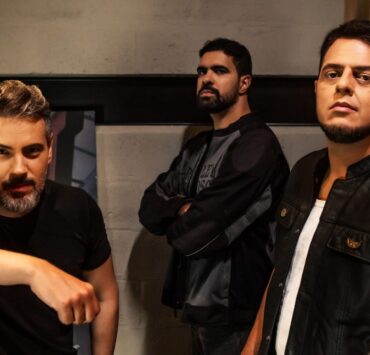
Three decades separate the creation of “Palavras” from its phonographic recording, but the anxieties that led Emanuel Neri to write the song remain at the heart of the reflection proposed by the artist. Originally conceived under the provisional title BPP (Brasil País do Passado – Brazil Country of the Past), the track confronts the idea of Brazil as a “country of the future” by questioning inequalities, the vulnerability of children, and the consequences of social problems accumulated over time. In an interview, the singer-songwriter talks about revisiting a work written so many years ago, the reasons that made him see its message as relevant today, and the choice to transform indignation into a rock song that starts from melancholy and grows towards urgency.
“Palavras” was composed about three decades ago and is now being recorded. What is it like to revisit a song written at another point in your life and realize that the message still remains urgent?
It’s a mix of joy and sadness. Look, on one hand I’m talking about something that hurts those who have eyes to see, which is inequality, the need to protect childhood, because children have no way to defend themselves. At the same time, I’m evaluating ourselves, evaluating the life that was my present, because we were the children of the past at that moment, but also, as if it were not a cyclical issue, but a continuous one.
And today, with different problems and a different reality, but still seeing immense inequalities, I realize that music has broken through space and time, and what is urgent can no longer wait.
The song was initially titled “BPP (Brazil Country of the Past),” as a counterpoint to the idea that Brazil would be the “country of the future.” What did this provocation say at that time—and what does it still say about the country today?
To me, she means that there’s a place in space-time where the past and the future meet. That’s the only place and moment that can be changed, where something can be done. She tells me that there’s still a lot of talk and little action. That the past is gone and we know it, and no matter how many people insist on painting a beautiful story that didn’t happen, we know it, and we know it well. Words say that action is needed, above all else; it’s actions that reshape the future, so we don’t leave for tomorrow, for later, what can be changed now.
The song stems from a feeling of venting and indignation in the face of social inequality and the lack of protection for the most vulnerable, especially children. What images or experiences most influenced the creation of these lyrics?
Simply put, I attended public school until the end of elementary school, and was on scholarship to a private school for high school. I saw and lived with differences. When I was in engineering school, I walked a lot through downtown Manaus and saw many children living on the streets, the so-called “street kids,” and that hurt me a lot because I saw in them the possible reality of some of my childhood friends who didn’t have the same opportunities as me, and some who had the opportunity but didn’t have the proper guidance, and succumbed. The reasons for this reflection became the question that seemed urgent, and today I’m sure it is. The question that is repeated several times throughout the lyrics.
In “Palavras,” you suggest that the future cannot simply be a repeated promise, but must be built through actions in the present. What kind of collective responsibility does the song attempt to awaken?
We can all do something today, whether it’s through a direct action that changes someone’s day, reflecting on the concepts and direction we are giving our children, or considering who we will choose to guide our important actions. The crowd is anonymous and in the stands, but it can and should take center stage through action. It’s not about politics, it’s about having humanity.

The central question, repeated throughout the lyrics, invites the listener to examine the relationship between the past, the present, and social structure. Why was it important to transform this almost historical reflection into music?
Because the past shows us where we came from, where we are, and how we got here. Human beings are driven by aspiration, by dreams; that is the future. Dreaming is good, it keeps us alive, but dreaming, dreaming, and dreaming without action, where does that lead us? To frustration, discouragement, and despair. That’s why the transformative action comes at the end of the song, inviting this turning point.
Sonically, the track grows from a reflective melancholy to a more pronounced, engaging, and urgent beat. How does this musical progression accompany the transformation of sadness into revolt?
First comes an observation, then indignation. I think that’s the natural path. Revolt is a consequence of knowledge, because it liberates, it removes the blinders. The observation is sad, it’s unpleasant. The restlessness, the dissatisfaction grows, changes its frequency, generates discomfort. And when it no longer fits inside you, you shout, you let it all out, you become a questioner. What was bad becomes your fuel.
“Palavras” was composed during the same period as songs like “Os Olhos do Brasil”, “Geração Perdida” and “Fábrica”. What do these songs reveal about the young Emanuel Neri and about the anxieties that already permeated his writing?
They reveal that I was, and I believe still am, someone who refuses to passively observe things. As Raul Seixas said: “I’m not going to sit on the throne of an apartment with my mouth wide open, full of teeth, waiting for death to arrive.” They reveal a pattern of believing in a better future through urgent changes in the present.
By releasing “Palavras” now, you reinforce a lyrical identity marked by social criticism, memory, and hope for transformation. What kind of echo do you hope this song will find in listeners in Brazil today?
I hope that those who have the opportunity to hear this music don’t leave it on the shelf of sounds, that it can resonate in their minds every morning, no longer questioning what they did, but what they can do today.
Soon we will face a scenario of important choices, at a relevant moment in our political and social history. I hope to help people reflect on all of this.
Follow Emanuel Neri Instagram
(Crédito: Courtesy)