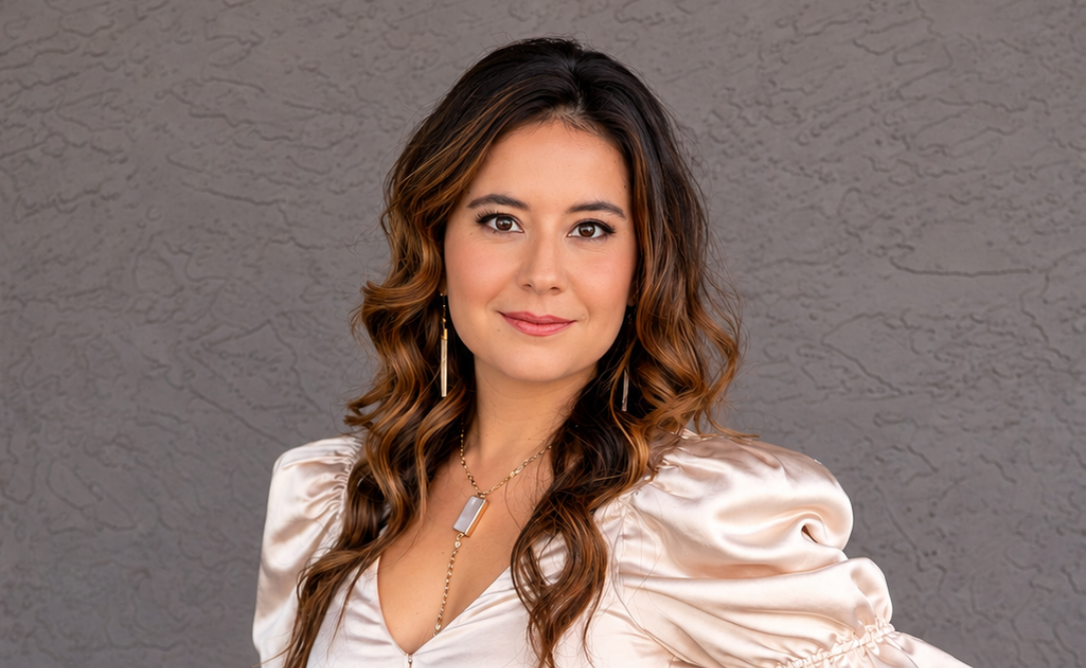
Across Queens, Amsterdam, London, the Andes, and different chapters of a life shaped by acting, spirituality, motherhood, and producing, Giulia Eve Flores has spent much of her journey exploring how seemingly different worlds can coexist within the same artist. Now, through Lila Studios, the actress and filmmaker is turning that multiplicity into the foundation of ECHO, her narrative feature debut, which she is writing, producing, and starring in. Inspired by her Bolivian and European roots, the project moves through ancestry, multicultural identity, quantum physics, spirituality, and intergenerational healing in a story that stretches from Queens to the Andes and the Amazon.
In the interview, Flores reflects on growing up as a “chakaruna” — a Quechua word she describes as a “bridge person” connecting different cultures and perspectives — temporarily stepping away from acting to rediscover her artistic purpose, building a production company as a single mother of two, and rejecting the idea that motherhood and ambition must compete. All of those experiences, she says, ultimately converge in ECHO: “It is the culmination of all I am and can currently express artistically.”
You have spent much of your life at the intersection of different places and identities — born in Queens, raised in Amsterdam, with Bolivian and Dutch roots, and artistically trained in London. When you began creating your own projects, did you realize that the experience of never belonging to just one place had also shaped the way you tell stories?
The Quechua word for how I’ve felt since I was little is ‘chakaruna’; bridge person. A bridge person is someone who connects and harmonizes different worlds, cultures, perspectives, and the material and spiritual realms. I do believe that is my role and purpose in life.
When you are very mixed, you are always seen as an outsider, wherever you are in the world. In Bolivia I was the Dutch girl, with lighter skin and a gringa “blonde giant” mother (my mother has brown hair and is 5’7”). In the Netherlands, home to the tallest people on Earth, I was 5’3″ with dark hair and I stood out, especially having lived my early years in La Paz. When training as an actress in London, my command of accents was so good that I adopted the British accent and no one could tell I wasn’t from there. In New York I was the British girl until the accent faded into its own diluted, watered-down version. Even the way I sound today shows the cultural mix and the lack of geographical or cultural roots. No one can tell where I’m from because they can’t place my accent and I have an ethnically ambiguous look, plus I speak multiple languages. I’m still a deer in the headlights when someone asks me where I’m from. ‘Do you mean my ethnicity? Where I was born? Where I grew up? Where my accent is from? Where I live?’ All different answers.
A few years ago I discovered the term ‘Third Culture Kid’ and I felt seen and understood in many ways I hadn’t before. Everyone in my family is an immigrant, or has been at some point, with generations on both sides moving across continents and countries, in all directions. Migration lives in my blood. I have always had family and friends all around the world. Never belonging to one place can feel like a wound, but it is also a healing balm, a neutral launch point, because I feel so connected to so many people from so many cultures, with such a deep and rich appreciation for their specificities. And beyond culture, in almost a cosmic sense, it comes natural to me to see the specificities of the human experience, but also the commonality, the unity and universality in all of it. It has always been hard for me to see separation between people of all kinds.
So it definitely shapes the way I tell stories. Whatever I produce has an undercurrent, a tonality, a feeling of wanting to bridge, harmonize, and unite – perspectives, ideologies, and people all around the world. To show the unity underneath the differences. In my projects, I zoom in on the specificities of a culture, a time in life, a specific city or place, and then zoom out to show that we’re all the same; we’re all one; we all go through the same initiations and rites of passage in life. We have more in common than we have differences.
ECHO, my first narrative feature, is a perfect example. Its lead is a multicultural, Third Culture woman. She carries the alienation I know well: belonging everywhere and nowhere. Beneath it all, there is a deep love and deep hope for the human race. At a soul level, what I want to transmit through film is a profound appreciation for the human experience, no matter what challenges, lessons, and blessings it comes with.
In your early twenties, a spiritual experience led you to temporarily step away from an acting career you had been building since childhood. Looking back on that period now, do you feel you were leaving acting behind, or did you need to step away in order to discover what kind of artist you wanted to be when you returned?
This was a crucial, alchemical crucible point in my life. Up until then I had been on two paths that now feel innate, united, and obvious. At the time they felt separate, and I didn’t know what the through line was. One path was artistic: the love of acting, writing, producing, storytelling. The dreams I held in my heart since I was four. The other was a blossoming spirituality that began young and opened with force at nineteen, and again at twenty-three. That was when I temporarily took a step back from the acting industry.
I find the traditional acting path disempowering. It demands that you outsource a lot of your creative power. Maybe not once you’re on set with a role that is exciting and fulfils you, but only a few actors experience that. The rest of us are auditioning for commercials, which can be fun, but is not why anyone wants to be in the industry, if you’re sincere and deeply in love with the craft. You are constantly waiting to be selected by someone else, to be “chosen”, in competition, performing your worth, leaking out a lot of precious creative energy, little of which results in the reason you wanted to act in the first place. I don’t believe in competition, or in the illusion of a finite number of roles or opportunities to compete over. I believe we are innately creative as human beings, as actor-creators, and that stories want to flow through us, channel through us, inhabit the instruments that are our bodies, so they can emerge into the world. It’s shamanic to me. I believe we are here to originate material.
I stepped away because of the incongruency I felt between the mainstream actor trajectory that ultimately has as its final goal fame and success (something I wasn’t immune to myself) and what I longed for to express at a deeper level, which is the true purpose of storytelling; showing us who we are and what we have the potential of becoming as human beings. So, in spite of “doing really well” as a twenty-two year old actress in New York, with an agent and a manager, auditioning and booking, in highly selective acting masterclasses with Broadway actors, and fresh from some of the best drama school training in the world… something about it wasn’t ‘it’ for me.
Meanwhile, I was in the depths of a mystical rapture with life itself, asking all the big questions and receiving answers. I had a catalytic spiritual experience where I left my body and saw past lives, my future life, and different emanations of ‘myself’ through different points in the fabric of space-time. This experience worked like a chiropractic adjustment on the spine of my life. Suddenly, going from that to a McDonald’s commercial felt meaningless and irrelevant.
So when I pulled back, I knew I wasn’t leaving acting behind. I just needed to go within and discover how to practice my craft it in a way that doesn’t feel flat, superficial, commodified, or diminishing of my creative power. Acting is a lot of rejection therapy, which made me somewhat immune to rejection, a great gift. But at a certain point, if you’re always waiting for someone else to give you the role that lets you soar, transcend yourself, and bring people into the intimacy of what it is to be human, you end up playing the waiting game for a long time.
So, I left for the North Indian Himalayas for months, got engaged, and trekked there pregnant. I came back, had my son at home, a profound, life-changing experience, and then fell into deep postpartum depression. I was very happy with my son, but I felt I had lost other important parts of myself. From that darkness I started asking why I was here. I couldn’t find the company to join or the people who saw things the way I did who already had something going, and that’s when I realized I had to originate it myself. I founded a nonprofit conscious theatre company and met like-minded artists who joined. We ran it for a few years, and it became my first taste of true fulfilment. That’s how I returned to the art of acting and storytelling, on my own terms.
After producing 12 series at Gaia, you left an established structure to build Lila Studios essentially from the ground up. What was the hardest shift in going from helping execute a company’s vision to having to define your own — and convince other people to believe in it?
The irony here is that defining my own vision was the easiest part. It was always there, even if it hadn’t fully matured. When I worked at Gaia, I really enjoyed my time there. I learned a lot and was shaped by the experience. There was a lot of alignment, until there was less and less. If you have a very strong creative vision, with projects rising from the center of your being like an endless well of ideas (short form, long form, writing, producing, ways to shoot things), an established structure may appreciate them but not share your taste, not want to move away from what it already feels comfortable creating, not have the budget to execute, or be much more risk averse than you, because it has more at stake. After a certain point, it’s hard to be in an environment like that.
Having my own vision was innate. Ideas are constantly bubbling up, and I always have to contain myself, because I would easily start another project, and another, and there’s only one of me. I had no trouble figuring out what I wanted to do, and why. I had glimpses of it at twenty-two, at twenty-five, but it wasn’t fully formed yet. By the time I left Gaia there was a ripeness: not just idealistic, youthful vision, but the robustness of experience. That informs how you walk and talk and step into a room.
The hardest part was actually the fear of jumping. When I quit my full-time producing job, I was a single mum of two, with no savings, no plan B, no family in the country, jumping at a time when I didn’t know how I would pay rent two months down the line. That was terrifying in many ways. I would not have done it four years earlier, because I didn’t have the conviction I had in that moment. That doesn’t mean that when you do you need to have it all figured out. I didn’t. There were a lot of question marks. There still are. But there’s a sense of: if not now, when? I have the ideas, I know how to execute, I have the experience, the network, the resume, I know what I want to do. Something wants to emerge through me that completely transcends me, and I am willing to devote myself to it.
I honestly don’t believe in luck. I believe in alignment, in coherence. Earlier in my life I’d had successes, but also many blocks, and I felt consistently stuck. No one would open the door to the room I really wanted to be in. And now suddenly I would reach for the door handle and realize there was no door. I could just walk through. Every step of the way I was like, oh my gosh, there is no door. I am just walking, the path is appearing before me, the wind is at my back, allies are appearing on my path, co-creating this with me. It felt magical. And suddenly, within less than a year, I was making three original films, and my company had grown from a $40 initial deposit to close to half a million dollars in combined revenue and investment.
It all comes down to the right timing, the right idea, and the right people at the right moment, and then really going for it, and doing the work on any limiting beliefs about what you think is possible. You can’t experience what you don’t believe you are and what you don’t believe you deserve at a nervous system level. So I started reverse engineering. I became the person I wanted to be two, five, ten years down the line and played her now, the way an actress plays a character, a future version of me. I’m not saying I came peacocking into the room. But I dug very deep into the essence, the root of my being, and wore that character as energetic wardrobe. It was much more about subtraction than addition.
Then everything was a yes. I met the right people at the right time. I met a woman I eye gazed with at a pitch conference, we were both moved and crying, and then she said, “I don’t know who you are or what you do, but I know I need to invest in you.” That is magical fairy tale stuff you cannot make up, force, or search for. It comes from locking into your alignment, into who you really are, and how that may be of service to the world.
Ultimately, I prayed to the universe, to God, to life itself, to my higher self, whatever you want to call it: “I have these gifts, and this is what gives me the most joy, passion, and aliveness. This puts me in a state of love. So, how can I be an instrument that the divine plays through, as a writer, actor, director, producer, orchestrating works of beauty that give people meaning in life, as if the creator itself were hugging the soul of a person after they step away from what I’ve created?” I know that’s a high, high hope, and as human beings we will always fall short to some degree. But if you tune yourself as an instrument like that, point the arrow of your being with precision, and get very specific and clear on your target and why it’s meaningful to the people you’ll touch on the way, the more wind you’ll feel at your back. You’ll know that you’re aligned and magic will happen.
You often speak about motherhood and ambition not having to compete. How has becoming a mother changed your relationship with the word “ambition”? Was there anything that once felt essential to your definition of success that became less important once you began building a career while raising your children?
I know this question points at an answer where I say becoming a mother completely redefined what ambition and success meant to me because my kids became the most important and meaningful part of my life. That is partially true. They are the most important and meaningful thing in my life. But my ambition, vision, idea of success, and what I would truly love to share with humanity at large, haven’t changed at all. They have only become richer, deeper, more fuelled. What my children gave me is the anchor I needed to stop faffing about: to stop playing small, playing safe, and luxuriating in self-doubt and insecurity.
My children are an anchor to me in the way roots are to a tree. A tree doesn’t just grow upwards. It grows in both directions, equally and mutually. The deepening of the roots allows for the branches to reach higher, the fruits and flowers of self-actualization to blossom more. Motherhood and ambition fuel each other.
I used to have so much time. I can’t even express the luxury of time I had in certain parts of my life. If I had that time now, I would have written five films already. But I was younger, and I didn’t have motherhood, and the grit and reality and challenges of motherhood pushed me to become more efficient and bold with the time I had to myself, and to just go for things more. I can’t afford to indulge in self-doubt anymore, because time just ticks on, and you feel it. So you might as well go for it, with messy, imperfect action, instead of sitting around, holding yourself precious and doing nothing. What fell away was waiting for perfect conditions.
Birthing and nurturing a child is similar to birthing and nurturing a project, which is also a child of your creativity. Creation requires patience, gentleness, letting things be incomplete, messy, an endless process. Ideally, both ask you to put your ego to the side constantly, to let yourself be changed and rewired by cultivating an ever-deepening love, devoting yourself to something larger than yourself. Legacy. Continuity. Tangible resonance that came from the emanation that is you.
It also gave me the push to walk my own path. Leaving my full-time job took ten months of deliberating. I’m not a risk-averse person at all. But when two children are involved, you don’t take a leap of faith like that as easily. Somewhere I believed it was selfish of me to risk my children’s stability “because I was creatively unfulfilled”. What made me hit an internal point of no return was this: Children don’t do as you say. They do as you are. I can say all I want to my children, but if I don’t embody it, they won’t absorb it. They’ll absorb my incongruency. Ultimately, what I believed was most important to model to my children was this: Regardless of outcome, if your heart, your intuition, your gut, and your soul tell you to go in a direction, even when it makes no logical sense and everyone around you doesn’t understand why, you have to trust yourself and go for it anyway. Because magic unfolds when you do. Life is an adventure, a play, a game, if we let it be. We can follow the magical breadcrumbs of our destiny and find the greatest fulfilment that way. That realization gave me the courage to jump.
Lila Studios aims to create more space for female, Latina, and Indigenous perspectives, but representation can mean much more than simply putting certain faces in front of a camera. In practical terms, what needs to happen during writing, hiring, production, and decision-making for those perspectives to have genuine power over how a story is told?
Genuine power means the people a story comes from are part of the decision-making process, and that reciprocity is built in from day one. I’ll use my current film, ECHO, my narrative feature debut, as an example. It is inspired by my own Andean and European roots. I’m half Bolivian and I lived in the Andes, and the film is set in the Andes and the Amazon.
I am writing from what feels like my ancestry, from very deep undercurrents of my subconscious that feel and know and can intuit the right decisions for the film. On top of that, I’m doing intensive historical, cultural, and language research, because I don’t know everything. Ayni is so important here. It is the Quechua word for reciprocity, and it is how Indigenous people view life and interconnectivity: we are all related, we are all one, forever in a circle of life where energy circulates. Even when you have roots in a place, it is important to give back and to be in reverence of the culture, language, spirituality, cosmovision, and paradigm you are inspired by or borrowing from in your storytelling. For ECHO, that means the Quechua, Q’ero and Shipibo.
Before we go out to film, we go out to listen. To listen to the people, the elders, the land, to be in communion with the elements and everyone who inhabits that space, and to pray, meditate, and ask what this project wants or needs to be. I’m working very hard on my script, and I already feel very attuned, through the heart, to what wants to come through as a transmission. But if I go there, I might be surprised or delighted, or taken in a different direction by putting myself in the space-time nexus where the story takes place. I believe wholeheartedly that there will be communication and experiences that feed into, and perhaps change, my script and how we film, perhaps even on the day itself, because that is how inspiration and attunement work, at least in my experience.
Depending on what you’re making, it is crucial to have those perspectives and cultural roots in the room, making decisions, in the creative positions that empower the project. In practice, that means cultural, spiritual and language advisers involved with the script, the translation, and edit, paid well and credited. Talent and crew with the culture or background. My films want to be like an Andean textile, woven by many hands, where every thread stays visible.
Say the film becomes a great success, critically, commercially, financially. I believe you have a delightful duty to give that back. So a share of profits or revenue for the communities involved is written in from the start. You also have to be smart. You will want to keep a reasonable amount in the company, pay back your investors, and keep some as fuel to keep creating more meaningful films. But when there is an overflow, an abundance, give back to the people you worked with, to the communities you touched and were touched by, to the area, to everything that inspired your filmmaking. Everyone in the ecosystem of this creation, directly or indirectly, gets to drink from the well of its abundance. I really believe in philanthropy and giving. There is nothing more joyful than giving. And it is important to be able to receive too, in all manners, so you can fulfil your dreams, create more, and then again, circulate it well among others.
Your leadership model rejects the idea that exhaustion is proof of commitment and incorporates body awareness, intuition, and systems such as astrology, Human Design, and Gene Keys. When making an important business decision, how do you distinguish intuition from impulse — particularly when you also have to account for budgets, deadlines, investors, and very concrete consequences?
I am definitely not a fan of hustle culture in any way, shape, or form. I think it’s unnecessary, I think it’s exhausting, and I think it’s not how we’re meant to live life, fundamentally speaking. I include nervous system awareness, astrology, Human Design, Gene Keys, and pure intuition in most of my decision making. Astrology gives me timing, Human Design shows me how I’m built to make decisions, Gene Keys reminds me of my innate gifts, and also their shadows. I use them like a trusted adviser; a second opinion on timing, a confirmation for what I felt in the first place. But ultimately, I’ll always go with intuition, even if the stars scream “no, not now”, and I’m always happy that I did.
How do I distinguish intuition from impulse? I can’t speak for everyone, but usually intuition is quite impulsive. Strong intuition is clear. It jumps, like a compass needle snapping toward north, and then it settles. Sometimes it can be quiet and soft too. If you learn to attune to it and trust it, you will cultivate the ability to hear it more clearly and to know what to do.
As for budgets, deadlines, investors, and very concrete consequences, this is the beauty of intuition. When a decision truly comes from intuition, it comes from a space deep inside you that transcends the logical mind, the shoulda, woulda, coulda, have-to way of thinking and being. It comes from a deeper gnosis, a deeper level of awareness and knowing, attuning to the unified field of space and time and feeling which trajectory would feel best, or do well. I think everyone is blessed with intuition, as long as they’re willing to trust, cultivate, and honour it. I have done that for a long time, so I know that when an intuition comes, most of the time it is impulsive. Sometimes it contradicts what I’m doing. Sometimes it pulls me in a completely different direction, or nudges me to reopen an old conversation or do X, Y, or Z. Intuition gives me direction, and then I bring my full commitment, strategy, and practical skills to it: the budget, the deadlines, the organization, the investor conversations.
When you’re acting impulsive and reckless, it isn’t coming from intuition. It’s coming from the mind, from a personality trait that needs to dig its heels in, push forward, insist while blocking out feedback, and feel in control, to seem in charge or seem to know what you’re doing in order for you to feel safe or worthy. If you’re operating from intuitive decision making, from coherence and an easeful way of being, an easeful joy, instead of self-imposed stress, contraction, pushing, survival mode, moving from fear instead of love, you will feel the difference. An impulse that comes from intuition feels exciting and expansive. It may move you emotionally. It’s going to feel right, like excitement and relief, a simple “yes”, even if it’s scary. The moment you feel, “Ah, yes, I know what this is, I’ve got to do it. I can’t explain why, it probably doesn’t make sense, but I’m going to go do it anyway”, you’re usually on the right track, and it has always worked out for me.
With ECHO, you are writing, producing, and starring in your first narrative feature — in some ways creating for yourself the film you once waited for someone else to offer you. What does this character and story allow you to express now that the Giulia who began acting at four years old might not yet have had the words or freedom to express?
I feel this film with my whole being, every fibre, cell, bone, tissue, in my body, every molecule. If my voice may only be heard once on this planet, to resound and touch people, this is the thing I want to say. Maybe I’ll create greater works later in life, but if this is my magnum opus, if I only get to say one thing, this is it, at least from this point in time.
It comes from a totality of prayer, a totality of my being, a totality of my attunement to my ancestors, to past and future timelines. I want to say something that will matter and be meaningful seven generations down the line. There is a beauty and a profoundness and a deep love at the core of what I’m trying to say. Whether I execute that fully is up to the universe, up to God, up to fate, ultimately. But my desire, my wish, and my hope are what I can speak to, and that is where I’m operating from.
When a story, a role, a message, comes from the depths of your being like that, of course no one is going to hand you that or create it for you. Because it’s supposed to emerge from you. It’s supposed to come through you. Stories choose you like that.
For me, the story comes first, the character second. I do feel that no one else can play this role. Not because of talent, but because of the tonality of the soul. There are many incredible, soulful actors, but this role is part of the transmission that needs to come through me, almost like I’m some energetic device or a specific frequency emission. The same music could play through a different instrument and sound beautiful, but it wouldn’t be the right choice in the symphony I’m orchestrating with this film.
There is also an intensity to this character. This character goes deep. There is a freebirthing scene, where she births her own child in the jungle (an echo of my home births where I caught my own son). There is a (seeming) death, a dark night of the soul, and a resurrection. It is all very symbolic. And beneath it all, the undercurrent is hope.
My casting has always been broad and this role encompasses all of it. It feels very multidimensional. I have always been cast as the ones who volunteer themselves, the ones who go first and initiate. I’ve played soldiers, the ones who sacrifice themselves for the greater whole. I’ve also played controlling, ambitious, corporate women. I’ve played true lovers, the warm, mature kind of love. I’ve played the super intellectual ones. I’ve played heroes who have hints of villain in them. And in my life I often play the role of medicine woman, the one who easily traverses between the seen and the unseen realms. This role has all of that.
Moreover, ECHO dramatises quantum physics (John Wheeler’s delayed-choice experiment), shamanic forms of time travel, a historical epic of the Incas and Conquistadors, and a setting that moves from Queens to the Andes and the Amazon. It carries the Prophecy of the Eagle and the Condor, spans a nine-month timeline from conception to birth with the protagonist pregnant, intergenerational healing, and chakaruna elements of being the bridge person. It is the culmination of all I am and can currently express artistically. Past versions of me had the seedlings of this dream in them. But the person I am today has the words, the capability, and the freedom, and in ECHO is where they all finally meet.
Follow Giulia Eve Flores on Instagram