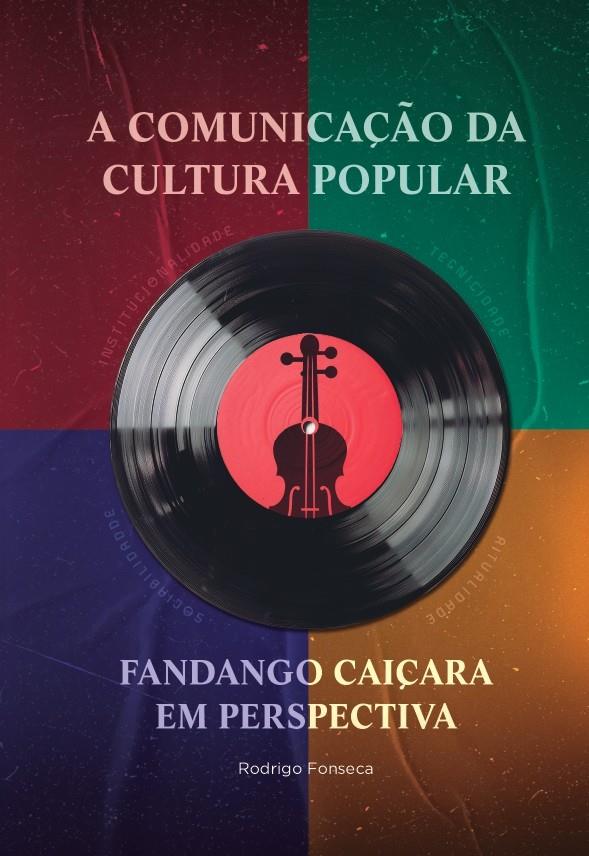
In *The Communication of Popular Culture*, researcher Rodrigo Fonseca investigates the Fandango Caiçara as a living manifestation, capable of articulating memory, identity, and resistance amidst the transformations of contemporary life. Based on ethnographic research and references from Latin American anthropology and communication studies, the author analyzes how popular traditions continue to circulate, adapt, and reaffirm meanings even under the impact of mass culture and globalization. More than an academic study, the work proposes a sensitive look at the ways in which communities preserve and reinvent their own forms of expression.
You chose the Fandango Caiçara as a starting point to discuss something much larger: the communication of popular culture. At what point did you realize that this manifestation could also be interpreted as a living system of meaning production?
For almost three decades, as an artist and researcher, I have dedicated myself to appreciating and experiencing popular and traditional cultural manifestations. Even so, I have always been driven by a constant restlessness: understanding the origins and meanings behind these expressions. Where do they come from? Where are they going? What do they seek to communicate? These are complex questions, difficult to answer without a deeper dive. It was then that I decided to embark on fieldwork, with a more discerning eye, seeking to understand the production of these meanings within cultural practices.
I first encountered Fandango Caiçara early in my artistic career, in 1998, during trips to Ilha do Cardoso, in the municipality of Cananéia, São Paulo. Due to the admiration and close relationship built over time, the choice to pursue this cultural expression came naturally.
Your book seems to view popular culture not as a relic of the past, but as something in motion, that resists, adapts, and continues to speak to the present. What were you most interested in challenging in this view of tradition as something static?
Perhaps the central issue lies in the need to distinguish the different meanings attributed to the term “popular culture.” In the book, I delve quite deeply into this. Here, I add that, in my view, popular culture is something alive, practiced daily in the peripheries, in rural areas, and in large urban centers. It is not a fixed image, but a continuous movement, a kind of dance between art, politics, and identity.
In this sense, what interested me most was precisely this view of tradition as something static, frozen in the past. On the contrary, I understand tradition as a constantly transforming process that reinvents itself without losing its roots.
In the case of Fandango Caiçara, we are talking about an expression whose origins date back to the 17th and 18th centuries, or even earlier, but which remains alive to this day, being practiced in Caiçara communities. This, in itself, reveals its strength and relevance today.
The research stems from attentive listening to regional leaders and an ethnographic approach. How has this direct contact with the subjects of the culture transformed the direction or sensitivity of your work?
This is a central point for understanding the origin of the senses. I believed I already knew the Fandango Caiçara, but in reality, I only perceived the surface of this expression. Listening to the music and watching the dance are only parts of this universe.
To understand a culture, and to have even a minimal capacity to understand its communication, it is necessary to know its history, its people, and, above all, the relationships that sustain it. It was through this direct contact, through attentive listening to leaders and living with the communities, that my perception began to transform.
Ethnographic research not only broadened my understanding, but completely reorganized my perspective, and everything began to make more sense.
By working with figures such as Jesús Martín-Barbero, Néstor García Canclini, and Luiz Beltrão, you bring theory and concrete experience closer together. How did you balance academic rigor with the need to keep the human pulse of the subject alive?
Good question. It happened naturally. As I began to choose theorists, such as Jesús Martín-Barbero, Néstor García Canclini, and Luiz Beltrão, and to engage with the concerns they raised about the topic, I began to realize that many of these issues were already appearing in the discussions during the field research itself.
Thus, the interviewees themselves responded, in a very natural way, to the questions raised in the research. This ensured that academic rigor did not distance itself from experience, but rather walked alongside it, keeping the human dimension of the topic alive.
The concept of Folk Communication helps us to see that popular groups have always created their own channels of expression and circulation. What does this perception reveal about the communicative power of communities that are often underestimated?
Yes, all this wisdom and cultural richness has always been present, but often made invisible. In a way, we listen to what we want to hear—or rather, what we are led to pay attention to, usually linked to what is hegemonic and to the massifying trends of a globalized culture.
Folk communication, as proposed by Luiz Beltrão, aims to show that a strong form of communication has always existed in popular cultures, but that it has been historically neglected. And when I say marginalized, I mean just that: something that has remained outside the visible spaces of mass society.
It is in this communication that we find the identity codes, the clues that help us understand the meanings that these communities produce. When we start to look at this more closely, it becomes clear that these communities never stopped communicating; they just weren’t being listened to.
You propose a “diagram of mediations” to observe rituals, audiences, forms of production, and reconfigurations. How did the need to create this tool arise, and what does it allow us to see that might have gone unnoticed before?
When I began studying Jesús Martín-Barbero’s work, From Means to Mediations, I came across the maps of mediations. At first, it seemed complex, but at the same time it spurred me to seek a deeper understanding of this concept.
It was, in a way, a rebirth of my research. From adapting these diagrams, I was able to better systematize my thinking and understand the production of meaning both by the sender – whom I call the producer – and by the receiver, that is, the audience.
This tool allowed me to see more clearly the relationships between rituals, practices, modes of production, and forms of reception—things that were there before, but that I couldn’t see. The diagram helps precisely to organize these layers and reveal connections that weren’t so evident.
The book shows that, even with the disappearance of some original contexts, such as the old communal work parties, Fandango continues to circulate through oral tradition, performances, and digital media. What does this capacity for adaptation teach us about cultural survival?
The most important point I observed was the strength of the cultural matrices and the social bond of the community in the continuity of its customs, its identity, and its resistance.
At the same time, there is great flexibility—I would even say malleability—in adapting and negotiating with the present. At times, it is necessary to yield to changes so that the practice continues to exist and makes sense within a new temporality.
Culture only stays alive as long as it is practiced. When it ceases to be lived in the present, it becomes merely history. Therefore, it needs to engage with time, with hybrid processes, and with the transformations of the world, without losing its foundation.
In the case of Fandango Caiçara, this is what guarantees its continuity: the ability to transform itself without breaking with its roots, maintaining meaning within the community itself.
In your speech, the work appears as a “sensitive journey” through the affections and strategies that keep popular culture in motion. After this research, what do you feel has changed in you in the way you listen to, observe, and understand these traditions?
I was able to experience firsthand this dimension of immersion in culture and the changes it brought about in my own way of relating to it.
I’ve come to understand the narratives of the songs in a different way. Before, I would just listen; now I can visualize what those stories portray, not only in a rational sense, but also in the realm of the invisible, the emotional, the sentimental. It’s a relationship that involves the environment, the history, and the senses that circulate there.
From this more sensitive connection, I developed my own link with this culture, even knowing that this happens on a different scale – after all, it’s not the place of someone who was born and raised within it. But even so, this process allowed me to build a more complete understanding: where the Fandango Caiçara comes from, where it’s going, and what it communicates, both in the visible and rational world and in the invisible, sensitive, and emotional one. It’s truly a journey.
And the invitation remains: that people seek to understand the Fandango Caiçara, or even their own culture, and, if possible, approach this reflection in “The Communication of Popular Culture.”
Follow Rodrigo Fonseca on Instagram