
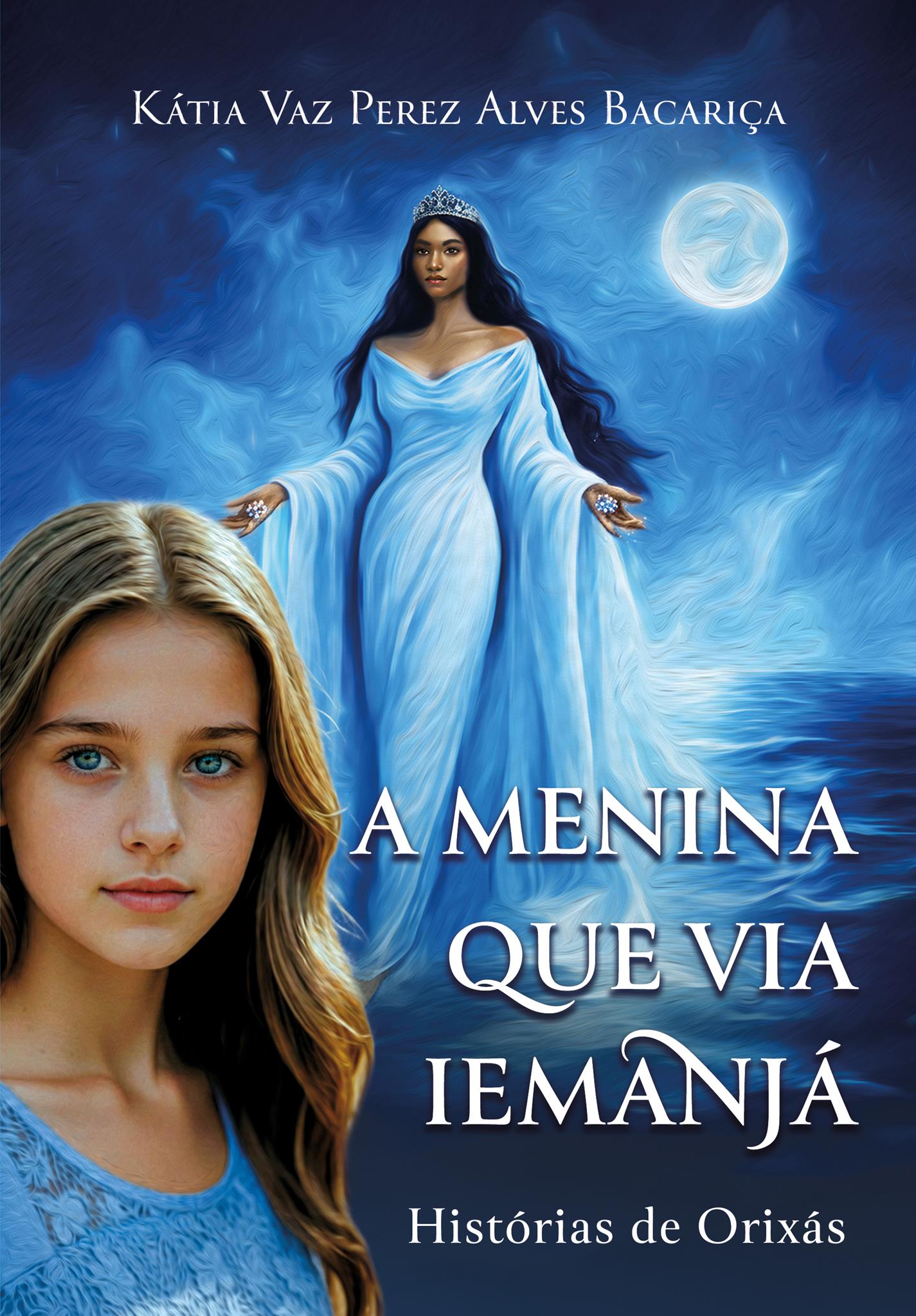
In “The Girl Who Saw Iemanjá,” yalorixá and writer Katia Vaz Perez Alves Bacariça transforms family memory, spirituality, and tradition into a narrative of acceptance and belonging. Inspired by the life of her grandmother Marina, a religious leader who dedicated decades to running an Umbanda temple, the work presents teachings about the Orishas, the history of the religion, and the importance of ancestry in the formation of identity. In an interview, Katia talks about the legacy passed down through generations, the mission of expanding knowledge about Umbanda, and the role of faith as an instrument of strength, hope, and transformation.
“The Girl Who Saw Iemanjá” stems from a very deep spiritual and familial legacy. At what point did you feel that this heritage needed to take the form of a book.
I believe that some stories don’t just choose to be remembered—they ask to be preserved. I was born into Umbanda and for many years, I lived surrounded by teachings, spiritual experiences, and accounts that were part of my childhood, my family, and the history of the Reino de Iemanjá e Nanã terreiro (Umbanda temple). At a certain point, I realized that this couldn’t remain only in the emotional memory of those who lived through it. The book was born from this need to record a very rich spiritual and human heritage, but also to transform experiences into a welcoming space for others. “The Girl Who Saw Iemanjá” is, at the same time, a tribute, a testimony, and an invitation to understand spirituality through affection, ancestry, and faith.
The artwork pays homage to his grandmother Marina and, at the same time, inaugurates a series. What is it about this ancestral figure that transcends personal memory and transforms into a symbol of continuity?
My grandmother Marina represents much more than a family memory. She symbolizes the ancestral strength of women who nurture, guide, and spiritually support their families, leaving deep marks on those around them. In writing about her, I realized that her journey transcends the personal sphere because it also speaks of continuity, oral tradition, care, and living spirituality. Marina becomes a symbol because her presence remains through her teachings, faith, and mission, which continue to resonate in future generations. There is something very powerful when we realize that someone’s love and wisdom continue to influence lives even after time has passed.
By presenting the Orishas not only as deities, but also as symbolic references for everyday life, you bring spirituality closer to daily life. What else were you interested in revealing with this perspective?
What interested me most was precisely showing that spirituality is not distant from everyday life. Often people see the Orishas only as religious figures, but there is also a very profound human teaching in each energy they represent. Iemanjá speaks of acceptance, Oxum of self-esteem and sensitivity, Iansã of courage and movement, Xangô of justice and balance. My desire was to bring these teachings closer to everyday experience, showing that spirituality can also be a tool for emotional strengthening, self-knowledge, and inner transformation.
The book also contextualizes Umbanda as an expression of Brazilian syncretism, a result of the encounter between African, Indigenous, and European traditions. Why was it important for you to unite spiritual teaching and historical dimension in the same work?
Because understanding Umbanda also requires understanding its origin, its resistance, and its cultural importance within the formation of Brazil. Often, religions of African origin are viewed superficially or surrounded by historically constructed prejudices. Bringing the historical dimension to the work was a way to show that there is a very profound spiritual, cultural, and human richness in this encounter of African, Indigenous, and European traditions. More than presenting religious fundamentals, I wanted to offer context, reflection, and knowledge, helping the reader to see Umbanda with more respect and awareness.
There is something very powerful in the idea that faith can also be a space for listening, solidarity, and hope. How do the real-life accounts in the book help to show this community dimension of Umbanda?
Real-life accounts play a very important role because they show spirituality happening in people’s concrete lives. Often, someone arrives at the terreiro (Umbanda temple) carrying emotional pain, fear, losses, or moments of fragility, and finds acceptance, a listening ear, and hope. Umbanda has a very strong community dimension, based on charity, care, and spiritual guidance. By including real experiences in the book, I wanted to show precisely this human side of faith—a faith that is not limited to ritual, but that also supports, strengthens, and helps people find balance again in difficult times.
You write from a living lineage, marked by the terreiro Reino de Iemanjá e Nanã and by the work of your grandmother, your grandfather, your mother, and now you and your sister. What does it mean, emotionally and spiritually, to occupy this place of continuity today?

It means carrying a great responsibility, but also a very deep feeling of honor and gratitude. There is emotion in realizing that we are part of a history built with spiritual dedication, acceptance, and love for others across generations. At the same time, there is a commitment to preserving this essence with respect and truth. I see this continuity not only as a family inheritance, but as a spiritual mission. It is to continue a legacy of faith, care, and guidance, keeping alive a tradition that has transformed and continues to transform lives.
In a country where there is still so much ignorance and prejudice regarding religions of African origin, the book also seems to fulfill a role of welcoming and enlightening. What would you most like to change in people’s view of Umbanda?
I would like people to see Umbanda with less fear and more humanity. Much of the prejudice stems precisely from a lack of knowledge. Umbanda is a religion based on charity, acceptance, spirituality, and love for one’s neighbor. There is much beauty, wisdom, and sensitivity within this tradition. If the book can help someone to look at religions of African origin with more respect, empathy, and openness, then it will already be fulfilling a very important mission.
You state that the main message of the work is to show spirituality as a source of strength, acceptance, and transformation. When someone finishes reading it, what feeling or lesson would you like them to take away?
I would like the reader to finish this book feeling embraced. To realize that spirituality can also be a path to emotional strengthening, hope, and reconnection with oneself. More than transmitting knowledge about the Orishas and Umbanda, my desire is to emotionally touch the reader, showing that faith can also be love, listening, balance, and inner transformation. And above all, I hope that a message of respect remains in people’s hearts—respect for ancestry, for spirituality, and for the different ways of living faith.
Follow Katia Vaz Perez Alves Bacariça on Instagram