In Labyrinths of Chaos, writer Maria Félix Fontele brings together speculative fiction short stories that navigate between disenchantment and hope to reflect on urgent issues of the present. Set in futuristic scenarios permeated by artificial intelligence, memory erasure, technology-mediated relationships, and environmental crises, the stories present ordinary characters confronted by profound transformations in their ways of living and relating to each other. In an interview, the author discusses the creative process that began during the pandemic, the construction of narratives that engage with contemporary challenges, and how literature can help us understand the paths—and risks—of a future that is already beginning to take shape.
“Labyrinths of Chaos” stems from a vision in which chaos is not only ruin, but also something that has not yet taken shape. At what point did this idea begin to transform into literature?
Yes, for me the idea of chaos has never been just disorder, but something unpredictable and disconnected, or that which is still obscure before us. To better elaborate on this idea, I sought to study a little about what chaos actually is. And I saw that, for mathematicians and physicists, chaos is not random, because it follows physical laws, although its complexity of systems leads to unpredictable and chaotic behaviors, but which, even so, obey laws and, therefore, follow an order. Psychologists and philosophers argue that we humans always live between the safe domain of order and the unknown world of chaos. But when I went to Lisbon in 2023 and visited the José Saramago Foundation, I bought a t-shirt in the souvenir shop with the following words from the writer: “Chaos is an order yet to be deciphered.” Okay, that’s where I started developing the idea for a book with that title: “Labyrinths of Chaos,” understanding that when I talk about chaos, I’m thinking of the unpredictable and disconnected evolving into something bigger and more structured, just like the creative process. After all, when we create something (in my case, literary stories), we start with chaotic ideas, but then they become organized and ordered.
The work was written during the pandemic, a period of collective powerlessness and uncertainty. How did this context influence your writing and help shape the dystopian tone of the stories?
Well, I usually say that the book has a somewhat dystopian vein because the stories touch on sensitive themes such as the control of emotions, environmental disasters, the disguised or hidden desire for domination in a kind of bio-power that infiltrates society at this moment of technological transition, when we, poor mortals, know very little about this new world that is emerging.QWhen I wrote the first short story (The Mysterious One of Virtual Nights) in 2022, still at the height of the coronavirus pandemic, I didn’t have a clear idea of writing a dystopian work, but that story gave me wings to create other stories, all of them with futuristic aspects, which take place up to the year 2050. It’s a book that was born from the desire to face the future not as a spectacle, but as human vertigo. Yes, there was already a buzz around technology, speed, efficiency, overcoming limits, however we were facing a deadly pandemic. And Labyrinths of Chaos emerged with a gaze of perplexity.
Your characters are ordinary people living through futuristic, strange, and chaotic situations, yet still very close to our daily lives. What were you interested in revealing about humanity when it is confronted with the unknown?
Look, the book, being fiction in nature, doesn’t offer answers, especially to questions that weren’t meant to be answered quickly, but to linger, like a nagging doubt. But it’s a work that I think provokes reflection, exposes contradictions, and forces us to think more deeply about what we are becoming through a reading that speaks of collapsing identity, the limits of humanity, a world in rupture, the normalization of the absurd, but also brings a kind of sensitive resistance with the following question: what is still possible to feel?
In “The Memories That Remained in the Trash Can,” the character chooses to erase memories and ends up breaking with her family’s past. What does this story question about memory, forgetting, and historical responsibility?
This short story exposes the friction between historical memory and forgetting, as it uses the often-forgotten or controversially interpreted period of the military dictatorship as its backdrop. Therefore, this story reflects on the danger of historical forgetting for democracy. Professor Elias Dourado, Master in Philosophy and PhD in Social Communication from the University of Brasília (UnB), upon reading this story, made the following comment: “Forgetting is dangerous because it doesn’t just erase old facts. It reorganizes the present. When a society forgets its violence, it loses the ability to recognize the signs of its repetition. The past doesn’t return exactly the same, but comes back with new masks: authoritarian discourses, the naturalization of inequality, contempt for human rights, persecution of minorities, political violence, racism, revisionism, and attacks on democratic institutions. Therefore, preserving historical memory is not worship of the past. It is a way of protecting the future.” I fully agree with him.
In “The Indigenous Woman and the Warrior,” a hologram is created to disguise the impacts of large corporations on the planet. How does speculative fiction allow you to discuss themes such as the environment, technology, and the manipulation of truth?
This story is very sensitive because it deals with the issue of indigenous peoples, who continue to be exterminated and, it seems, will not have much of a place in the future. Here, speculative fiction infiltrates naturally, finding solace in the creation of a hologram with the figure of the very indigenist who died in the forest from yellow fever. When activated, the hologram shows her in the future, saying the same thing she said decades ago: that it is necessary to preserve nature and the environment, with an old discourse but with the new guise of the hologram. As if everyone were saying: look, we care about preserving the environment and indigenous peoples, but in the end, nothing is done. Thus, in the future, the hologram replaces those medals that are given to people who fight for the common good. In short, in the future, holograms will be a kind of consolation prize, something modern to talk about old struggles that are not definitively resolved.
The book also addresses emotional bonds mediated by technology, as in “The Secret” and “Her Name Is Sensitivity.” What do these relationships with artificial intelligence and cyborgs reveal about loneliness, desire, and human connection?

In fact, the entire book, practically in every story, deals with emotional bonds, melancholy, and the permanence of humanity in a world in transformation, amidst chaotic realities where machines can be programmed for love—that is, when a technological order hides an emotional disorder. And there I think that the representation of chaos lies more in the changes in personal relationships than in the uncertainty of the technological future. We can also consider that the problem has never been technology itself, but what we are becoming because of it.
Despite the disillusionment present in the stories, the work also carries hope. How can we find glimpses of sensitivity and creativity within such unstable and threatening futures?
I often say that we humans have two great tools at our disposal: sensitivity and imagination. I believe that no machine will have these two qualities. Or will it? I suggest that we remain hopeful and positive, hoping that this doesn’t happen and that we overcome everything with sensitivity, affection, and imagination.
Each story begins with illustrations that help immerse the reader in that universe. How do you see the dialogue between image and word in the construction of the emotional and social labyrinths of the book?
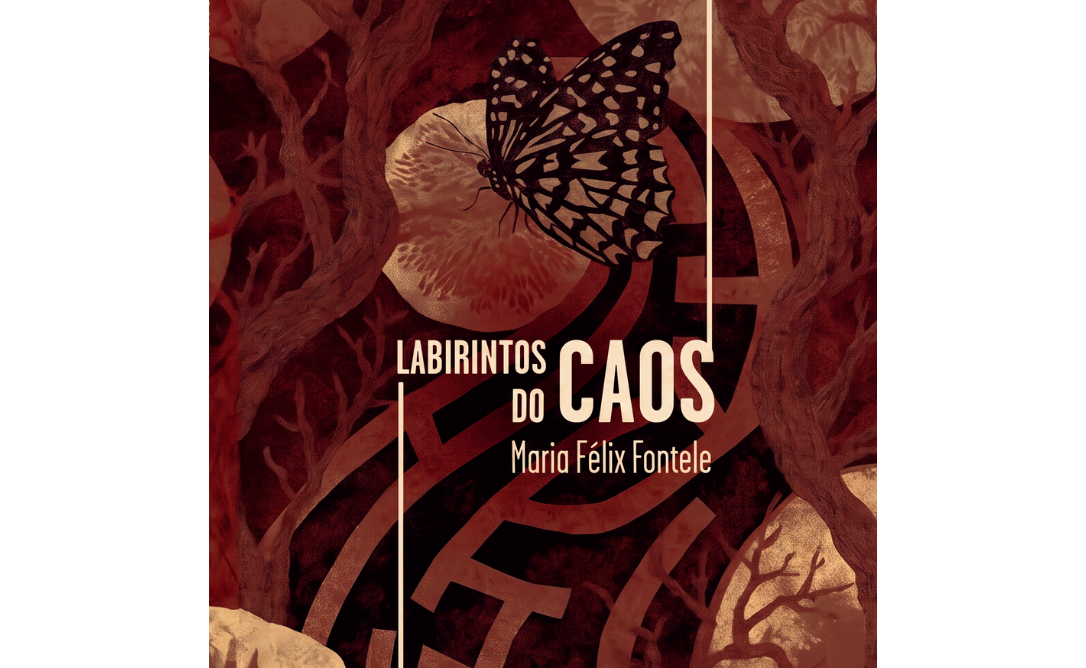
I really like the book’s illustrations, all done by the artist and designer Jeferson Barbosa. He states that “the concept for the cover and illustrations arose from the idea of a hybrid labyrinth, a vision that merges two of the book’s most powerful themes: the struggle between nature and the artificial.” The images, therefore, enhance the union between image, text, and emotion. I thought the book’s overall vision was very good, bringing modernity while also incorporating a touch of nature, expressed by the butterfly, branches, and leaves atop an artificial labyrinth.
Follow Maria Félix Fontele on Instagram