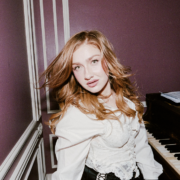
Sylvestra Bianchi – On Thursday, August 20th, Sylvestra releases the single “Esquecemos Quem Somos” (We Forgot Who We Are), a track representing Paraná in the compilation *Brasil Plural*, expanding on the sensitive approach of her songwriting career. With elements of contemporary Brazilian Popular Music (MPB) and a contemplative atmosphere, the singer-songwriter proposes a reflection on identity, external expectations, and the process of rediscovering one’s own essence. In an interview, Sylvestra discusses the intuitive inspiration behind the composition, the significance of representing her state in a national project, and the search for music that doesn’t offer ready-made answers but invites the audience to look inward.
“We Forget Who We Are” stems from a reflection on how, throughout life, people try to fit into external expectations until they distance themselves from their own essence. At what point did this restlessness become music for you?
The music began to take shape after being invited to participate in the Brasil Plural compilation by Marã Música. I started thinking about what theme I could connect with people from different places and backgrounds, and self-knowledge emerged as a very human and universal possibility.
I started writing at night, almost like a conversation with myself. During the early morning hours, I woke up with some verses and the melody in my head and recorded the idea on my phone so I wouldn’t lose it. The next day, I contacted Music Producer Leomaristi so we could start turning that inspiration into music.
That’s how a concern that was already part of my reflections found a way to exist through song.
The song was composed specifically to represent Paraná in the compilation “Brasil Plural,” but it speaks of a human experience that transcends borders. How was it to balance its original identity with such a universal message?
For me, representing Paraná didn’t necessarily mean talking only about the state’s cultural elements. I wanted to find something that could also represent how we, as Brazilians, are diverse and, at the same time, share experiences that bring us closer together.
Self-knowledge ended up being that meeting point. We may have very different histories, accents, cultures, and paths, but perhaps all of us, at some point, have felt the need to please, to fit in, or to rediscover ourselves.
So, the music carries my identity and my worldview, but it seeks to leave room for each person to find their own story within it.
You mention that the track doesn’t aim to offer ready-made answers about self-knowledge, but rather to open up space for questions. What kind of questions would you like the listener to ask themselves while listening to the music?
Perhaps I would like each person to find their own question. But some may arise naturally while listening to the music:
What truly makes sense to me?
How much of my choices stem from genuine desire, and how much stem from the fear of disappointing someone?
Who am I when I don’t need to meet anyone’s expectations?
I don’t believe there’s a definitive answer to these questions. For me, self-knowledge is much more a process of listening and perception than a conclusion. Perhaps music can simply open that door.
The composition emerged very intuitively, with verses and melody appearing during the early hours of the morning. How do you deal with those moments when the music seems to arrive almost whole, even before being rationalized?
I’ve learned not to try to control those moments too much. When an idea comes, I try to record it immediately, even if it’s just a recording on my phone or a few words jotted down.
“We Forgot Who We Are” was exactly like that. I was writing the lyrics and, during the early hours of the morning, I woke up with the melody and some changes to the verses. I recorded everything right then and there.
Then there’s the conscious work of organizing, refining, and transforming that inspiration into a song. But I believe there’s a part of the process that simply happens. Perhaps our role, as composers, is to be attentive enough to recognize when it arrives.

The arrangement combines piano, keyboard, guitar, bass, and percussion in a delicate and contemplative atmosphere. How did you conceive this sound to guide the audience to slow down and look inward?
The idea was to create a sound that would complement the lyrics without competing with them. Because the song contains a very intimate reflection, I felt that the instruments needed to create space for the message to breathe.
The piano and guitar help to bring out this delicacy, while the bass, percussion, and keyboards add movement and depth to the production.
We didn’t want to create something overly intense. The intention was to build an atmosphere where the listener could gradually enter the music and allow themselves to be carried away by reflection.
The partnership with Leomaristi, the LadoBe Music team, and musicians from different states helped shape the song. What did this collective effort bring to a song so connected to intimacy and essence?
It was very special because, although the music originated from an intimate experience, it gained new layers through encounters with other professionals.
The instrumental production began remotely, bringing together musicians from different states, coordinated by Leomaristi in partnership with the LadoBe Music team and Marã Música. Later, I had the opportunity to record the vocals at LadoBe Music, in a very welcoming and high-quality environment.
I’ve been working with Leomaristi and Marã Música since 2021, so there’s a relationship of trust and a very beautiful trajectory of artistic evolution. At the same time, each new professional brings a different perspective. I think this exchange has allowed a song that was born so deeply within me to gain other perspectives without losing its essence.
The music video, which you described as the most artistic project of your career so far, incorporates symbols such as picture frames, labels, books, a window, and the planting of a seedling. How do these elements help represent the journey back to yourself?
I wanted the music video to not only illustrate the lyrics, but to create a visual experience for them.
Labels represent the roles and characteristics we often assume in order to be accepted: being strong, perfect, productive, a warrior, agreeable, among many others. Frames convey the idea of the limits and standards we try to fit into.
Planting the seedling represents another dimension of this process: perhaps turning inward is also a form of cultivation, something that requires time, care, and presence.
And the makeup scene, where I start by applying makeup and then remove everything until I appear with a clean face, is perhaps one of the most direct images of this idea of removing layers.
I wanted to leave these symbols open to interpretation. Perhaps each person will see something different in them, and that’s also part of the video’s concept.
The music video will be released on September 17th at 11 AM on the YouTube channel “Sylvestra Bianchi”.
Your journey unites music, spirituality, inner healing, and the concept of Cosmic Rock. Within this path, what place does “We Forget Who We Are” occupy in how you wish to emotionally connect with people?
I think “We Forgot Who We Are” represents a maturation within the universe I’ve been building as an artist.
My work has always revolved around themes such as spirituality, self-knowledge, and connection with something beyond everyday life. But each song finds a different way to address these issues.
In this song, I feel less interested in providing answers and more in sharing questions. I don’t want to occupy the position of someone who teaches others how they should live. I want to create a song that can accompany someone in a moment of reflection and, perhaps, make that person look at themselves with a little more honesty and affection.
The concept of Cosmic Rock continues to be this meeting space between music, spirituality, reflection, and humanity. The songs are lighter, but rock embraces my freedom of expression. And perhaps “We Forgot Who We Are” is precisely a more mature expression of this: a song that doesn’t intend to say who we are, but to make us remember to ask ourselves.
Perhaps this is the place I want to occupy as an artist: not that of someone who has all the answers, but that of someone who can transform some questions into music.
Follow Sylvestra Bianchi on Instagram